Saturday, October 05, 2013

all aboard for the Nour Festival of Middle East and North African culture


The Nour Tour Bus

On Saturday 9 November one of London's iconic Routemaster double-decker buses will travel the streets of the Royal Borough of Kensington and Chelsea (RBKC) to the accompaniment of Middle Eastern music, courtesy of an onboard DJ.

The bus will stop at four of the borough's key venues related to Arab art: the Victoria and Albert Museum, the Ismaili Centre, Leighton House Museum and the Mosaic Rooms. The bus will also stop at  Al Saqi - the capital's leading Arab literature bookshop. The £25 tour ticket covers private visits to the five venues. At midday passengers will be served with a complimentary drink and a mezze platter.

The bus - dubbed the Nour Tour Bus - is just one of the events on the programme of the two-month Nour Festival of Arts: Contemporary art, film, literature, music and performance from the Middle East and North Africa. The festival organised by RBKC in association with some 36 partners runs from 1 October to 30 November. It encompasses more than 20 venues across the borough. RBKC is home to a diversity of communities from the Middle East and North Africa, and its second language is Arabic.


from the Ferozkoh exhibition

This is the fourth year of the Nour Festival. One of the highlights of this year's Festival is the partnership with the Museum of Islamic Art (MIA) in Doha, which brings to Leighton House Museum the remarkable exhibition  Ferozkoh: Tradition and Continuity in Afghan Art. Ferozkoh pairs priceless historical objects from MIA's collection with modern-day interpretations by craftspeople from Afghanistan. The exhibition is MIA's first-ever touring show, and is part of Qatar UK 2013 Year of Culture. Ferozkoh runs from 15 November to 23 February 2014.
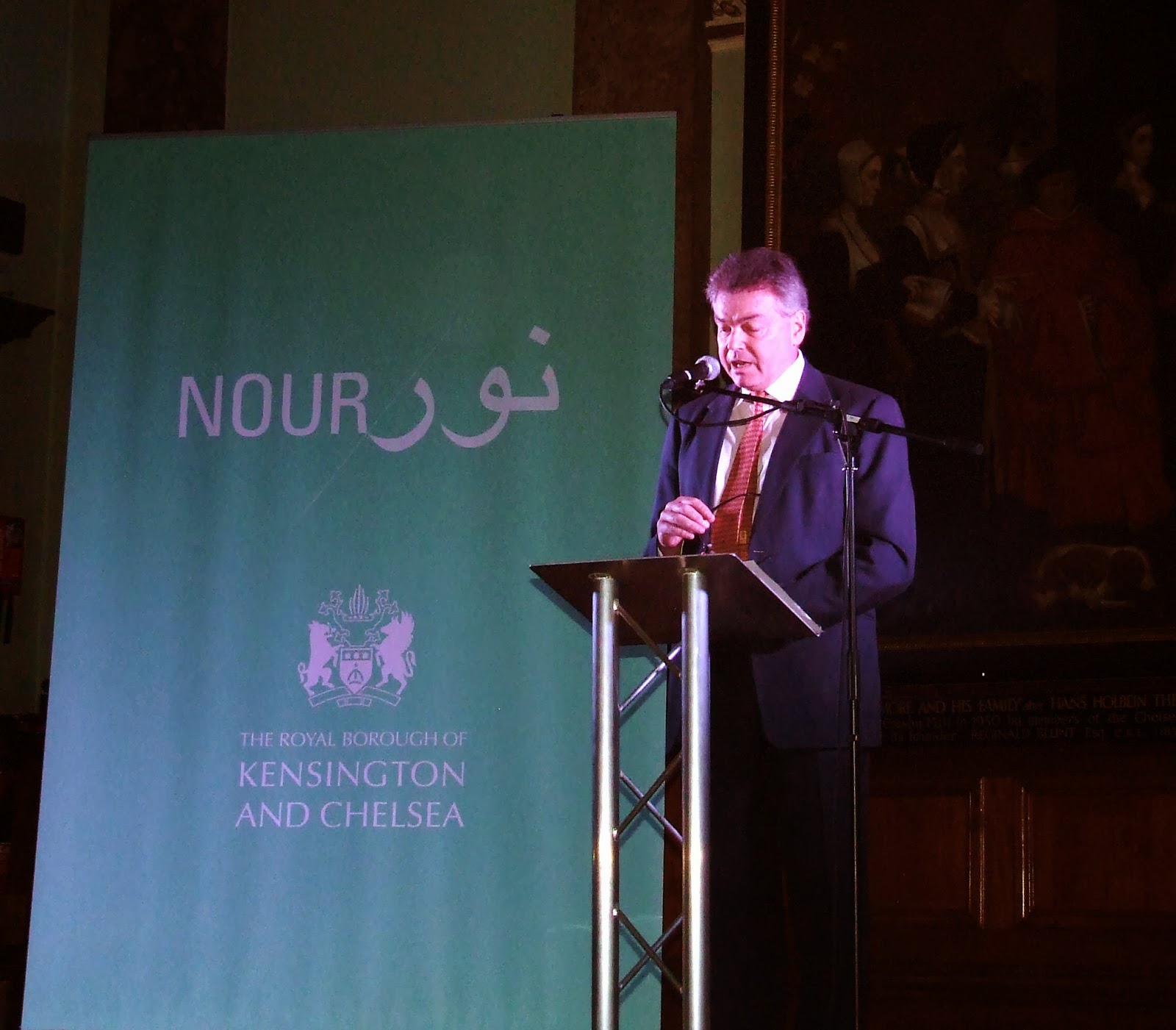
Councillor Timothy Coleridge

The Festival was launched on Tuesday evening at a reception held in the splendid surroundings of Chelsea Old Town Hall on the King's Road, with live music performed by Parvaz Ensemble. In his speech Councillor Timothy Coleridge, RBKC Cabinet Member for Planning Policy, Transport and Arts, enumerated the events on offer during the Festival: six art exhibitions, 16 film screenings, 15 talks and debates, 14 performances across dance and drama music and poetry, four evenings of special events, three cookery classes, eight workshops, a Pop-up Souk, and the Nour Tour Bus.

Councillor Coleridge said: "The Royal Borough believes very strongly that arts and culture are an important part of our  borough's life. We want all our residents to have an opportunity to experience and enjoy the arts in their own communities. We believe that the arts can bring out the best in people and they can  help build together better neighbourhoods, encourage economic benefit and most important of all bring enjoyment to people's lives."

earrings from the Ferozkoh exhibition

The RBKC Council enables the Festival to happen by acting as an organiser and a catalyst. "But it is without doubt the partnership of all the organisations - you who are here tonight - and the artists represented that make it such a success."

Coleridge was sure those attending the opening would like to join him in extending thanks to Alan Kirwan, the Council's former Arts Officer.  Kirwan created the Nour Festival in its first three years. "We wish him well in his new role at the European Parliament's House of European History in Brussels," Coleridge said, adding jokingly "I expect he'll have to rewrite most of it."

Since its inception, Nour has grown and is rapidly becoming one of Europe's most significant annual showcases of contemporary arts and culture from across the Middle East and North Africa. Councillor Coleridge said:  "We always have an eye on the future, and our ambition is to make Nour year on year better and more successful. So I'm very pleased tonight that guests include representatives of prominent organisations which have not been part of Nour before but with whom we are beginning to discuss collaborations and partnerships. 


 Dr Shahidha Bari

Dr Shahidha Bari, lecturer in Romanticism at the Department of English at Queen Mary's University of London has research interests including the Romantic Poets, and Islam and Arab Culture. She said in her speech how excited she was to be at the Nour Festival  which is so obviously going to be "lively, challenging and engaging."

She had been invited to address the opening by John Hampson, the Strategy Officer behind the Arts and Culture programme at RBKC. She thought it worth noting "how hard he himself has worked on developing this very important festival, now in its fourth year, growing bigger and bolder."

Dr Bari said the festival is important for several reasons, not least because it brings something enriching and rewarding to the area: for two months it alters the complexion and nature of this particularly highly cultured part of London.

"But it's important too because it is representative of the way culture is in itself inestimably valuable. It is, of course, increasingly important that we continue to support and sanction ventures like this, providing platforms and audiences for practitioners, especially through moments of economic downturn and political tumult - even more so, in those circumstances. And the Nour Festival is an intellectual and political venture as well as a celebratory cultural one."

The Festival is freighted with the political and intellectual weight of what has happened and is happening in the Arab and North African world, Dr Bari observed. "But it's important to note that it is not simply the case that culture and the arts represent or respond to the complex social world we live in", they also "produce the world as well as reflect it. The arts not only represent but produce our world in powerful ways."


London Algerian Ballet

Dr Bari thought it important to remember that "this lovely festival, which promises to be full of inquiry and intelligence, is also a small but significant part of a serious engagement with ourselves in the present. It is an opportunity to articulate our global, collective selves, where the people of Kensington & Chelsea borough are not separable from the worlds that will be presented to them throughout the duration of his festival."

This year's Nour programme showcases the varied work of diaspora communities. The London Algerian Ballet promises to marry vintage, traditional and contemporary dance. "I don't know if we have any representatives, but in the programme you've also promised to feed us - 'A traditional Algerian meal will be served during the evening.' -  I'm there! It's at the Tabernacle on 8th Nov. It sounds amazing!

"I'm there because the ways that diaspora communities sustain, develop and transform their cultures in different places, is sacred and important and valuable work. And the programme is full of these great projects." Dr Bari also noted that the Council has made particular efforts to make the Festival genuinely participatory, as evidenced by the impressive number of open workshops, art, dance and calligraphy classes. "I think these are marvellous efforts at making our cultural engagement engaged."

The third speaker was Rose Issa of the Rose Issa Gallery, which has been a Nour partner from the start. This year the Gallery is sponsoring two events in the Nour programme. The first is the London debut of the Paris-based Tunisian artist Mourad Salem with his exhibition 'Sultans Are No Sultans' at the Leighton House Museum from 3 to 31 October.

 Beware of the Orchids by Mourad Salem, from the exhibition Sultans Are No Sultans

The second event sponsored by the Rose Issa gallery is Sajaya:Oud concert by the Egyptian composer and player Georges Kazazian at Leighton House Museum on 29 October. The recital will be Kazazian's first performance in London. 

 Rose Issa

Issa thanked the senior curator of Leighton House Museum Daniel Robbins, as well as John Hampson of RBKC. They had been extremely supportive generally, and in particular over the participation of Mourad Salem and Georges Kazazian in their events at Leighton House Museum. She said many of the artists who were promoted at Leighton House 10 or 20 years ago are now big names, thanks to this first  small-scale breakthrough in Europe.

Issa recalled how when the idea of  a Middle Eastern festival for the borough was first being mooted a few years back, Alan Kirwan - who was at that time working at  Leighton House - approached her to find a name for it. Issa is half Lebanese, half Iranian, and has been promoting for the last 30 years mainly contemporary artists and filmmakers from the Arab world, Iran and Turkey.  Nour means light, and enlightenment, and is a word that "links Arab culture with Iranian culture with Turkish culture with Kurdish culture, with many Afghans and central Asians: that was the word that linked us together." Nour opens the door for many to understand the region's cultures.

Isssa said she has always thought that "artists are our best speakers, whether it be visual arts, film or music. Giving  a platform to talented artists means opening new doors for the general public in Britain to our culture." The public is bombarded with media distortions  and this image needs to be balanced. "With  sNour and this enlightenment we can fight distorted perspectives. Nour is part of that struggle to open doors to understanding."
 by Susannah Tarbush

Friday, September 27, 2013

an evening of Arab literature at Maida Vale Library

 Maida Vale Library

At Maida Vale Library in West London last Monday evening, the publisher of Arabia Books and Haus Publishing Barbara Schwepcke, the co-founder and publisher of Banipal magazine Margaret Obank, and translator, author and Banipal contributing editor Peter Clark were panellists at an event entitled Arab Literature Today.

Introducing the event, area manager of Westminster City Council libraries Ben Walsh explained that the library has only just returned to its home after having to be relocated in 2012 due to a major problem with the roof. The library moved temporarily down to the basement while the roof repairs were carried out. Since 12th August it has been moving back to its original home on the ground floor.

To mark its return, the library has been holding a series of free Super September events. "This is our largest attended event so far," Walsh said of Arab Literature Today.

Barbara Schwepcke (L) and Margaret Obank

Arabia Books was set up in 2008, as an imprint of London-based Haus Publishing, with the aim of bringing to a British readership the best literature by Arab authors in English translation. To celebrate its fifth anniversary, Arabia Books has teamed up with the Reading Agency to offer sets of the thirty books it has published since 2008 to each of the 200 or so library services in the UK (including two prison libraries). The Reading Agency is a charity with a mission to inspire more people to read more. It work with many partners, but in particular with libraries because they offer everyone equal access to books and reading.

The 30 Arabia Books titles donated to Maida Vale Library were arranged in a colourful display at the Arab Literature Today event. Authors published by the imprint include Rafik Schami, Hoda Barakat, Radwa Ashour, Rashid Boudjedra, Habib Selmi and Samar Yazbek, winner of the 2012 PEN/Pinter Author of Courage Award.

Peter Clark

Peter Clark, who was for a number of years head of the British Council in Damascus, outlined the dramatic changes in Arab literature translation and publishing he has witnessed since his first translation from Arabic was published in 1980. He and Schwepcke both paid tribute to the pivotal role Banipal Magazine of Modern Arab Literature has played in helping transform the availability of Arab literature in English translation over the past 15 years.

Margaret Obank spoke on Banipal's mission to open a window on the literature of the Arab world, and on the changes in the magazine from its first issue published in February 1998 to the current issue, Number 47, which has a special feature on Kuwaiti fiction. She outlined Banipal's other activities including tours by visiting Arab authors, its data base of some 1000 titles, the establishment of the Saif Ghobash-Banipal Prize for Arabic Literary Translation, and how she and Peter Clark were involved in the setting up of the International Prize for Arabic Fiction. Banipal has also founded the Banipal Arab British Centre Library of Modern Arab Literature (BALMAL), based, like the magazine's offices, in the Arab British Centre in London.


part of the display of titles from Arabia Books

Barbara Schwepcke recalled how the idea of starting Arabia Books arose from a conversation she had at the 2008 London Book Fair with the late Mark Linz, director of the American University in Cairo Press. In that year the Arab world was the LBF's Market Focus. At that time she was a publisher only of non-fiction, through Haus Publishing, and publishing translated Arab fiction was a new departure. She believes translation helps build bridges between cultures, and as regards Arab fiction "there is a wealth of literature out there that people should read." Her discussions with Linz led to Arabia Books having a co-publishing and distribution with AUC Press, with an initial list of nine titles. In her choice of titles she tried to show the variety of Arab writing in terms of genre (including crime fiction), and geographical spread from the Mediterranean to the Indian Ocean. Arabia Books has "not quite an even mix of men and women" writers.

Arabia Books forged a particularly strong link with the Syrian writer Rafik Schami, born in Damascus in 1946, "a firebrand who fell out in rather a spectacular way with Bashar Assad's father." He has lived in Germany since 1971 and writes in German. Haus Publishing published the English translation of his book Damascus: Taste of a City written with the "culinary help" of his sister Marie Fadel. Schami's novel The Dark Side of Love was the first book whose translation Arabia Books itself commissioned. The translation from German, by Anthea Bell, had the distinction of being shortlisted for the Independent Foreign Fiction Prize in 2010. 
  
 
more titles from Arabia Books in Maida Vale Library

 
This prize is shared between author and translation. Schami had said that if his novel won he would put his share of the prize towards setting up a fund to help emerging writers in the Middle East get published in English. Even though he did not win he still went ahead and set up the imprint Swallow Editions. The first, and so far only, book to be published by Swallow Editions was Sarmada by Syrian writer Fadi Azzam which appeared in 2011 in translation by Adam Talib.

During the Maida Vale Library evening Schwepcke played a recording made at the launch of Sarmada at Haus Publishing's Bookhaus in Cadogan Place, Central London. (The recording is on YouTube). Given the terrible bloodshed Syria has endured for more than two and a half years, it was moving to hear the evocative recording, in which Diwan Foundation's Louai Alhenawi plays nay to a soundtrack of bird song and percussion, recreating the atmosphere of the Syrian village in which the novel is set. The extract from Sarmada read in English translation by an actress tells of a beautiful girl, Hela Mansour,  returning to the village five years after she fled it with her lover, knowing that her five brothers will butcher her to death. Her killing is graphically described.
report and photographs by Susannah Tarbush 

Thursday, September 26, 2013

Anissa Helou's 'Levant': a compendium of Middle Eastern recipes and memories


In her prolific career as a cookery writer, the acclaimed Syrian-Lebanese food expert Anissa Helou (of whom this blog published a  profile last year) has written authoritative books on Lebanese cuisine, Mediterranean savoury baking, modern mezze, offal cookery, and the street food of Morocco and of the Mediterranean more generally.

Helou's latest, seventh, book Levant: Recipes and Memories from the Middle East (Harper Collins, in hardback and on Kindle) is a wide-ranging and ambitious work covering an entire region and a lifetime of food memories. Helou draws on her long experience of Middle Eastern food from her early childhood to her recent travels in the region.

The book has an attractive cover design based on patterned classic tiles with the shades of blue so characteristic of the Middle East.  In her introduction Helou explains the term Levant and why for the purposes of her book she defines it as comprising her two home countries, Lebanon and Syria, plus Iran, Turkey, Jordan and Palestine. She acknowledges that some may find the inclusion of Iran controversial. But Iran has had a "sweeping influence" over the cookery of the Middle East and North Africa and she feels justified in including some of its classic northern dishes.

Another possibly controversial choice is the exclusion of Israel. Helou explains: "As everyone knows, Israel is a very young state and many dishes that are now described as Israeli were, and still are, originally Palestinian, Lebanese or Egyptian, and I prefer to give the original rather than the assumed version of a dish where I can."

There are few pictures in the 346 pages of Helou's book. This is unusual in an age when cookery books tend to be ever more lavishly illustrated, but Levant does not suffer as a result. The few photographs in Levant are in black and white. One shows Anissa standing in front of one side of al-Dar in Mashta el-Helou, the ancestral home in Syria of her late father. She and her family would spend their summers there.

Another picture is of Helou's maternal grandmother and aunt in action in their kitchen in Beirut. helou also includes a photo of a "sexy ambulant green grocer in Beirut", his stall groaning with fresh produce.

Anissa's interest in food and cookery began as a child, when she watched her mother and other women of the family preparing dishes. Her mother, Laurice Helou, comes from the lovely Lebanese village of Rechmaya perched above a dramatic valley in the Shouf mountains and is "an invaluable fount of knowledge as far as the country's cooking is concerned."

Levant is a  treasure trove of insights and tips and Helou is refreshingly opinionated. She states: "The Silver Shore in Tripoli is another of my favourite fish restaurants. and Tripoli is my favourite city in Lebanon now because it hasn't lost its character like Beirut has." And she is always open to experimentation. Her recipe for Samkeh Harrah - Spicy Fish - is a hybrid of the recipe of her of mother (with no tahini sauce) and the Silver Shore (which has tahini sauce, and less coriander).

As regards tabbuleh, the iconic parsley, burghul and tomato salad, it may have "gone global" but it is rare to find it made properly in the West with the correct ratio of parsley and herbs to burghul. "Somehow it is not natural for Westerners to regard parsley as an essential ingredient when they are used to it as a garnish." Helou is convinced that the Turkish version of tabbuleh is at the root of how tabbuleh came to be misinterpreted in the West as a grain salad. Whereas it is a herb salad. 

During her culinary travels Helou has made numerous friends, who have offered her hospitality and invited her into their kitchens: the acknowledgements at the end of the book run to three pages. I was pleased to see a couple of recipes from a mutual friend, the Palestinian singer Reem Kelani (on whose traditional Palestinian food Anissa wrote in the Financial Times).   One is Mutabbal Qara' - Pumpkin dip made with tahini, garlic and lemon (both Helou and Kelani have separately concluded that butternut squash is preferable to pumpkin). The other is Mussakhkhan - Sumac Chicken Wraps.


Anissa Helou beside al-Dar in Mashta el-Helou


Levant is organised differently from conventional cookery books which begin with starters, move on to mains and end with desserts. Her six chapters are named after locations and settings: En Famille; On the Farm; In the Souq; At the Restaurant; At the Bakery; and At the Sweet-maker's. This way of organising the book works well.

In the 'At the Restaurant' chapter Helou takes the reader on a tour of favourite restaurants scattered through the Levant.  Although Wild Chicory in Olive Oil with Caremelised Onions - or Hindbeh bil-Zeyt - is on the menu at most Lebanese restaurants Helou only orders it at Chez Sami on the beach north of Beirut "because theirs is almost as good as my mother's".

The book is highly evocative. Helou recalls a wonderful moment near Aleppo at Apamea, a stunning Roman site, where she came across farmers "burning" frikeh, green cracked wheat. "The last time I had seen farmers doing this was back in 1982, near Qalb Lozeh, a fabuouls Byzantine church now surrounded by ugly concrete modern houses". When frikeh is cooked in the broth of the boiled lamb or chicken it is served with, some cooks add a little rice to make the frikeh lighter but "I prefer it without as I love  the distinctive smoky flavour."  

When Helou was growing up, her father took the family only to elegant resaturants. As she grew older and became independent she was free to explore street food and simple cafes/restaurants specialising in one particular dish or a specific meal such as breakfast. One of her favourites is the basic El-Soussi, a simple breakfast cafe in West Beirut which specialises in fatteh. Fatteh is a composite dish made of different layers starting with toasted or fried pita bread and ending with yoghurt mixed with crushed garlic and garnished with toasted pine nuts. When it comes to ful medammes, the breakfast dish of boiled fava beans originally from Egypt, Helou would wait until she as in Alepppo and could go to Hajj Abdo, "a wonderful old man whose ful medammes is the best".

Helou says that although Damascus has many restaurants few of them are good. An exception is Khawali which was until recently the only excellent restaurant in town. Now there is also Naranj "the restaurant of choice for the top echelon of Syrian society", where Bashar  Assad entertained Brad Pitt and Angelina Jolie. Helou used to love going to Naranj until she  realised it was the place of choice of the Syrian regime "who wined and dined their guests there while their army and shabbiha were killing the people." Regardless, the food "was, and I suppose still is, exquisite."

When Anissa wrote her first book Lebanese Cuisine (initially published by Grub Street in 1994), one of her aims was to address the needs of young Lebanese who had been displaced from their country by the civil war and had not had the chance to learn how to cook Lebanese dishes from observing their mothers in the kitchen.

Now it is her father's country, Syria, that is tearing itself apart in civil war. Millions of Syrians have been uprooted, taking refuge outside the country or in different regions of Syria. Cities and cultures are being destroyed.

In the years before the war in Syria erupted Helou used to take small groups to Syria on culinary tours. The members of such tours had the chance to get  intimately acquainted with Syrian cuisine in food markets, restaurants, homes and kitchens. Anissa's book is rich in recipes and food from Syria, and is a precious record of the food culture. It is of course the terrible loss of lives and material destruction that are the main concern in  the Syrian civil war. In the longer term it will become more evident what the toll has also been on culture, including the magnificent culinary traditions of for example Aleppo.
Susannah Tarbush

Monday, September 16, 2013

Arab British Centre announces shortlist for its Culture Award 2013

The London-based Arab British Centre announced today the six-person shortlist for its 2013 Award for Culture, for which nominations were submitted from 20 May. The winner will be announced at an Award Ceremony to be held at Leighton House Museum, London, on Thursday 26 September.

The shortlistees are:


Palestinian visual communicator Danah Abdulla, founder, creative director and editor of Kalimat Magazine


 Iraqi playwright and scientist Dr Hassan Abdulrazzak


Syria-born oud performer of Iraqi descent  Khyam Allami 


Daniel Gorman, a founder of Reel Festivals


Palestinian singer and musicologist Reem Kelani  


Jordan-born filmmaker Amin Matalqa

The Arab British Centre has been playing an increasingly prominent role in promoting Arab culture in Britain, and in April it won the UNESCO-Sharjah Prize for Arab Culture,. The Centre's £2,500 Culture Award celebrates the individual who is judged to have made the most constructive contribution to British understanding of Arab culture in the past two years. It is the successor to the £5,000 Arab British Culture and Society Award, which ran from 2008 to 2011.While the Arab British Culture and Society Award was open to both organisations and individuals, the revamped award  has been tailored to celebrate individuals only. This year's shortlist was chosen by a panel of five judges from more than 40 applications from the world of arts and culture - including actors, musicians, curators, authors, playwrights, filmmakers and artists.

The members of the panel are distinguished experts with knowledge of the cultures of the Arab World and of the UK. The panel is chaired by Baroness Helena Kennedy QC who was previously a chair of the judges of the Arab British Culture and Society Award.  Kennedy has served as Chair of the British Council and of the London International Festival of Theatre (LIFT), and is a Trustee of the British Museum and the Booker Prize.

The other panellists are: Maxime Duda, CEO and Founder of Arab New Trends; Rose Issa, a curator, writer and publisher who for the last 30 years has been promoting contemporary art and films from the Arab world and Iran; Deborah Shaw, Associate Director of the Royal Shakespeare Company and Director of the World Shakespeare Festival 2012, and Brian Whitaker, journalist and former Middle East Editor of the Guardian newspaper.

BIOS OF THE SHORTLISTEES:

DANAH ABDULLA Over the last two years, as both an individual and representing Kalimat, Abdulla has participated in numerous conferecnes, panels, organised events, and exhibitions. As well as this, Abdulla has produced a publication entirely dedicated to providing an open space for Arab creative to showcase their work. Since launching Kalimat in November 2010, the project has grown to incorporate an expanding network of contributors worldwide, and a series of events that seeks innovative ways of bringing the project to wider audiences. A designer by trade, Abdulla is currently enrolled for her PhD at Goldsmiths, University of London, where she focuses on integrating locality in design education in Amman, Jordan, and the development of design policy. In September 2013, Abdulla organised and curated In The City, a graphic design and sound exhibition showing at P21 Gallery, London. The exhibition invites graphic designers and sound artists to reinterpret and reimagine four overlooked cities in the Middle East; Alexandria, Algiers, Baghdad and Nablus. As well as this, the exhibition will feature a number of talks, readings and screenings throughout its run at the gallery.

HASSAN ABDULRAZZAK A playwright of Iraqi origin, the plays Abdulrazzak has written thus far have all been about the Arab world. In 2012, Abdulrazzak’s second full-length play The Prophet premiered at the Gate Theatre, London. The play’s events take place during a single day, January 28th 2011, the start of the Egyptian revolution. The Prophet has been described as “a vivid picture of the way public corruption invades private life”, Michael Billington, The Guardian; “Visceral, verbally dextrous, edgy, exciting, darkly humorous and downright riveting”, What’s On Stage; “Abdulrazzak’s script is laced with witticisms and colourful symmetry”, The New Statesmen; “a gripping non-stop ninety minutes that mixes humour with visceral excitement”, The British Theatre Guide; “bright, sexy, dirty, critical, sarcastic and beautifully wrought. It buzzes with psychological insight and radical references; Abdulrazzak’s confident storytelling is faultless, and this play about betrayal and moral courage comes in the guise of a thriller…[the] play is immensely satisfying”, Alex Sierz, The Arts Desk. Abdulrazzak is currently working on a feature film, a TV film and two plays.

KHYAM ALLAMI Allami’s critically acclaimed 2011 debut album Resonance/Dissonance, was a profound and honest work representing his attempts at the process of “individuation” which was marked by the 2003 US/UK war on Iraq and directly questioned his relationship with himself, his country of origin, his past, present and future. Since its release he has toured across the UK, Europe and the Arab world. Allami was chosen by Scottish director Anthony Nielson to compose new music and re-set all the songs in his revival of Peter Weisse’s seminal play Marat/Sade as part of the Royal Shakespeare Company’s 50 Year Anniversary programming. His 2011 collaboration with the London based acapella trio Voice, was a new work commissioned from British composer Marcus Davidson for three voices, oud and cello, using the poem The Ziggurat Builders by Iraqi-Assyrian poet Sargon Boulus (translated by the author himself). This was the first time ever that Sargon Boulus’s work was set to music. In 2012 Allami dedicated all of his UK based opportunities to creating new projects with contemporary musicians from the Arab world; Double Duo with Ahmad Al Khatib (Palestine), Youssef Hbeisch (Palestine) and Andrea Piccioni (Italy), and the Alif Ensemble with Tamer Abu Ghazaleh (Palestine), Maurice Louca (Egypt), Khaled Yassine (Lebanon), and Bashar Farran (Lebanon).

DANIEL GORMAN Over the past six years, Gorman has developed several large-scale festivals and long-term exchange and translation projects which have focused on his goal of fostering dialogue between communitis in the UK and Arab world. In 2007, Gorman co-founded Reel Festivals which now takes place on an annual basis and in 2012, Reel Syria took place in London and Edinburgh. Artists such as Ali Ferzat and Samih Choukeir were brought to the UK as well as independent documentary films courtesy of DoxBox; The National reported that ‘Reel Syria gives British audiences a look beyond the conflict’. In 2013, Gorman coordinated Reel Iraq, a wide ranging project showcasing a range of contemporary Iraqi arts which included over fifty events in nine cities in the UK. In 2011, Gorman also organised a number of poetry exchange projects involving Arab and British poets which included a workshop where a series of short films by British-Iranian director Roxana Vilk were created. These films led to the development of a six part ‘Poets of Protest’ series which was aired on Al Jazeera.

REEM KELANI For over 20 years, Kelani has been putting herself out into communities across the UK and connecting with people, through her concerts, lectures, workshops and her radio work. In July 2013, Kelani delivered workshops in Egyptian song to some 180 Year 3 and Year 5 children at two schools in Kent. In April 2013, as part of Kelani’s tour in Seattle and Vancouver, she gave a master class at the prestigious Cornish College of the Arts. In May 2011, she gave a master class to over 70 students and tutors at the Shanghai Conservatory of Music. Closer to home, Kelani has been a visiting lecturer at Goldsmiths College for the past decade. In 2012, Radio 4 broadcast ‘Songs for Tahrir’, which was researched, written and presented by Kelani, about her experiences in Cairo from the beginning of the revolution in 2011. BBC figures suggest that over 1 million people will have listened to Kelani’s analysis of the songs and their musical and political components, and the broadcast was in ‘Pick of the week’ for online programmes. Kelani’s work on introducing Arabic music to British listeners took another edge, when she contributed her arrangement of an anthemic Tunisian song as part of the Anti-Capitalist Roadshow.

AMIN MATALQA In 2003, Matalqa quit his successful corporate career to pursue filmmaking fulltime, an act he deems “mad”. Ten years on, Matalqa has graduated from the American Film Institute, directed three feature films, 27 short films and written over twenty screenplays. When Matalqa set out to make Captain Abu Raed in Jordan in 2007, there was no Jordanian film industry and most thought it would be a failed experiment. Matalqa and his team raised $2 million from private Jordanian investors, hired a cast of non-actors (apart from the lead, played by Nadim Sawalha), taught local crews as they went along and ended up making a film that not only had critical and festival success, but went on to play in theatres internationally which is a rare feat for an Arabic language film. Matalqa’s second feature film, The United was due to take place in Egypt pre-revolution, 2010, but when the Egyptian producers failed to deliver their promises, Disney slammed the brakes on the film and stopped the entire plan. Matalqa therefore, rewrote the script, set the film in Jordan but retained the pan-Arab cast led by an Egyptian star and Disney agreed. Although the uprisings in the Middle East pushed Disney to threaten shutting down the production, Matalqa and his team kept convincing everyone to keep going and the film is currently rolling out to 80 countries across the world.

For further information contact: Ruba Asfahani | ruba@arabbritishcentre.org.uk | 020 7832 1310

Thursday, August 29, 2013

Tina Gharavi's BAFTA-nominated 'I Am Nasrine' screened in Notting Hill

feature film on Iranian refugee siblings shown at Gate Cinema
by
Susannah Tarbush 


I
Micsha Sadeghi as Nasrine

I'd been hoping to see Tina Gharavi's feature film I Am Nasrine ever since I heard about it at the opening in February of the Last of the Dictionary Men exhibition on the Yemenis of South Shields, held at the Mosaic Rooms in London. This touring exhibition was conceived and executed by Iran-born filmmaker  Gharavi, who trained as a painter in USA and studied cinema in France.

My chance to see the BAFTA-nominated film - written, directed and produced by Gharavi -  came a few days ago at a special screening at the Gate Cinema in Notting Hill, West London. The screening was introduced by economist Susie Symes, Chair of 19 Princelet Street - the East London-based Museum of Immigration and Diversity, the only such museum in Britain (in a nice touch 19 Princelet Street gave members of the audience on arrival Middle Eastern sweets from Edgware Road).

After the screening Symes chaired an on-stage Q and A session with two of the film's stars  -  Shiraz Haq who plays Iranian refugee Ali (Nasrine's brother), and Steven Hooper who portrays Gypsy traveller Leigh.

I Am Nasrine is the first feature film of  Bridge + Tunnel, the award-winning production company founded by Gharavi in 1998 in the north-eastern English city of Newcastle to support "unheard voices, untold stories".  Bridge + Tunnel, of which Gharavi is the creative director, has produced a string of acclaimed documentaries and short dramas, and has several other feature films and documentaries in development. I Am Nasrine had the distinction earlier this year of being on the BAFTA Film Awards 2013 five-film shortlist for 'Outstanding Debut by a British Writer, Director or Producer'.


Tina Gharavi

Patron of the project to make I Am Nasrine was actor Ben Kingsley who wrote a letter of support for "an important and much-needed film." The film has attracted considerable high-profile interest and praise, including from critic Jason Solomons who wrote about it in The Observer under the heading "The Other Argo" (a reference to Ben Affleck's Oscar-winning 2012 film Argo which centres on a phoney American film crew in post-revolutionary Iran on a secret mission to rescue American hostages from their embassy).

I Am Nasrine is relatively short, at 93 minutes, but has a wide scope  and its story unfolds with admirable economy and surprising developments. Nasrine and Ali are the children of a comfortably-off Tehran family. Nasrine is hauled in by the police after she is seen riding with a boy on the pillion of his motorcycle. The policemen's interrogation of Nasrine morphs into sexual violation. Nasrine's saying "I Am Nasrine!" is her defiant assertion of her strength in the face of this attempt to crush her. Micsha Sadeghi, with her eloquent facial expressions, gives a powerful, sensitive performance as Nasrine.

Realising that things are likely to get even worse for his daughter, Nasrine's father decides that she must leave Iran for safety abroad, and he arranges for people-traffickers to transport her and Ali to the UK. They reach there with other illegals in the back of a lorry, and claim political asylum. While their asylum claim is considered they are accommodated in a flat on a  run-down council estate in the Tyneside area of north-east England. 
 

 actors Steven Hooper (left) and Shiraz Haq answer questions after the screening

While Nasrine is a free spirit and open to her new surroundings Ali is a buttoned-up, watchful character, aware of the burden of responsibility for his sister. He and Nasrine have to renegotiate their relationship as they come to terms with their new surroundings. They face problems as Muslim immigrants living in a deprived area, especially after the 9/11 attacks in the USA.

One might expect a relentlessly downbeat story of alienated and desperate asylum seekers in the UK,  but Gharavi's film is a nuanced mixture of light and shade. It is a non-stereotypical film with surprising turns. It gives a strong flavour of life in Tyneside, an area with a distinctive character and scenery. Nasrine is befriended by a spirited Gypsy Traveller girl Nichole (played by Nichole Hall) who rides around in a horse and cart. They first meet when Nichole comes to Nasrine's aid and reprimands some men who are harassing her. Nasrine is warmly accepted into Nichole's family, who live in an encampment of caravans. As an outsider herself Nasrine seems to find an affinity with a marginal group reviled by some other parts of society.

 Shiraz Haq as Ali

The scenes in which Nasrine learns to groom and ride horses, finding a sense of release and freedom, are some of the most beautiful in the film. One scene is set at the famous Appleby Horse Fair  which is held for a week in June every year in the Cumbrian village of Appleby-in-Westmorland. It is attended by thousands of Gypsies and Travellers. In the scene Nasrine and Nichole ride a horse through the river.

Nasrine and the tall, softly-spoken, Traveller Leigh are drawn to each other, but her ordeal in Iran at the hands of the police carries over into her new life in England and she fends off Leigh's physical advances at a certain point. At the same time, over-protective Ali is wary of Nasrine's friendship with the Travellers, and tries to come down heavily on her budding relationship with Leigh. But she points out to Ali that he has he has sexual identity issues of his own to grapple with. He begins to unfreeze and realises he is free to explore new possibilities. The film packs an increasing emotional punch, and some scenes are likely to have viewers reaching for their hankies (OK, I admit I was among them).


Steven Hooper as Leigh

Ali is part of the immigrant workers' sub-culture, working first in a car wash and then - when the carwash  hurriedly closes down in the face of  official checks for illegal immigrants - in a fast food takeaway.  The film captures both the constant anxiety of the immigrant workers and their camaraderie.  When Nichole and Nasrine dress up and put on makeup for a night on the town, and go to visit Ali at the takeaway, Ali is angry at what he sees as his sister's shamefulness. But his co-workers behind the counter defuse the situation, defending Nasrine and teasing Ali for his almost regimental restraint.


Nasrine and Leigh at the seaside

The cast give authentic, natural performances. Asked during the Q and A session whether shooting  had started with a complete script, or whether there was development and improvisation while the film was being made, Haq said it had started out with a 30-page script rather than the 90 or so pages that might have been expected. Much of the dialogue and characterisation emerged during the making of the film. Haq said that on occasion Ghiravi had asked him to stay silent during certain shots, and once he saw the film he had understood why. His expressions say a lot without words.

Haq described how he and the others involved in the shooting of the Tehran scenes had travelled to Iran and worked covertly, with the risk of discovery constantly present. Gharavi  had used her resourcefulness to get the footage out of Iran.

Seeing the actors in "real life" one realised how fully they had developed and inhaibted their on-screen characters. They described the processes through which they arrived at their characterisations. Both had needed to master accents: Haq, who was born and brought up in England  had to learn to speak in English with Ali's Iranian accent, and Hooper  needed to speak in Leigh's Geordie accent. 

Haq told how once he had started to learn the Iranian accent he would go to parts of London such as Kilburn where many Iranians live and work. Once he wasmore  confident of the accent, he put on old clothes and went to other parts of London, masquerading as a recent immigrant and asking directions  in heavily accented English "because I needed to feel like a refugee".  The experience really did  make him feel small, and low, he said.

Hooper joined the cast at a fairly late stage, and had little time to prepare a Geordie accent in advance. For the first day's filming, " I had to learn it in a couple of minutes; I spoke to some Geordies and they gave me advice. After that, it was a  case of trying to talk with the accent constantly day after day on set, and off set, asking the people I was working with 'is this right?', and 'how would you say it?''" They advised him that one of the most important things was not to force the Geordie accent in a stereotyped way but to be natural. "They said  Byker Grove [a TV youth series set in Newcastle] was not a good example" because its characters have exaggerated  "wahey man"-type exaggerated Geordie accents. 

For his role as Leigh, Hooper had needed to feel comfortable within the Traveller community, and he spent time with the Traveller family who took part in the film. In addition, "the producer took me to a local farm where I learned to ride horses, and a horse and cart.. I would spend time with the horses just touching them, because I'd not worked with animals before or been near them and horses pick up very easily on how you're feeling. If you're nervous, you make the horse nervous and it becomes a potentially dangerous situation." 

The two actors spoke warmly of the genuine immigrants they had met who, as non-professional actors, had roles in the film.

Nichole (Nichole Hall) and Nasrine (Micsha Sadeghi)

It is to be hoped that I Am Nasrine will reach the wide audience it deserves. It has been on a UK tour, of which the Gate Notting Hill was a venue. The tour's the final screening will take place tomorrow in the Centuria Building of Teesside University, Middlesbrough,  at 18.30 (doors open at 17.30).

In the USA the film will be screened at the Creative Alliance at the Patterson in Baltimore on 24 October. The film returns to the north of England on 8 December when it will be shown at the Alhambra Cinema in Keswick. 

I Am Nasrine has yet to be screened on a UK TV channel. Film programmers at channels such as Channel 4, Film Four, BBC2 or BBC4 should definitely consider showing it. Not only is the film compelling, with excellent performances, but it addresses vital issues of today including migration, identity, various kinds of bigotry, Traveller life, and the North-South divide in England.   

Tuesday, August 27, 2013

second issue of Beirut-based city journal Portal 9 focuses on the square

Portal 9 editor-in-chief Fadi Tofeili and his team probe the significance of the city square in the Arab region and beyond
by Susannah Tarbush 


The squares of Arab cities and towns have been constantly in the news over the past two and half years as places and symbols of demonstrations, uprisings and revolutions.

 It is therefore highly appropriate that the Beirut-based journal on urbanism and the city, Portal 9 (in Arabic Al-Bawwaba al-Tasi’a), has chosen The Square (al-Sahat) as the theme of its recently-published second issue.

In his editorial essay "The Square" introducing the second issue, Portal 9’s editor-in-chief, the Lebanese writer, poet and translator Fadi Tofeili, explores the roots and history of the two main Arabic terms for square - sahat and midan. He looks at the ways in which the ideas associated with these two words intersect in various ways with what has happened over the past two and a half years in the squares of cities and towns across the Arab region. The diverse movements unsettled a long period of stagnation. “The crowds of activists, like water over the earth, gravitated toward the squares and open spaces and breathed new life into the original meanings of sahat and midan.”


Fadi Tofeili Editor-in-Chief of Portal 9

Portal 9 is backed by Solidere, the Lebanese Company for the Development and Reconstruction of the Beirut Central Districtand is published twice a year by Solidere Management Services. Its name was inspired by the historical gates of Beirut. In the 19th century the walls of Beirut had seven gates. With the growth of the city an eighth was added. Portal 9 is an imaginary opening into the city, “a gateway to endless possibilities.”

When the first issue of Portal 9 appeared in early 2013 it was immediately clear [as reported on this blog] that here was an original, exciting new kind of publication, dedicated to "Stories and Critical Writing About the City". The theme of that first issue was The Imagined. The second issue of Portal 9 has sustained and built on the quality of the first.

Each issue of the journal consists of separate Arabic and English editions, which are sold together and fit sugly side by side within a durable sleeve made of card, on one side of which is the Arabic cover words and images and words and on the other side the English. The journal’s articles are in-depth, and well-informed, yet highly readable. The journal is beautifully designed and the text is interspersed with copious high-standard photographs, drawings, maps and plans. It is a journal that readers will want to keep, and is set to to be a collector’s item.

Editor-in-chief Fadi Tofeili was born in Beirut in 1973. Asked about Portal 9’s aims and philosophy he says: “We hope to make Portal 9 a platform for city thoughts, histories, studies, and writings. A publication that deals with unwritten and oral stories and transforms them to documents and texts.” He adds: “Its ambition is to be a think tank that may produce multidisciplinary products and publications.”

The second issue of Portal 9 contains a variety of articles and stories inspired by squares and other public spaces that became vital areas of dissent, in the Arab world and elsewhere.


There are articles on Tahrir Square, on public spaces in Tunisia, on Martyr’s Square in Algiers, on the battle for Belgrade’s Streets, and on the gap between Casablanca city centre and its slums as seen in the novels of Muhammed Zafzaf. From Yemeni journalist Jamal Jubran there is the essay "Sanaa’s Walls and the Myth of Security".(Jubran is also a contributor to the recent I B Tauris anthology of essays Writing Revolution: The Voices from Tunis to Damascus.)

The creative writing section includes a powerful short story by Tofeili entitled "Bones". It also has a moving essay-memoir by Syrian novelist and activist Khaled Khalifa who is originally from Aleppo, entitled “In Search of a Tahrir Square”, translated into English by Maia Tabet.

Like other contributors, Khalifa was specially commissioned by Portal 9 to write his essay. “Every piece in Portal 9 is a commissioned piece written exclusively for our journal and dealing with the theme of the issue,” Tofeili says.

Portal 9’s creative writing section contains a piece by Mario Sabino, editor-in-chief of Brazil’s most influential weekly, Veja, in which he reflects on the square on which he lives - Place du Palais Bourbon in Paris. 

The new issue of Portal 9 has a lively interview, conducted by Todd Reisz, with the outspoken veteran Egyptian architect and urban planner Dr Abdulrahman Makhlouf, under the title "Plans the Earth Swallows". And there is an extensive photo essay by Ziyah Gafic on the architect Oscar Niemeyer and his designs for the Brazilian capital Brasilia, built from nothing in the 1950s.

One of the journal’s attractive features is the folded, removable, inserts placed in its pages like small treasures, each one individually designed. Tofeili says: “The inserts in Portal 9 are part of its identity. They give spaces for different styles in approaching our themes and topics. These ideas are related to our multidisciplinary backgrounds as a team of writers, editors, designers, and artists.”

There are four different inserts in the second issue, two in the English edition and two in the Arabic. In the English edition is Palestinian-Jordanian artist and architect Saba Innab’s folded insert “Disco”– on how radical Italian architects in the 1960s deserted the public space as a site of experimentation in favour of the underground city: they built discos.

One of the two inserts in the Arabic edition is by George Arbid, Professor of Architecture at the American University of Beirut. On the basis of old documents he recently discovered, he compares the three competing design projects for the National Museum of Antiquities and Fine Arts in Beirut in the competition of 1928.

Tofeili attaches much value to the research of old documents and other archival material. “Photographs, objects, old newspapers articles, and keepsakes from personal archives are always sources of fascination, so we seek them,” he says. “They are great sources of knowledge about a place and its inhabitants, and they merit special consideration in print and publications.

Formulating the presentation of these important sources, with academic research and creative writing pieces, makes a very special identity for Portal 9.”


What kind of readership is Portal 9 aimed at? Tofeili says an idea of the type of readers can be “concluded from the map of our contributors in the first and second issues. Because what we aimed for as contributors mirrors what we have in mind as the audience.

“We had young writers, in their early 20s, publishing their first writings, and we had professional researchers, academicians, novelists, journalists, photographers, a taxi driver, artists, historians, and critics. This circle of contributors includes a wide range of audience, interested in reading stories, research texts, and images as well.”

He adds that the Arabic and English bilingualism of the journal ”widens the map of contributors and audience, which lends diversity to Portal 9. It gives us incentives to look for new possibilities with each theme of the journal.”

The English and Arabic editions of Portal do not contain exactly the same contents in the two languages. The photographs illustrations in the two editions are different. Some articles appear in only one of the printed editions, but the translation into the other language can be found on the journal’s website. And the website recently added two videos supplementing articles in the new issue of the printed journal.

Tofeili says the project to launch Portal 9 started as an informal conversation around two years ago between him and his friend Nathalie Elmir, who is now creative director of the journal.


Portal 9's Creative Director Nathalie El-Mir

 “Our common interest in publications drew us together,” he says. “I was a freelance writer and translator with years of experience in newspapers, and Nathalie was a designer producing publications for Solidere. She had received several communication design awards, such as the notable German Design Council Gold Award for a corporate annual report.”

Their initial conversations “investigated how to re-engage people with their city center in Beirut – which has endured intense and devastating experiences of war and division – and how to re-involve them in their city’s existing public realms.”

They then held “a brainstorming workshop which included an architect, urban planner, novelist, photographer, publisher, artist, journalist, academic, theatre director, and designer, from Lebanon and abroad. “


The three-day workshop took place in Beirut city centre – “the location of the Solidere Multidisciplinary Design Department, and also the ‘kitchen’ of Portal 9. We discussed the structure of the journal and its possibilities.”

The workshop resulted in the formation of a team of editors based in Beirut and abroad. Editor-in-chief Tofeili and the managing editor Eyad Houssami are based in Beirut. The editor-at-large Malu Halasa, a curator and a writer of books on Middle Eastern visual culture, is based in London. 

The journal’s reviews and critique editor is Egyptian-born Omar Kholeif, a curator, writer and editor who was based in Liverpool in the North of England but now works in London. The urbanography editor, architect and writer Todd Reisz, who is a visiting assistant professor in Urbanism at the Yale School of Architecture.

Tofeili’s academic background is interior architecture, which he studied in the Institute of Fine Arts at the Lebanese University. While studying, he started to write for An-Nahar newspaper’s literary supplement Al Molhak. He wrote poetry, essays on city and urban issues, and reviews and critique pieces.

After graduating from the Institute of Fine Arts he worked for a year as a designer in an architecture studio in Beirut. “But I didn’t like what I was doing. So I decided to make a major shift in my career... and found myself involved completely in writing”

His first professional position as a journalist was as a reporter in Assafir newspaper. Then, in 1999, he joined the team of novelist Hassan Daoud who was establishing the cultural supplement, Nawafez, of the then new Al-Mustaqbal newspaper.

“My experience in Nawafez was a great opportunity in writing, editing, and translation,” Tofeili says. In addition to Hassan Daoud, the team included the prominent poet and translator Bassam Hajjar (1955-2009); poet and journalist Youssef Bazzi, and the anthropologist Chawky Douwayhi. “The result was a very significant weekly supplement that covered a wide range of culture.” He spent ten years at Nawafez, gaining major experience as a writer.

 “During that period I decided to continue my studies. I did an MA in American Studies at the University of Amsterdam. I focused on metropolitan America, as I was fascinated by the American metropolis.” At the same time he continued to send weekly articles from Amsterdam to Al-Mustaqbal.

Three books of his poetry have been published: Aw Akthar (2000), Hal Jarahta Yadak? Hal Jarahta Khaddak? (2008) and Shajara Baydaa' Touhawelo t'tayaran (2010).

In addition Tofeili translated several books including the novel Shame in the Blood (Aa'ron fi Al Solalaby) by Japanese writer Tetsuo Miura, and the classic study The Myths of the Cherokee (Al Hikayat al Shaa'biyya Li Kabilat Al Cheeroke), in three parts, by the American anthropologist James Mooney.

The inclusion of Tofeili’s short story "Bones" in the second issue of Portal 9 prompts the question, has he written other fiction? “Yes, I do write fiction,” he says. “I am trying to finish a book which is a collection of stories linked with a thread of characters and certain places in Beirut. It is a sort of novel – but I don’t call it a novel yet!”

The theme of the third issue of Portal 9 is to be Fiction. “It will contain a novella, and many other stories.” Tofeili says. The journal welcomes submissions of new writing in English and Arabic: the Portal 9 website provides a form for submissions, and a downloadable PDF of an eight-page style sheet.

Copies of Portal 9 can be ordered via the journal’s website, which links to stockist AntoineOnline. The journal is distributed to book stores and subscribers in the Arab countries by COLIDI. The international distributor is Amsterdam-based Idea Books which distributes the journal in the EU, US and Australasia. It is hoped that in the future it may also be possible to distribute Portal 9 via Amazon.

As editor-in-chief of a journal devoted to studies and writing on the city, which are Tofeili’s five favourite cities? He names: 1-Beirut 2-Amsterdam 3-Istanbul 4-New York 5-Berlin “The reasons for the first 3 are very personal,” he says. “I favour them because I know them very well, or because they are very nostalgic to me.” His choice of New York is “because of cosmopolitanism.” As for Berlin, “it is because of art, culture - and tragic historical lessons.”
[a version of this article appeared in Arabic translation in Al-Hayat newspaper on 25 August 2013]

Friday, August 09, 2013

Sarah al-Hamad's book 'sun bread and sticky toffee' elevates the date to star status


Kuwaiti writer and home cook Sarah Al-Hamad, a long time resident of London, broke new ground in Middle Eastern cookery writing with the publication in 2008 of her first book  Cardamom and Lime: Recipes from the Arabian Gulf (review in Banipal magazine). Al-Hamad revealed a fascinating cuisine in which Indian, Persian and Turkish influences mingle with the traditional Bedouin diet of dates and dairy products.


Now with her second book, Sun Bread and Sticky Toffee: Date Desserts from Everywhere, Al-Hamad has elevated the traditional Gulf staple food, the date, to star status. The new book is, like the first, published by Interlink Publishing of Northampton, Massachusetts. And like the first book, Sun Bread and Sticky Toffee is beautifully and imaginatively produced. Its many striking pictures include photographs taken by Al-Hamad in date-producing locations across the globe.

Sarah Al-Hamad at the launch of Sun Bread and Sticky Toffee

At the launch of her book at the Mosaic Rooms in London, Al-Hamad gave an entertaining slideshow on her "date trail" through the world of dates and date desserts. "My love affair with the humble date goes back to my childhood in the Gulf; you can say it's in my DNA. And growing up surrounded by palm trees helped."

Her interest in dates was reignited some three years ago by the English dessert sticky toffee pudding, of which a main ingredient is dates.

Al-Hamad wanted to know how, when and why this "quintessentially English" dessert came to have dates as its crucial ingredient. "That's what spurred me on and sent me off on this three-year journey of recipe testing, researching, talking to people and travelling."

Al-Hamad's version of sticky toffee pudding

Dried fruits entered the medieval kitchen in England kitchen around the 15th century when the first ships travelled from North Africa to England carrying dried nuts and fruits. "Medieval cookbooks from that time have recipes, especially custards and pies, that contain dried fruit and marry them with meats because in those days they considered that optimal health was attained by mixing cooling and warming foods."

As dates were considered cooling they would be mixed with meats like mutton or pigeon to create a wholesome recipe. "And so, thanks to trade, dried fruits were brought into the UK, and I think improved the British diet immeasurably"

Cartmel, a small town in Cumbria, England, claims to be the "home of the sticky toffee pudding". When Al-Hamad visited the town she found a lot of sticky toffee puddings being made and sold for consumption locally or abroad. But Cartmel is far from being the only place in England that claims to be home to the sticky toffee pudding. "I couldn't actually pinpoint where the dessert originates from," Al-Hamad said. "You can't help but imagine it being eaten at sumptuous banquets hundreds of years ago - but in fact the dessert first appeared on menus in the 20th century."

Al-Hamad's version of the pudding, Sticky Sponge Cake with a Toffee Sauce: King of Dates Pudding, is named after the medjool date. This  large, fleshy, and sweet date, with its irresistible toffee notes, is regarded as "the king of dates".

The recipes in Sun Bread and Sticky Toffee are divided into five sections: breads and spreads; cookies, brownies and slices; date cakes; puddings, fudges and custards; and ice cream, milkshakes and stuffed dates. Each section includes a photo spread on a particular place of interest on Al-Hamad's "date trail".

With the date having been an important part of Middle Eastern diets since antiquity, Al-Hamad provides frequent historical references. In some cases she devises a modern interpretation of an ancient recipe. For example Pineapple Palace Cake: Upside-down in Babylon, topped with an attractive pattern of sliced dates and pineapple, is a lighter version of the rich palace cake that the Babylonians would make for the gods.

Al-Hamad's Sun Bread: Date, Spice and Honey Loaf is a "dense, fragrant, sweet bread", inspired by the ancient recipe from Upper Egypt. The ancient Egyptians, like the Mesopotamians, used wheat, barley or corn as a base for bread, and for special occasions added dates, spices, honey and seeds. Al-Hamad suggests her Sun Bread be eaten for breakfast "slathered with cream cheese, or any time with a cup of tea."

an amateur's rendering of Sun Bread: Date, Spice and Honey Loaf

I had a go at making Sun Bread, using a cake tin rather than the bread tin specified in the recipe. The recipe includes generous amounts of chopped dates, almonds, eggs and honey and 1 tablespoon each of cinnamon and nutmeg. The quantity of spices seemed disconcertingly large, but their presence proved subtle rather than overpowering.

Sun Bread gets its rise from the whites of six eggs beaten into soft peaks. The bread rose nicely, with the crust having a slightly honeyed gloss, and had a pleasing texture, something between a cake and a bread, with the crunch of almonds and succulence of dates. Al-Hamad says the Sun Cake keeps for days. However, it is so delicious that it is unlikely to survive for long in most households.

At the launch of Sun Bread and Sticky Toffee guests had the chance to sample three different types of date, as well as some of the goodies from the book including Desert Date Balls, Pinwheel Date Shortbread, and Bejewelled Haroset: Date, Walnut and Apricot Spread.

Desert Energy Balls [pictured below], or Hais, are an ancient sweetmeat for which Al-Baghdadi gave a recipe in his 1226 cookbook Kitab al-Tabikh. They consist of a paste of dates, almonds, pistachios and vegetable oil shaped into balls (or other shapes) and rolled in toasted sesame seeds, desiccated coconut or chopped pistachios.


The decorative and moreish Pinwheel Date Shortbreads are made by spreading a date and pistachio mixture on a rich pastry, rolling it up into a long sausage shape and slicing into biscuit shapes ready for baking.

Pinwheel Date Shortbreads

Haroset, the fruit and nut paste eaten by Jews at Passover, symbolises the mortar used by slaves in Egypt. While the Ashkenazi version is traditionally basic, with apples and walnuts, the Sephardi version is - depending on local ingredients - likely  to be sumptuous, with the addition of dates, chestnuts, almonds, figs and raisins.

The trajectory of Al-Hamad's date trail was partly determined by the feasibility of visiting particular date-producing countries. "There are many other date-tastic places that I wasn't really able to visit," she said. Saudi Arabia is today's premier date centre, but was not easily accessible, so she went instead to the UAE. Nor was it practicable to do a research trip to Iraq, which was for much of the 20th century the world's 's leading date centre. The city of Basra in particular was famed for its extensive date plantations and the high quality of its dates. But decades of war, occupation and repression have devastated Iraq's date plantations and date production is only a fraction of what it once was.

Al-Hamad began her date trail in the indigenous home of the date, the Arabian Peninsula. In her slideshow there were pictures of Gulf date shops with their great mounds and displays of dates. People tend to buy dates in large quantities, especially before the month of fasting in Ramadan. Dates are customarily eaten as the first food to break the fast, and they are often given as charity.

The book includes a recipe for tamriya, a typical Khaliji date dessert in which dates are cooked with flour and vegetable oil. She calls her tamriya Desert Date Fudge, and finishes it off with slivered pistachio or chopped walnuts or almonds.

In the Gulf Al-Hamad came across date-flavoured flatbread, baked by Afghan bakers, and delicious with sharp white cheese. Another Gulf date bread is the Parsi dish Kajoor ni-ghari: Coconut and Date Stuffed Naans. 

honeyed barhi dates

In the UAE Al-Hamad went to the Date Festival in the Liwa Oasis green belt of villages and date plantations on the edge of the Empty Quarter. "In the Gulf they say the date has 360 uses, and when I  went to Liwa I understood why." In addition to the profusion of fresh dates on show, Al-Hamad found women weaving palm baskets, fans and mats. There were palm offshoots for sale, and palm-leaf houses to admire.

In Spain Al-Hamad visited Europe's largest date plantation in Elche, a half-hour drive from Alicante. In its heyday in Moorish times, in the 10th or 11th centuries Elche had about 1 million palm trees.  Today the number has dwindled to a quarter of a million and the Palmeral of Elche is now a UNESCO World Heritage Site.

"One of the interesting things for me is that in the kitchen the Spanish did not really absorb the date although it grows very well there," Al-Hamad said. "There was a bit of distancing themselves I think, historically." They do have pan-fried almond-stuffed dates, and  Elche makes a date liqueur. Elche is also world famous for the snack Delicias de Elche - almond-stuffed dates wrapped in bacon - although Al-Hamad did not find it on menus in the town.

The Mediterranean region is peppered with date palms, and there is evidence that  dates were eaten up and down the Mediterranean. Roman soldiers battling the Persians ate dates, and inspired by an Italian classic Al-Hamad has a recipe for the stunning-looking Ruby Polenta Cake: Date and Polenta Cake with Pomegranate Syrup, topped with pomegranate seeds.

Al-Hamad's date trail concluded with a visit to New World date cultivation, in California. The 1920s date boom in California came about after the medjool date variety was struck down in North Africa by a disease. The US Department of Agriculture was asked to help, and it took 11 healthy offshoots to Nevada and planted them out to see how they would do. They thrived, and grew into the newest date producing centre. Al-Hamad was interested to find that date producers in California still use the traditional Arabic words to describe different stages of maturity of the date.

Southern California's Coachella Valley is the home of the date palm in the USA.  At the valley's heart is the town of Indio which hosts the National Date Festival every February. Al-Hamad says that no visit to the valley is complete without a stop at the Shields Date Garden, which started in 1924. A quirky 15-minute film The Romance and Sex Life of the Date "playing here since the 1950s, sets the mood as the garden's signature 'blonde' and 'brunette' dates are sampled and a deliciously refreshing date shake is enjoyed."Al-Hamad's recipe for Highway Date Shakes starts involves blending dates, milk, and ice cream or frozen yoghurt, and adding adds sesame seeds, coffee powder or smooth peanut butter.

One of  the most moving things Al-Hamad found during her research was that "the date palm is very human:  there's a female and a male, only the female bears fruit - the  pollen is gathered from the male tree and sprinkled onto the female tree - and they have an almost human average life span of 75 years. They have  little baby offshoots that are then planted and grow into adult palm trees. They are very sociable, they like to be in company, they can overheat, they can grow sick."
by Susannah Tarbush

Sunday, August 04, 2013

arab new trends issues call for exhibitors for the souq @ nour festival

press release from Arab New Trends:


ARAB NEW TRENDS LAUNCHES THE SOUK @ NOUR FESTIVAL
14 November - 1 December 2013

a call for exhibitors for London's very first pop-up Arab Arts and Crafts Boutique

The event is part of the Nour Festival of Arts, which will deliver dazzling contemporary artistic talent from the Middle East and North Africa to London audiences during October-November 2013.
A Borough-wide event, the festival partners include the Victoria and Albert Museum, the Ismaili Centre, the Mosaic Rooms, Al-Manaar: the Muslim Cultural Heritage Centre, The Tabernacle, the Arab British Centre, Qatar UK Year of Culture, the London MENA Film Festival and us, Arab New Trends Ltd.

The Nour Festival of Arts aims to:

- reflect and celebrate the arts and culture of contemporary Middle Eastern and North African regions

- promote film, literature, music, visual arts, fashion, dance, crafts

- demonstrate artistic excellence and work that is thought-provoking and challenging

The Nour Festival is coordinated by the Royal Borough of Kensington and Chelsea and reflects the Council’s commitment to bring the very best international contemporary arts and culture to the borough. Nour – which means ‘light’ or ‘illumination’– sets out to explore contemporary culture from across the region. The festival was inaugurated at Leighton House Museum in 2010, a building that is recognized as being an international symbol of east meeting west.

The Event producer: Founded in 2009 by Maxime Duda, Arab New Trends Ltd is a cultural consulting company specialized in creating, marketing and producing Arts and Culture projects in link with or dedicated to artists, creators and Arts adventurers in the Arab World and the Middle East.

The Event: London will host its very first pop-up Arab Arts and Crafts Boutique, Al Souk @ Nour Festival, for 2 weeks in buzzing Notting Hill.

Right in the heart of one of London’s most fashionable district, we will present the very best and upcoming artists, designers and craftsmen from the Middle East and Northern Africa. Unique pieces, design object, exhibitions of art and photographic works shown for the first time in the UK.

Conceived of as a combination of an art exhibition and one of those free open-air markets that are so typical of the Arab World, Al Souk @ Nour Festival will be bustling with the sounds of the streets of Cairo, Beirut, Aleppo and Marrakech, with a selection of the very best in design, fashion, jewelry, visual art, photography, music, literature, illustrated books, furniture and stationery.

We will handpick all the artists and designers who will present new works in London, with a vast range of pieces and prices perfect for everyone’s wallet.

Al Souk @ Nour Festival will take place between November 14th and December 1st in two of Notting Hill’s most reputed Art galleries :

West Bank Gallery (14-21 November) and The Tabernacle W11 (25 November - 1 December)


Al Souk @ Nour Festival will provide a huge exposure to all the artists who will be invited to share our space:
- Through the Festival programme, distributed throughout London during 3 months. (Sept-Nov 2013)

- With the special brochure of the Souk that we will print in September 2013 (20 000 brochures)

- Thanks to our extensive e-promo on Facebook, Tweeter, Instagram, Tumblr and on the Festival website

- Along with our numerous local Institutional and Arts partners in the UK and London (Shubbak Festival, RBKC, Arab British Center, Embassies, etc...)

- Through the 2 galleries that will host the Souk (25 000 followers and arts and crafts buyers).

- A large press and media campaign will be led in Art specialist media, Arab specialized press and all UK and worldwide lifestyle media.

- This event is a unique opportunity for you to get a broader exposure in the UK, and particularly in London and the Borough of Kensington and Chelsea, reputed for its large Arab Diaspora.

WE ARE OPENED TO RECEIVE APPLICATIONS FROM EXHIBITORS, ARTISTS AND CREATIVE COMPANIES IN THE FOLLOWING SECTORS:

- Design (objects, jewelry, modern crafts)
- Fashion (couture and high street)
- Furniture design (home appliance, small furniture, lighting, textile)
- visual art (painting, collage, mixed media, photography, sculpture)
- music (preferably via a music label / distributor)
- literature (illustrated books, comics, art books, novels)
- Stationery (calligraphy, notebooks, etc)

What are we looking for:
● Be contemporary: we aim at showcasing the best in contemporary design from the region. We do not aim at promoting folkloric objects.
● Have a “regional twist”: we are looking for unique pieces, that couldn’t be found anywhere else in the world and are representative of the perception of Arts and Crafts in the Arab World.
● Be realistic: Please make sure that all the pieces you want to propose us can easily be carried/sent to London in November.
●Be unique: propose us your most original pieces: we are exhibiting in 2 Art Galleries, we want you to be bold!

To all designers, artists and companies interested to join us on this project, please email:
- Your CV/ brief about your work
- Links to any relevant website, with pictures
- A price list of the pieces you would wish to exhibit. (in USD or Euros)
to: maxime.duda@gmail.com or md@arabnewtrends.com

Applications will be accepted until August 31st 2013 but the first candidacies will be considered in priority, so feel free to just drop an email and ask any question you might have and contact us asap