Monday, October 26, 2009
prof avi shlaim's economist interview & review
the Economist website's intro to the audio interview with Prof Avi Shlaim of St Antony's College, Oxford:
Avi Shlaim on Israel and Palestine
Allocating responsibility
A noted Israeli revisionist historian calls Israel the stumbling block to peace since 1967.
In addition Prof Shlaim's latest book, 'Israel and Palestine: Reappraisals, Revisions, Refutations', published by Verso, is reviewed in the Economist.

Monday, October 19, 2009
arab women's association (awa) gaza fundraiser

British artists join the call to ‘Let Gaza Live!’
by
Susannah Tarbush
The ‘Let Gaza Live!’ cultural evening held in London at the Royal Geographical Society’s Ondaatje Theatre last week, was an opportunity for musicians, actors and authors to express their solidarity with the people of Gaza.
The fundraiser, organized by the Arab Women’s Association (AWA) with the support of the Palestine Solidarity Campaign (PSC), was attended by several hundred people. All proceeds went to the Red Crescent Society for the Gaza Strip and the AWA Fund for Gaza.
Dr Mona el-Farra, deputy director of the Red Crescent Society for the Gaza Strip, was to have been the special guest. But the continuing Israeli sealing off of Gaza prevented her from traveling, and her daughter Basma Ghalayini read the speech on her behalf.
In her speech Dr el-Farra stated: “Israel’s massive onslaught on the people of the Gaza Strip in December 2008 and January 2009 and its subsequent tightening of its blockade have rendered us unable to trade and unable to move.”
Reconstruction is impossible without the basic building materials that Israel refuses to allow in, and the closures are “pushing life in Gaza to the point of collapse”. She spoke of the “daily pain, grief and deprivation of 1.5 million people living under total siege.”
There is a lack of electricity and safe drinking water, and “our health system is breaking down at a time when we have greatest need of it.” More than 45 percent of children under the age of five suffer from iron deficiency anemia
More optimistically, Dr el-Farra observed that “people are also determined to overcome their pain and to rebuild their lives. Every day I see the extraordinary determination of people to survive, against all the odds.”
The compere of the evening was the writer, journalist and activist Victoria Brittain. Introductory words came from the AWA Vice-Chair Pauline Khazen, who said: “We are here to support Gaza. Do I need to tell you about the Gaza Strip, which Israel has turned into an outdoor detention center?”
The evening’s cultural program was organized and produced by the Palestinian singer, musician and broadcaster Reem Kelani [pictured top]. Accompanied by David Beebee on piano, Ryan Trebilcock on double bass and Milo Fell on drums, Reem gave a searing performance of her setting to music of “Mawwaal” by the late Palestinian poet Mahmoud Darwish who died last August. At the end of the evening she sang with much spirit, and audience participation, the Palestinian national anthem “Mawtini”.
Brittain read the lyrics of “Mawwaal” in English translation. She also read the poem “I was already dead” by another outstanding Palestinian poet – the late Mu’in Bseiso, whom she described as “a great child of Gaza”.
A recording of singer-songwriter Reverend Garth Hewitt, a PSC patron, performing “From The Broken Heart of Gaza (Father Musallam’s letter)”, was played to a slide show of images from Gaza. Hewitt was inspired to write the song by an open letter that Father Manuel Musallam, the Parish priest of Gaza, wrote to the to the wider Church last January.
The renowned Jewish musician and protest song writer Leon Rosselson performed “Song of the Olive Tree”. The song was written after “I saw in the main street of the very large settlement of Maale Adumim east of Jerusalem a row of ancient olive trees. All of them had been uprooted from Palestinian land and replanted there.”
The musician, composer and improviser Camilla Saunders played her piano composition “Unbinding”, dedicated “to all those who are oppressed and dispossessed, especially the Palestinians.” She has given music workshops to schoolchildren in West Bank refugee camps.
Father and son Bill and Alfie Horrocks sang unaccompanied “Iman”, their tribute to Iman Darwish Al-Hams a 13-year-old girl killed in Gaza in 2004 by an Israeli soldier who allegedly continued to fire at her as she lay wounded on the ground.
The actors Corin Redgrave and his wife Kika Markham [pictured below], with David Beebee on piano, read “Letter from Gaza” by Ghassan Kanafani. Kanafani, along with his young niece, was killed in Beirut in 1972 when Israeli intelligence agency Mossad planted a bomb in his car.
Dr Shelagh Weir gave an informative and evocative presentation on “Textiles, Costumes and Embroidery of the Gaza area.” Weir, a former curator at the British Museum, has organized three exhibitions and written several books on Palestine textiles and costume.
She said: “I want to remember some positive and beautiful things about the Gaza area,” and pointed out that before the 1948 nakba, textile production was one of the most important handicrafts in Palestine. The largest weaving center was Majdal, just north of Gaza. Most of the population fled to Gaza, and Majdal became the Israeli city of Ashkelon.

Dr Weir showed examples of the beautiful fabrics produced by weavers of Gaza and south-west Palestine. The fabrics and embroidery used for wedding trousseaux are particularly splendid.
She stressed: “Costume, textiles and embroidery have always been incredibly important in Palestine for symbolizing not only your regional and your village identity but also, as politics came more to the fore, your Palestinian identity” Despite the destruction of villages, their former inhabitants and their descendants continued to wear and produce their local village costumes, even after decades living in refugee camps.
The evening included a talk by investigative food journalist Joanna Blythman, the author of several prizewinning books. Blythman argues that “boycotting Israeli produce gives us all a way in our daily lives to register our ongoing disapproval of Israel’s behavior in Gaza and treatment of the Palestinian people in general.”
She highlighted one of the main concerns over Israeli food exports: that Israel is labeling the produce of illegal Israeli settlements as “West Bank”. This “deliberate deception” misleads those UK consumers who wish to support the Palestinians into thinking the produce is Palestinian. “To put it at its most pejorative, the fertile Jordan valley is land stolen by Israel from Palestine, so arguably its agricultural products are stolen goods.”
In July Blythman traveled to the West Bank with a Fairtrade Foundation delegation to meet Palestinians farmers and research an article for Observer Food Monthly. “I came back gripped by a burning sense of injustice at the Israeli treatment of the Palestinians ... It became clear to me that Palestine is a beautifully and deeply productive land with a highly skilled farming tradition,” she said.
Blythman called on consumers to stop buying Israeli produce, to put pressure on supermarkets to stop stocking Israeli produce, and to “buy as much Palestinian olive oil and as many Palestinian foods as you can possibly eat.”
Saudi Gazette
October 19 2009

Wednesday, October 14, 2009
demo over israeli settlement produce in sainsbury's
From International Solidarity Movement:
Activists occupy British supermarket in opposition to the sale of settlement produce
Posted on: October 14, 2009 ShareThis
ISM London
11 October 2009
On 11th October 2009, a swarm of activists descended upon Sainsbury’s on Cromwell Street, West London to highlight the sale of Israeli and illegal Settlement produce by both Sainsbury’s and other major supermarket chains. Coming from a diverse range of campaign organisations, around 40 activists stood in solidarity with the Palestinian call for a global boycott, divestment and sanctions campaign.
Entering the store, protestors held up an array of settlement and Israeli produce demanding that the supermarkets put a halt to their sale and reminding consumers of their capacity to effect change by not buying these goods.
Popping up a tent and claiming it to be an “Israeli Settlement”, the actions demonstrated the ridiculous ease at which Israeli Settlements pop up around the West Bank, protected by the military and evicting Palestinians from their land and homes.
They proceded to chant against the occupation and the sale of Israeli goods, following this they went on a tour of the store so that all staff and customers were made aware of Sainsbury’s role in supporting illegal settlements. Handing out leaflets and engaging with customers, many of which were supportive, the actions communicated the need for greater citizen action.
Management and security were keen to encourage the protestors to leave but with no success. After twenty minutes within the store, demonstrators left of their own accord, clapping hands and chanting “Free Free Palestine”, feeling that their efforts had been succesful in communicating to the store and the general public.
Police arrived soon after and despite a brief interaction with protestors there were no arrests and no signs of aggression.
Activists then left the scene and were followed for some time afterwards, however no further action by the police was taken.
———————–
This non-violent initiative seeks to challenge the economic and political infrastructure that supports the Israeli occupation of Palestine. Similar to the efforts against Apartheid South Africa, the Boycott, Divestment and Sanctions Campaign hopes to undermine the apartheid in the West Bank and Gaza whereby checkpoints, Israel only roads and the Apartheid all segregate and impoverish Palestinians. According to the International Committee of the Red Cross, over 60% of Palestinians live below the poverty line, and in Gaza the figure sits at 70%.
Illegal Israeli Settlement produce is on sale in most of the high street supermarket chains, including Tesco’s, Morrisons, Waitrose, Marks and Spencers, and Asda as well as Sainsbury’s. According to the 2004 judgement by the International Court of Justice, Settlements are illegal and in violation of the Fourth Geneva Conventions. Sale of produce from these Settlements reinforce their existence and financially contribute to Israel’s theft of Palestinian land and violent oppression of Palestinians themselves.
This mass action follows a number of smaller protests that have taken place across in London and across the UK which make explicit public opposition to the sale of Settlement goods in British stores. It also follows the September 2009 decision by the Trade Union Congress to commit to building a mass boycott, divestment and sanctions campaign.
Tuesday, October 13, 2009
iraqi author hassan blasim's book of stories launched in london 23 oct


Comma Press launches
The Madman of Freedom Square
by Hassan Blasim
Friday 23rd October 7pm
Calder Bookshop.
51 The Cut,
London SE1 8LF
Admission Free. All Welcome
Celebrating a unique short story collection from a young filmmaker, writer and refugee of the Iraq War. Hassan's debut collection is a dark excursion into the chaos of contemporary Baghdad, an allegorical snapshot of recent Iraqi history (spanning over twenty years from the Iran-Iraq War through to the Occupation), and a rare critique of the refugee experience in Europe.
"At first you receive it with the kind of shocked applause you’d award a fairly transgressive stand-up. You’re quite elated. Then you stop reading it at bedtime. At his best Blasim produces a corrosive mixture of broken lyricism, bitter irony & hyper-realism which topples into the fantastic & the quotidian in the same reading moment." - M John Harrison
'The Madman of Freedom Square' has been selected to receive financial assistance from English PEN's Writers in Translation programme, supported by Bloomberg.
Comma Press
www.commapress.co.uk
http://www.versionfestival.co.uk/
Comma's previous titles include 'Madinah: City Stories from the Middle East' edited by the Lebanese poet, translator and journalist Joumana Haddad.
Monday, October 12, 2009
bloomsbury qatar foundation publishing
British-Qatari publishing venture gathers pace
by
Susannah Tarbush
A year after independent London publisher Bloomsbury and the Qatar Foundation signed an agreement to set up Bloomsbury Qatar Foundation Publishing (BQFP), the joint venture is gathering momentum. A few days ago BQFP published its first catalogue, with a strong list of books in Arabic and English.
BQFP’s Consultant Publisher Andy Smart told Saudi Gazette that the joint venture has so far focused mainly on fiction for adults and children. By the end of the year its list will expand to include adult non-fiction, monographs and academic books; further down the line it is to add school and university textbooks.
Bloomsbury’s highest-profile activity in Qatar so far was the launch on 1 October, in partnership with the Qatar Financial Centre, of the free access online financial resource QFINANCE.com. It includes contributions from 300 of the world’s leading financial practitioners and others on the crucial issues facing finance managers and executives. QFINANCE is also available as an annually-updated reference book, which BQFP will publish in the Middle East.
Bloomsbury has enjoyed much success in its 23-year history, especially with J K Rowling’s extraordinarily lucrative Harry Potter series. But the ending of the Harry Potter series has been one reason for a decline in Bloomsbury’s profit, which in the first half of this year were down to £1.8 million, from £3.5 million in the same period of 2008.
Bloomsbury has sought to diversify into more stable sources of profit, and it described the formation of BQFP as “an important strategic partnership”. The BQFP agreement initially operates from October 2008 to June 2014, with a contract value of £7.55mn.
Smart says that BQFP is “unique in lots of ways”. It is a publisher that publishes in both Arabic and English equally, and it has the advantage of being a joint venture involving a very well-established publisher in London.
Another special feature is that it has two budget lines: the publishing side, and the “community development” side. An early appointment by BQFP was that of its reading and writing development director, Mohana Rajakumar.
BQFP’s first step in encouraging young readers and writers was organizing the first World Book Day Qatar on April 23 this year, in collaboration with Qatar University and UK World Book Day. To mark the day BQFP published its first book: a dual Arabic-English edition of Bloomsbury’s best-selling children’s picture book “The Selfish Crocodile” by Faustin Charles, illustrated by Michael Terry. There were readings from the book at events in local schools, and children were able to take copies home with them.
One way in which BQFP is nurturing new writing in Qatar and the region is by holding writing workshops in Arabic and English. “We hope to have an interactive BQFP website up and running by the end of the year” says Smart. As well as articles and coverage of events, it will include forums and blogs.
At the forthcoming Qatar Book Fair from 30 December to 9 January, BQFP is planning a venue known as “The Tent”, where kids will work with writers and illustrators to create their own books in English and Arabic. BQFP will also organize activities in poetry for young people at the Fair.

The Bloomsbury Qatar Literary Salon founded by BQFP in London and Qatar has proved to be a hit with attendees. The salon’s inaugural meeting was held in London on 30 July with Egyptian-British novelist Ahdaf Soueif, a Bloomsbury author, as the guest interviewee.
The second salon took place in Doha on 9 September at the BQFP villa in Education City. It took the form of an iftar with readings in Arabic and English by three local poets: Abdullah Salem, Maryam al-Subaiey and Rana al-Tonsi.
Last Wednesday the third salon, featuring the Lebanese novelist, short story writer and dramatist Hanan Al-Shaykh [pictured], was held at the House of St Barnabus in Soho, central London. Bloomsbury has published several of Al-Shaykh’s novels and recently issued her frank and moving memoir “The Locust and the Bird: My Mother’s Story”.
Al-Shaykh has clearly inherited the storytelling gifts of her late mother Kamila, and she captivated the audience with her perceptiveness and humor. As at the inaugural salon, the interviewer was Peter Florence, director of the Hay Festival of Literature and Arts.
Bloomsbury founder and chief executive Nigel Newton introduced the salon, and Andy Smart gave a welcoming address in fluent Arabic. Bloomsbury's editor-in-chief Alexandra Pringle was also present.
A major highlight of the newly-published BQPF catalogue is the anthology “Beirut 39: New Writing from the Arab World”, in English and Arabic editions. The book is edited by Iraqi writer Samuel Shimon, deputy editor of Banipal magazine, and has an introduction by the acclaimed Lebanese author Amin Maalouf.
The anthology is published in association with Beirut World Book Capital and the Hay Festival. The Beirut 39 project involves a panel of judges selecting the 39 most interesting Arab writers aged 39 or less from more than 350 submissions.

Another BQFP title that is bound to arouse much interest is the English translation of “The American Granddaughter” by the Baghdad-born writer and journalist Inaam Kachachi [pictured], who now lives in Paris. The novel was one of the six novels shortlisted for the 2009 International Prize for Arabic Fiction (IPAF), known as the Arabic Booker
“Murad Murad” by Palestinian Suad Amiry, author of “Sharon and My Mother –in-Law: Ramallah Diaries”, is an intriguing-sounding true account of how Amiry disguised herself as a man and illegally crossed the border into Israel to seek work in Tel Aviv.
BQFP’s children’s titles include three books in English from the “Hey Fafa!” series, written by Egyptian Rania Amin and illustrated by Mohamed Sayed. Among the Arabic children’s titles is a translation of “Eliza and the Moonchild” written and illustrated by Emma Chichester Clark and translated by Mahmoud Gaafar.
For Arabic-reading young adults there is a translation of “Where the Streets Had a Name” by lawyer Randa Abdel-Fattah [pictured] born in Australia to Egyptian-Palestinian parents. This book is highly topical given recent events: a 13-year-old Palestinian girl believes a handful of earth from her grandmother’s ancestral home in Jerusalem will save the grandmother’s life, and she is determined to get there despite the wall, checkpoints and other hazards of West Bank life..
by
Susannah Tarbush
A year after independent London publisher Bloomsbury and the Qatar Foundation signed an agreement to set up Bloomsbury Qatar Foundation Publishing (BQFP), the joint venture is gathering momentum. A few days ago BQFP published its first catalogue, with a strong list of books in Arabic and English.
BQFP’s Consultant Publisher Andy Smart told Saudi Gazette that the joint venture has so far focused mainly on fiction for adults and children. By the end of the year its list will expand to include adult non-fiction, monographs and academic books; further down the line it is to add school and university textbooks.
Bloomsbury’s highest-profile activity in Qatar so far was the launch on 1 October, in partnership with the Qatar Financial Centre, of the free access online financial resource QFINANCE.com. It includes contributions from 300 of the world’s leading financial practitioners and others on the crucial issues facing finance managers and executives. QFINANCE is also available as an annually-updated reference book, which BQFP will publish in the Middle East.

Bloomsbury has enjoyed much success in its 23-year history, especially with J K Rowling’s extraordinarily lucrative Harry Potter series. But the ending of the Harry Potter series has been one reason for a decline in Bloomsbury’s profit, which in the first half of this year were down to £1.8 million, from £3.5 million in the same period of 2008.
Bloomsbury has sought to diversify into more stable sources of profit, and it described the formation of BQFP as “an important strategic partnership”. The BQFP agreement initially operates from October 2008 to June 2014, with a contract value of £7.55mn.
Smart says that BQFP is “unique in lots of ways”. It is a publisher that publishes in both Arabic and English equally, and it has the advantage of being a joint venture involving a very well-established publisher in London.
Another special feature is that it has two budget lines: the publishing side, and the “community development” side. An early appointment by BQFP was that of its reading and writing development director, Mohana Rajakumar.
BQFP’s first step in encouraging young readers and writers was organizing the first World Book Day Qatar on April 23 this year, in collaboration with Qatar University and UK World Book Day. To mark the day BQFP published its first book: a dual Arabic-English edition of Bloomsbury’s best-selling children’s picture book “The Selfish Crocodile” by Faustin Charles, illustrated by Michael Terry. There were readings from the book at events in local schools, and children were able to take copies home with them.
One way in which BQFP is nurturing new writing in Qatar and the region is by holding writing workshops in Arabic and English. “We hope to have an interactive BQFP website up and running by the end of the year” says Smart. As well as articles and coverage of events, it will include forums and blogs.
At the forthcoming Qatar Book Fair from 30 December to 9 January, BQFP is planning a venue known as “The Tent”, where kids will work with writers and illustrators to create their own books in English and Arabic. BQFP will also organize activities in poetry for young people at the Fair.

The Bloomsbury Qatar Literary Salon founded by BQFP in London and Qatar has proved to be a hit with attendees. The salon’s inaugural meeting was held in London on 30 July with Egyptian-British novelist Ahdaf Soueif, a Bloomsbury author, as the guest interviewee.
The second salon took place in Doha on 9 September at the BQFP villa in Education City. It took the form of an iftar with readings in Arabic and English by three local poets: Abdullah Salem, Maryam al-Subaiey and Rana al-Tonsi.
Last Wednesday the third salon, featuring the Lebanese novelist, short story writer and dramatist Hanan Al-Shaykh [pictured], was held at the House of St Barnabus in Soho, central London. Bloomsbury has published several of Al-Shaykh’s novels and recently issued her frank and moving memoir “The Locust and the Bird: My Mother’s Story”.
Al-Shaykh has clearly inherited the storytelling gifts of her late mother Kamila, and she captivated the audience with her perceptiveness and humor. As at the inaugural salon, the interviewer was Peter Florence, director of the Hay Festival of Literature and Arts.
Bloomsbury founder and chief executive Nigel Newton introduced the salon, and Andy Smart gave a welcoming address in fluent Arabic. Bloomsbury's editor-in-chief Alexandra Pringle was also present.
A major highlight of the newly-published BQPF catalogue is the anthology “Beirut 39: New Writing from the Arab World”, in English and Arabic editions. The book is edited by Iraqi writer Samuel Shimon, deputy editor of Banipal magazine, and has an introduction by the acclaimed Lebanese author Amin Maalouf.
The anthology is published in association with Beirut World Book Capital and the Hay Festival. The Beirut 39 project involves a panel of judges selecting the 39 most interesting Arab writers aged 39 or less from more than 350 submissions.

Another BQFP title that is bound to arouse much interest is the English translation of “The American Granddaughter” by the Baghdad-born writer and journalist Inaam Kachachi [pictured], who now lives in Paris. The novel was one of the six novels shortlisted for the 2009 International Prize for Arabic Fiction (IPAF), known as the Arabic Booker
“Murad Murad” by Palestinian Suad Amiry, author of “Sharon and My Mother –in-Law: Ramallah Diaries”, is an intriguing-sounding true account of how Amiry disguised herself as a man and illegally crossed the border into Israel to seek work in Tel Aviv.
BQFP’s children’s titles include three books in English from the “Hey Fafa!” series, written by Egyptian Rania Amin and illustrated by Mohamed Sayed. Among the Arabic children’s titles is a translation of “Eliza and the Moonchild” written and illustrated by Emma Chichester Clark and translated by Mahmoud Gaafar.
For Arabic-reading young adults there is a translation of “Where the Streets Had a Name” by lawyer Randa Abdel-Fattah [pictured] born in Australia to Egyptian-Palestinian parents. This book is highly topical given recent events: a 13-year-old Palestinian girl believes a handful of earth from her grandmother’s ancestral home in Jerusalem will save the grandmother’s life, and she is determined to get there despite the wall, checkpoints and other hazards of West Bank life..

Sunday, October 11, 2009
arto tunçboyacıyan - zetuni zar
Zetuni Zar: composed by the great Armenian composer and percussionist, Arto Tuncboyaciyan - from the soundtrack of the film ‘Voyage en Armenie’.
Thursday, October 08, 2009
hanan al-shaykh guests at bloomsbury qatar literary salon
 Hanan Al-Shaykh
 L to R: back - Alexandra Pringle, Hanan Al-Shaykh; front - Andy Smart, Nigel Newton
The third Bloomsbury Qatar Literary Salon - which featured Lebanese novelist, short story writers and dramatist Hanan Al-Shaykh - held at the House of St Barnabus at 1 Greek Street in Soho, central London.As at the inaugural meeting of the salon held in the same venue on 30th July, at which the guest interviewee was Egyptian-British novelist Ahdaf Soueif, the interviewer was Peter Florence, director of the Hay Festival of Literature and Arts.
The salon was established by Bloomsbury Qatar Foundation Publishing (BQFP),which was launched at last year's Frankfurt Book Fair as a partnership between Bloomsbury Publishing and the Qatar Foundation.
The evening was introduced by Bloomsbury founder and chief executive Nigel Newton. BQFP's consultant publisher Andy Smith then surprised the audience by giving a welcoming address in Arabic. Bloomsbury's editor-in-chief Alexandra Pringle, one of the legends of British publishing (her career started at women's publisher Virago in 1978), was also present.
The second salon was held in Doha on 9th September at the BQFP villa at Education City. It took the form of an iftar and a reading by local Arabic poets.
[more to follow...]
Tuesday, October 06, 2009
awa's gaza fundraiser in London 9 October
from the Arab Women's Association:
“Thousands of families across the Gaza Strip lack food and shelter; schools and hospitals have been destroyed; children are suffering from malnutrition and have been scarred psychologically, if not wounded physically. The AWA has long supported us in Gaza; I hope that the British public will help them to help us in our hour of need.” Dr. Mona el-Farra, public health physician from Gaza.
The evening’s varied programme will focus on the indigenous culture in Gaza, with contributions by Corin Redgrave and Kika Markham, eye-witness accounts by Dr. el-Farra and moving songs by Leon Rosselson, Garth Hewitt and Reem Kelani".
PLEASE MAKE A SPECIAL EFFORT TO ATTEND AND TO SHOW YOUR SUPPORT, IF YOU HAPPEN TO BE IN LONDON ON 9TH OCTOBER.
THANK YOU!
***********
Let Gaza Live
An evening of culture in support of Gaza Friday 9th October 2009.
Venue: Royal Geographical Society, 1 Kensington Gore, London SW7 2AR.
Tickets £35 & £50 - For reserved front row seats £80. Cash bar is available. All proceeds will be donated to the Red Crescent Society for the Gaza Strip and the Arab Women’s Association Fund for Gaza..
PLEASE NOTE THAT DOORS OPEN AT 7PM, AND THE CULTURAL PROGRAMME WILL BEGIN AT 8PM AND WILL LAST APPROXIMATELY 2 HOURS.
The programme:
- Report from Gaza: Dr. Mona Al-Farra
- Special Guests: Corin Redgrave & Kika Markham, Ghassan Kanafani’s Letter from Gaza
- Compère: Victoria Brittain

- Shelagh Weir, Textiles, Costumes & Embroidery of the Gaza area
- Joanna Blythman, Food & Palestine
- Garth Hewitt, The Broken Heart of Gaza
- Leon Rosselson, Song of the Olive Tree
- Camilla Saunders, “Unbinding” - Piano for Gaza
- Bill & Alfie Horrocks, In Memory of Iman from Gaza
- Reem Kelani, Songs from Palestine
For details and bookings, please contact:
Ms. Shereen Nannis on 07977 146 349 or Shereen@awa-london.org.
We kindly urge our close members & friends to support us in part sponsoring this event and/or to purchase the £80 tickets to help us maximise fundraising.
This event is supported by Palestine Solidarity Campaign
AWA is a UK registered charity number 29 22 72 Registered Address: 515 Linen Hall, 162-168 Regent Street, London W1B 5TF
Shereen Nannis
AWA
515 Linen Hall
162-168 Regent Street
London W1B 5TF
Tel: 020 7039 0182
Fax: 020 7039 0183
 cover of Shelagh Weir's latest book on Palestinian embroidery

“Thousands of families across the Gaza Strip lack food and shelter; schools and hospitals have been destroyed; children are suffering from malnutrition and have been scarred psychologically, if not wounded physically. The AWA has long supported us in Gaza; I hope that the British public will help them to help us in our hour of need.” Dr. Mona el-Farra, public health physician from Gaza.
The evening’s varied programme will focus on the indigenous culture in Gaza, with contributions by Corin Redgrave and Kika Markham, eye-witness accounts by Dr. el-Farra and moving songs by Leon Rosselson, Garth Hewitt and Reem Kelani".
PLEASE MAKE A SPECIAL EFFORT TO ATTEND AND TO SHOW YOUR SUPPORT, IF YOU HAPPEN TO BE IN LONDON ON 9TH OCTOBER.
THANK YOU!
***********
Let Gaza Live
An evening of culture in support of Gaza Friday 9th October 2009.
Venue: Royal Geographical Society, 1 Kensington Gore, London SW7 2AR.
Tickets £35 & £50 - For reserved front row seats £80. Cash bar is available. All proceeds will be donated to the Red Crescent Society for the Gaza Strip and the Arab Women’s Association Fund for Gaza..
PLEASE NOTE THAT DOORS OPEN AT 7PM, AND THE CULTURAL PROGRAMME WILL BEGIN AT 8PM AND WILL LAST APPROXIMATELY 2 HOURS.
The programme:
- Report from Gaza: Dr. Mona Al-Farra
- Special Guests: Corin Redgrave & Kika Markham, Ghassan Kanafani’s Letter from Gaza
- Compère: Victoria Brittain

- Shelagh Weir, Textiles, Costumes & Embroidery of the Gaza area
- Joanna Blythman, Food & Palestine
- Garth Hewitt, The Broken Heart of Gaza
- Leon Rosselson, Song of the Olive Tree
- Camilla Saunders, “Unbinding” - Piano for Gaza
- Bill & Alfie Horrocks, In Memory of Iman from Gaza
- Reem Kelani, Songs from Palestine

For details and bookings, please contact:
Ms. Shereen Nannis on 07977 146 349 or Shereen@awa-london.org.
We kindly urge our close members & friends to support us in part sponsoring this event and/or to purchase the £80 tickets to help us maximise fundraising.
This event is supported by Palestine Solidarity Campaign
AWA is a UK registered charity number 29 22 72 Registered Address: 515 Linen Hall, 162-168 Regent Street, London W1B 5TF
Shereen Nannis
AWA
515 Linen Hall
162-168 Regent Street
London W1B 5TF
Tel: 020 7039 0182
Fax: 020 7039 0183
 cover of Shelagh Weir's latest book on Palestinian embroidery
Monday, October 05, 2009
lse's 'transit tehran'

LSE (London School of Economics & Political Science) Arts has launched a Transit Tehran: Art and Documentary from Iran programme of events, running from 28 September to 6 November.
On Wednesday 7th Oct there is a reception hosted by Prof Sarah Worthington with a talk by the exhibition's curator, Middle Eastern culture dynamo Malu Halasa. Halasa is co-editor, with Maziar Bahari, of the handsome pictures and text book "Transit Tehran: Young Iran and Its Inspirations" (pictured above) published in the UK earlier this year by Garnet Publishing.
On Wednesday 7th Oct there is a reception hosted by Prof Sarah Worthington with a talk by the exhibition's curator, Middle Eastern culture dynamo Malu Halasa. Halasa is co-editor, with Maziar Bahari, of the handsome pictures and text book "Transit Tehran: Young Iran and Its Inspirations" (pictured above) published in the UK earlier this year by Garnet Publishing.
The Transit Tehran events include the film "Tehran Has No More Pomegranates" (14th Oct), a lecture by Halasa on Young Iran: Pictures, politics and stories (19th Oct) and the documentaries "Online Ayatollah" and "Countdown" (21st Oct). Details are in the calendar on the LSE arts website.
nabil saleh's novel 'the curse of ezekiel'

Lebanese novelist recreates Alexander the Great’s siege of Tyre
by Susannah Tarbush
In his new novel “The Curse of Ezekiel,” published by Quartet Books of London, the Lebanese novelist and lawyer Nabil Saleh transports the reader to Alexander the Great’s siege of the Phoenician coastal city of Tyre in 332 BC.
by Susannah Tarbush
In his new novel “The Curse of Ezekiel,” published by Quartet Books of London, the Lebanese novelist and lawyer Nabil Saleh transports the reader to Alexander the Great’s siege of the Phoenician coastal city of Tyre in 332 BC.
At that time, Tyre was the largest and most prominent Phoenician city-state. Much of its wealth was derived from the purple dye produced from the shell of the Murex sea snail. Today, Tyre – or Sour – is a city on the southern coast of Lebanon, rich in archeological remains.
Alexander’s seven-month siege of Tyre took place in the context of his campaigns against the Persians. Sidon surrendered to Alexander, but its rival neighbor Tyre held out. Tyre was located on an island opposite the abandoned mainland city of Old Tyre, and was defended by high walls. Alexander faced the problem that he had no fleet to call on, while Tyre had ships. Unable to attack by sea he drew up an audacious plan to build a causeway from the mainland.
The Tyrians attacked Alexander’s forces repeatedly during the siege, but were finally overcome. Alexander by now had backing from ships from Cyprus, and from Sidon and other Phoenician cities that had switched allegiance from the Persians.
“The Curse of Ezekiel” is Saleh’s fifth novel to explore Lebanese history. Saleh told Saudi Gazette that one reason for choosing to write about Alexander’s siege is that although it is “a very interesting period, very little has been written on it, even in Lebanon.”
In addition, the Phoenicians have tended to get a “bad press” in Lebanon, but this has now changed. Saleh explains that during the French mandate imposed on Lebanon after the First World War, the French encouraged the idea that Lebanese Christians had Phoenician rather than Arab roots. This was part of the colonizing power’s ploy to divide and rule the population, and to counter ideas of Arab unity. In recent years however there has been a growing appreciation of Lebanon’s Phoenician past.
Saleh sees something “fantastic” in the Phoenicians’ ability to create a kind of commercial empire by founding trading posts and settlements throughout the Mediterranean world. The civilization of the Phoenicians endured for hundreds of years because “they created mutual interests in trade, exchange and barter with the inhabitants of their settlements and trading posts.”
He contrasts this with “an empire that works to enforce its will by force. When there is a one-way interest only, it doesn’t last.”
He contrasts this with “an empire that works to enforce its will by force. When there is a one-way interest only, it doesn’t last.”
Saleh has lived since 1977 in London, where he works as a lawyer, arbitrator and writer. His first two books were not novels. “The General Principles of Saudi Arabian and Omani Company Laws (statutes and shari’a)” was published by Namara in 1981. It was followed in 1986 by “Unlawful Gain and Legitimate Profit in Islamic Law: Riba, Gharar and Islamic Banking” (Cambridge University Press, re-published by Graham and Trotman in 1992).
Saleh intended his third book to be another factual work on law, but instead found himself writing his first novel “The Qadi and the Fortune Teller” (Quartet, 1996). The novel takes the form of the diary of a Muslim judge in Ottoman Beirut in 1843. It was re-published in 2008 by American publisher Interlink.
Once Saleh had started writing historical fiction set in Lebanon, there was no stopping him. 
His second novel “Outremer” (1999) portrays the Levant in the 13th century, when it was under European control. The action of “Open House” (2001) takes place in Second World War Beirut. “Red Anemone” (Tamyras 2004), set in the city of Byblos in 1935, is based on the legend of Venus and Adonis.

His second novel “Outremer” (1999) portrays the Levant in the 13th century, when it was under European control. The action of “Open House” (2001) takes place in Second World War Beirut. “Red Anemone” (Tamyras 2004), set in the city of Byblos in 1935, is based on the legend of Venus and Adonis.
The central character of “The Curse of Ezekiel” is a wealthy young Tyrian, Bomilcar, who leads a pleasure-filled life following the death of his father. He is an insider of the circles around Azemilk, King of Tyre.
When news reaches Tyre that Alexander has defeated the Persian King Darius at the Battle of Issus in southern Anatolia, the city’s elite has to decide how to react, especially given Alexander’s reputation for extracting bloody retribution. A wealthy ship-owner, Chelbes, advocates a simple switch from paying tribute to the Persians to paying it to Alexander, but others oppose such appeasement and are in favor of resistance.
The rivalry between Tyre and Sidon is an axis of the novel. After Alexander subdues Sidon, he allows his general Hephaestion to choose who should be crowned King of Sidon. Hephaestion selects a noble-blooded farmer, Abdalonymus.
Abdalonymus’s daughter Chiboulet is a beautiful young widow with whom Bomilcar falls in love when he meets her at the healing temple of Eshmun near Sidon. Bomilcar rescues Chiboulet from the evil designs of a priest at the temple, but the priest is killed in the struggle and Bomilcar and his new love must flee.
Bomilcar’s mother Inat at first opposes a union between her son and Chiboulet on the grounds that the young woman’s father is a mere farmer. But after Abdalonymus is crowned King of Sidon, he considers Bomilcar an unsuitable suitor for his daughter. It seems that the personal and political pressures on the couple will drive them apart.
Saleh is an unpretentious writer, with an emphasis on the story rather than on literary style, and the novel is lively and entertaining. He recreates a fascinating period of history, and furnishes the narrative with much authentic detail.
He describes how Alexander’s forces built the causeway from stones ripped from the buildings of Old Tyre, and wood from the forests of Mount Libanus. The Tyrians constructed skiffs and attacked the construction workers with arrows and javelins.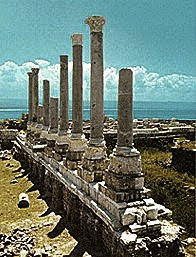

The workers were unable to build the causeway right up the walls of Tyre, as there the waters plunge to a depth of 600 feet. To overcome this problem Alexander ordered two siege towers to be taken to the causeway. When completed, they were taller than the city walls, and the range of their artillery had been doubled through the use of springs made of twisted animal tendons.
Saleh is now working on his sixth novel, and has moved beyond Lebanon to Baghdad in the ninth century AD when it was capital of Abbasid Empire under the Caliph Al-Ma’mun.
Al-Ma’mun encouraged scholarship, initiating a drive to translate works of knowledge into Arabic and founding the “Bayt al-Hikma” (House of Wisdom).
Al-Ma’mun encouraged scholarship, initiating a drive to translate works of knowledge into Arabic and founding the “Bayt al-Hikma” (House of Wisdom).
Saudi Gazette 25 October 2009
Friday, October 02, 2009
youssef ziedan's ipaf winner 'azazel' in translation deals

Further evidence of the role of the International Prize for Arabic Fiction (IPAF) in stimulating translation of Arabic fiction into other languages comes with a report from the Emirates News Agency WAM that translations of this year's winner "Azazel" (Beelzebub) by Egyptian novelist Youssef Ziedan are to be published in the UK and five other European countries, plus Indonesia, next year. IPAF is a prestigous literary prize, worth a total of $60,000 to the winner.
The foreign publication rights are handled by London-based literary agent Andrew Nurnberg Associates (ANA) International. ANA also handles foreign rights for Ziedan's fellow Egyptian author Bahaa Taher who won IPAF in 2008, its inaugural year, for his novel "Sunset Oasis". Sceptre, the literary imprint of Hodder & Stoughton, published the book in the UK last month in translation by Humphrey Davies. Taher recently made a joint appearance at the Frontline Club in London with Lebanese novelist Elias Khoury to discuss "Sunset Oasis" and Khoury's novel "Yalo".
 The English translation of "Azazel", being done by Jonathan Wright, is to be published by Atlantic Books. The other European publishing deals for the book are in Germany (Luchterhand), Italy (Neri Pozza), Greece (Livanis), Bosnia and Croatia (Ljevak) and Romania (Trei). In Indonesia the novel will be published by Serambi.
IPAF, launched by the Emirates Foundation in association with the Booker Prize Foundation of London, has the sobriquet "the Arab Booker". The longlist for the 2010 award is due to be announced on November 17, and the shortlist on December 15. The winner will be announced in Abu Dhabi on March 2. The judging process has stirred up considerable controversy in the first two years of IPAF, and the same is likely to be true in the current round of assessment. In the previous two years the identity of the judges was not revealed until the shortlist was announced, so as to avoid any attempts at external pressurisation of the judges. The previous two shortlists confirmed the strong position of Lebanon in publishing fiction, and of Egypt in fiction writing.
Monday, September 28, 2009
raja shehadeh and kamila shamsie at the tabernacle in london

The Palestinian writer and lawyer Raja Shehadeh leapt to fame in Britain when his book “Palestinian Walks: Notes on a Vanishing Landscape” won the 2008 Orwell Prize, Britain’s pre-eminent award for political writing.
In his prizewinning book Shehadeh recounts a series of walks he made over 27 years in the hills of the West Bank, where he lives in the town of Ramallah. His walks reveal the devastation visited on the landscape treasures of Palestine by Israeli occupation and settlement building.
And yet when Shehadeh appeared onstage at the Tabernacle cultural center in West London last Wednesday evening, in conversation with the Pakistani novelist Kamila Shamsie [pictured], he began by reading an account of hillwalking not in the West Bank but in the Scottish Highlands.
Shehadeh first walked in the Highlands of Scotland in 1992. His essay on that walk, entitled “Echoing Lands”, starts: “I come from a land of hills full of stories that the lingering ghosts of those who once lived there want to tell. I did not know the same was true of the Scottish Highlands.”
Shehadeh has done much walking in the Scottish Highlands in the nearly two decades since that first walk. “I welcomed the opportunity to write about that part of the world and found that there are so many echoes with Palestine. Palestine is not an isolated issue: it’s important to see it in wider context.”

“Echoing Lands” appears in the anthology “In a Wilder Vein”, newly published by Two Ravens Press, which focuses on the relationship between people and the wild places of Britain and Ireland.
The evening at the Tabernacle was organized on behalf of the Palestine Festival of Literature (PalFest). It gave the audience a chance to interact with a spellbinding writer who combines a passion for justice with sharp perceptions and gentle humor. His writing goes far beyond mere reportage and is permeated by a deep humanity.
In 1979 Shehadeh co-founded the human rights group Al Haq to defend human rights in the occupied territories. Although he is no longer working directly with Al Haq, he considers that through his writing he continues to serve the cause of human rights. Books, whether fiction or non-fiction, are able to touch readers and enable them to understand a situation through experiencing emotion in a way that reports, information or statistics alone cannot do.
Two of Shehadeh’s books, both published by Profile Books of London, were on display for sale and signing at the event. One of the books was the recently-published paperback edition of his 2002 family memoir “Strangers in the House”. The new edition has an afterword by Shehadeh entitled: “A Palestinian Son’s Search for Justice”.
Raja’s prominent lawyer father Aziz Shehadeh was murdered in 1985, and it took Raja years to reach at least the partial truth, with the Israelis laying false trails thereby causing the family much anguish. In his afterword he explains how only in 2006 was he finally able to piece together the story and identify the culprit, by then dead, who had enjoyed Israeli protection as a collaborator.
The other book on display was the 2008 paperback edition of “Palestinian Walks”. The first edition of the book included six walks, but for the paperback edition Shehadeh has added a seventh. During this walk, in August 2007, he and a woman volunteer he had first met in Scotland were menaced by two teenage Palestinians carrying clubs, their faces masked by kufiehs. Shehadeh feared that the situation would turn ugly at any moment. The incident left him feeling “the hills were not mine any more. I am no longer free to come and walk.”
Kamila Shamsie said she had read “Palestinian Walks” and “Strangers in the House” separately, and then together. “The way they interweave with each other is really very moving. They are both books which go right to the heart of how the personal and political are indivisible, and how the land and the people of the land are indivisible.”

When Shehadeh returned to Ramallah from his law studies in London, he was the first Western-educated lawyer to return to the West Bank since 1948. He was determined not only to practice law but to become a writer. His books draw on his own experiences to illuminate the wider human predicament of the Palestinians. His first book, “The Third Way: Journal of the Life in the West Bank”, was published in 1982. “When the Bulbul Stopped Singing: A Dairy of Ramallah Under Siege”, was published by Profile in 2003.
Shehade recently finished writing his latest book. It is based on his great great uncle Najib Nassar, originally from a Lebanese village, who lived in Haifa where he was the editor of Al Karmil newspaper. In 1908 he wrote a book on the dangers of Zionism to Palestine and Palestinian life.

During the First World War Nassar thought that it was a mistake for the Ottomans to enter the war, and to do so on the German side. The Germans and Ottomans tried to use him as a propagandist for their cause; when he refused to comply, a warrant was issued for his arrest. So as to avoid the risk of being hanged (as many others were) in what became Martyrs Square in Beirut, Nassar went on the run for the three years 1915-18. He first hid with Bedouin, travelling with them in Galilee, and then crossed the River Jordan to take refuge in the wilderness of the East Bank.
Nassar wrote in detail about his travels, and in his latest book Shehadeh traces his route, as well as visiting Nassar’s Lebanese village of origin. “I have tried to write about how things are today – all the borders, the fragmentation, and the difficulties – and the change that has occurred in the land from the way it was 100 years ago. And then I end the book by going into the future 50 years from today to see how things might look: so it’s the past, the present and the future.”
Shehadeh does not thinks that in 50 years the situation will be as it is now, with an ideological Israeli state believing it can survive through military power in a region that does not accept it. “They will have to make peace with the region, and peace must mean breaking the walls that they have put in place – ideological walls, and walls built by fear and insecurity.” He stressed the interdependence of states in the area. In 50 years there will be “either utter destruction, or peace built on more rational reasoning.”
Susannah Tarbush
Wednesday, September 16, 2009
quartet publishes george zakhem's memoir
 [Original of article published in Arabic in Al-Hayat on 14 September 2009]
George’s Zakhem’s memoir
by
Susannah Tarbush
At book fairs and international seminars on Arab literature, participants often lament the fact there are so few memoirs and autobiographies by Arabs available in English. In Britain and the US, memoirs are an increasingly popular sector of the book market. As well as being an account of a particular life, a memoir can deepen our understanding of particular times, places and events.
The few memoirs by Arabs that have been published in English tend to be by writers, scholars or political personalities. There are fewer by figures from the world of business. The publication of “Men Who Can Dream: A Memoir” by prominent Lebanese contractor and engineer George Zakhem is therefore to be welcomed. Zakhem’s memoir was published recently by Quartet Books, the London-based publishing company founded by Palestinian publisher and businessman Naim Attallah.
It is an appropriate time for Zakhem to look back over his career and life. It is only now that Zakhem, who is 74 this year, is planning for his retirement. His sons Marwan and Salim and his youngest brother Albert are spearheading the growth of the Zakhem business.
Zakhem has led an eventful life. From his humble beginnings in the village of Deddeh in the Al-Koura district of North Lebanon, where he was born in 1935, Zakhem and his brothers built up an engineering and contracting business that has operated in many parts of the world including the Middle East, Europe, the US and Africa. The business has been though major challenges and setbacks, as Zakhem describes, but it has grown to have an annual turnover of hundreds of millions of dollars.
At the same time, George has over the past quarter of a century been a major philanthropist in the field of Lebanese higher education. He writes: “”By the year 2005, we had contributed over $18 million to institutions of higher education in Lebanon. This is a figure I believe was only matched by the late Prime Minister Rafic Hariri.” He adds: “Although many of our countrymen have amassed great fortunes and are much wealthier than we are, they have failed to make similar contributions to promote education in our country.”
Zakhem has written the story of his life in straightforward prose, with no attempt at a flowery literary style. Contracting and engineering might be thought of as dry and factual subjects, and Zakhem gives technical and financial details of the projects he has undertaken. But he also conveys something of the excitement in bidding for new contracts, of the fierce competition to win business and of the personality clashes and feuds that are sometimes seen.
The district of origin, Al-Koura, was notable for two reasons: “First, it boasted the highest percentage of educated people in Lebanon, and second, its inhabitants produced the best olive oil in the land.”
Zakhem was born in Deddeh to parents who had experienced considerable hardship. His father Salim’s father Tannous had gone out to Brazil to find a better life for his family, only to die in an epidemic there in 1918 leaving his widow Tarfa in Lebanon with three young children.
Zakhem dedicates his book to his parents Salim and Hanneh, and when he financed the construction of a building at Balamand University named it after them. His parents were determined that their children should have the best education possible despite their modest means. His father Salim had a grocery shop and later became a trader in olives and olive oil. He frequently found it difficult to pay his children’s school fees on time.
George Zakhem still has much feeling for the Al-Koura district, and remembers its hills and olive groves, valleys and brooks, and the different types of tree. The first English he ever heard spoken was from Australian soldiers who requisitioned the upper floor of his family’s house in the Second World War.
The Zakhem family is of the Greek Orthodox faith associated with the Church of Antioch, and this religious background was a mainstay to George and a source of values. He is secular-minded and non-sectarian, but at the same time proud of the role of the Greek Orthodox “as catalysts of dialogue, as educators, scientists, doctors, and businessmen.”
George pays tribute to an outstanding educator of boys in the Koura area, George Ibrahim Abdullah who opened a school at Bishmizene, 12 kilometres from Deddeh. George and one of his brothers would walk for two hours there on Mondays with their mother and stay there with an aunt during the week. When George Ibrahim Abdullah moved and set up a school the village of Aba, George transferred there, walking for two hours from Deddeh to get there every morning.
In 1948 George began his secondary education at Tripoli College High School, founded by Ilias Milhem. When he finished there he was recommended to the American University of Beirut (AUB) and entered the new engineering school. The dean of the engineering school, Ken Weidner, “was devoted to the idea of creating an Engineering school that would serve the ambitious construction and development projects of countries located in the Middle East and Africa.”
There was one Lebanese business personality above all who was a role model and mentor to George, and that was the legendary Lebanese MP and contractor Emile Bustani, the founder of the Contracting and Trading Company (CAT). Whiles studying at AUB George had summer work experience with CAT in Qatar. He joined the company after graduation, and was sent to work on projects in Pakistan.
When Zakhem decided to leave CAT in 1962 because he did not feel he was being properly rewarded., Bustani suggested that he and Zakhem set up a company in which Bustani would be the “sleeping” partner and Zakhem the active partner.
This joint venture undertook several projects in Pakistan. Bustani was keen that it should win a contract for work on the construction of the first Atomic Centre in Rawlpinkdi. He lobbied the President of Pakistan Ayub Khan by letter, and he when Prime Minster Rashid Karami went on an official visit to Pakistan in January 1963, Bustani was among those accompanying him. Zakhem came to admire Bustani’s qualities even more. “During his visit to Pakistan, Emile exemplified the ideal Lebanese politician and the experienced international businessman.” [picture shows Emile Bustani (with trademark cigar) with CAT employees on his trip to Pakistan, George Zakehm second from R]
 Bustani was expected by many to become president of Lebanon. But tragedy stuck in March 1963 when his plane crashed in Lebanon. Emile was killed together with Palestinian engineer Marwan Khartabil – who was George Zakhem’s best friend – Dr Nimir Touqan of AUB and the pilot John Ogilvi.
After Bustani’s death Zakhem decided to liquidate his partnership with CAT and to launch his own business. In early 1964 he and his brother Abdullah registered Zakhem Engineering in Beirut. The business expanded and took on projects in a number of countries. In the personal sphere, Zakhem married in 1969 Lisa Masad. She had been born in Alexandria, Egypt to parents Nicolas Masad and Rose Kadir who were both originally from Zahle.
Zakhem gives several dramatic examples of how politics sometimes disrupted business. In Iraq in 1969, the year after the Baathist revolution, Abdullah Zakhem was arrested on his way to the airport and held for 45 days. At the time the Zakhems had around 400 people working in Iraq. They sought help from the Lebanese foreign ministry and leaders of the Baath Party in Lebanon to get Abdullah released. According to George, this episode showed “we had many enemies but few friends. Some who had appeared to be close to us immediately turned their backs at the first sign of trouble.”
In July 1972 trouble came in Italy when the Popular Front for the Liberation of Palestine (PFLP) claimed responsibility for an explosion at Trieste oil, where Zakhem’s company was building oil tanks. Italian police seized a bus load of around 30 Lebanese and Palestinian welders and fitters who had been working on the project and expelled them from Italy. They later denied George and Abdullah permission to enter the country.
“A few years after the Trieste incident, the Italian government discovered the identities of the perpetrators, who of course had no connection to Zakhem Italia,” Zakhem writes. “But the damage had been done. Our work in Italy was stopped and our company closed its offices in Milan after liquidating our Italian assets.”
In 1975 George was detained by the police in Italy after travelling there on business, despite having the necessary visa. It was not until 1987 that he returned to Italy and even then he was so worried about how he would be treated by the Italian authorities that he asked his friend Dr Khalil Makkawi, then Lebanon’s ambassador to Italy, for his assistance and Makkawi met him at the airport.
Libya was an important focus of operations for the Zakhems, but serious problems arose in 1983 as a result of a row between Lebanese President Amin Gemayel and Libyan leader Muammar Gaddafi at a summit meeting of non-aligned countries.
Abdullah Zakhem’s private jet was barred when it tried to enter Libyan airspace, and the Libyans forced the Zakhem’s company to cease operations in Libya. More than two decades later, the company has still not received payment for the construction equipment that was seized in Libya, despite a Libyan court ruling that it should be paid around $10 million.
In 1975 George Zakhem left Lebanon as a result of the civil war, and moved to London. Like many other Lebanese who left at that time, he assumed that his move abroad would be temporary. However, London has been the centre of the company’s activities ever since.
Trying to working on government reconstruction contracts in Lebanon in the 1980s provided some of the biggest frustrations of his career, for which Zakhem blames corruption, mismanagement and factionalism. His brothers disagreed with his gloomy view of the Lebanese government, and in the 1990s persuaded him to go after some fresh government work.
Zakhem executed five government projects in Lebanon, only one of which ended amicably. “The other four ended up in court, and we are awaiting the court’s judgement to this day. In the process we spent over $40 million to finance the jobs and complete them on time.” The Zakhems’ successes in other countries in effect subsidised the losses in Lebanon.
Zakhem has been very active in Lebanese higher education since the early 1980s, as a donor and fundraiser. He was intimately involved in the transformation of Beirut University College (BUC) into the Lebanese American University in 1994, and in the founding of the University of Balamand. Last year AUB announced that George and his four brothers, who are all AUB graduates, had given $3 million to establish a deanship at the AUB Faculty of Engineering and Architecture.
Some of Zakhem’s activities in higher education caused controversy: there was for example widespread opposition to his pushing for the building of a campus of BUC at Byblos. The Zakhem family donated the engineering building at the Byblos campus. In the 1980s Zakhem was keen to see a university set up in at Balamand sponsored by the Greek Orthodox Church. He proposed the idea to His Beatitude Ignatius IV, Patriarch of the Greek Orthodox Church for Antioch and the Orient and to fellow members of the church’s Economic and Development Advisory Board, and the new university was launched in 1987. In all, the Zakhems gave $10 to the Lebanese American University and $5 million to Balamand University.
He writes of how he was never happy over MP and publisher Ghassan Tueini’s presidency of the university. Tueini was furious when Zakhem called in 1993 for his removal, although according to Zakhem he later cooperated over finding the most suitable person to replace him. Zakhem had always favoured former foreign minister Elie Salem as president of the university, a position that Salem took over from Tueini and still holds.
To cover its losses in Lebanon, the Zakhem group has since the beginning of this century sought income from other areas. In particular, it has focused on Africa. George is especially optimistic over the potential of Ghana where the company is developing a downtown area of the capital Accra including a five-star hotel which is due to open next year.
Zakhem’s memoir gives his own perspective on the events he has been involved in, and others are likely to have their own version of history. But his memoir is a lively read, and is also a useful contribution to the social and business history of Lebanon and the wider region over the past seven decades.
 George Zakhem and Elie Salem on the steps of the building at Balamand University donated by him and named after his parents Hanneh and Salim
Monday, September 14, 2009
bbc documentary on 'the muslim tommies' of WW1
 Shah Jehan Mosque, Woking: dead 'Muslim Tommies' were laid to rest in its burial ground
British television brings ‘Muslim Tommies’ to light
by Susannah Tarbush
Saudi Gazette 14 September 2009
Each year during Ramadan, British TV carries some special programs to mark the holy month. A major contribution this Ramadan has been the fascinating and moving documentary “The Muslim Tommies” shown on BBC One. “Tommy” is slang for a British soldier, and the half-hour film reveals the extent to which Britain depended on troops from India, including many Muslims, to hold the front line in France and Belgium during World War One.
The pre-screening publicity for the film said that while much has been made of the threat posed by Islamic fundamentalist to the security of Britain, “what is often forgotten is that Muslims have fought on behalf of Britain for hundreds of years. Thousands have lost their lives in the process – a sacrifice that has rarely been acknowledged.”
Soldiers in the Indian corps experienced the full horror of trench warfare in Europe’s bloodiest of wars. Two divisions of infantry and cavalry of the Indian Army started to arrive in September 1914, a month after the outbreak of the war. The role of these sepoys in filling gaps in the British defensive line was crucial. Eventually, the Indians were stationed in their own sector, south of the Belgian town of Ypres, which accounted for around a third of the total 30-40 mile front line. The film brings the experiences of the Muslim soldiers powerfully to life through reconstruction of conditions in the trenches, and readings by actors from the soldiers’ letters back home. The letters were translated and typed up by military censors at the time so as to ensure they did not reveal sensitive military information.
The thousands of letters had lain undisturbed for nearly a century, and poignantly reveal the inner thoughts, hopes and beliefs of Muslim soldiers as they fought in “the war to end all wars.” Subadar Muhammad Agia of the 57th rifles wrote in May 1915: “It is just like the grinding of corn in a mill; there is no counting the number of lives lost. Not a single British or native officer of the old regiment is left, and not one sepoy.”
Many of the Muslim soldiers came from provinces which are now part of Afghanistan, Pakistan and North India. Recruitment from these areas was heavily influenced by the British idea of “martial races”. Jahan Mahmood, a community historian, says: “British martial theory was the idea that certain races were much more warlike and had much more stamina on the battlefield than others. Military historian Gordon Corrigan [pictured] says the role of the Indian soldiers was vital, and had they not been fighting on the front line the Germans might well have broken through and made it to the ports on the English channel. “The Punjabi Musselman, to give them their correct title, was regarded as the backbone of the old Indian army and was about a third of that army.”
Khudadad Khan was the first-ever Indian to be awarded the Victoria Cross, for his actions on Oct. 30, 1914. His grandson Abdul-Samad Khan explains that Khan was a machine gunner, and that all other members of his group had been killed by German shelling. “A shell hit him, but despite this, right to the end he kept trying to stop the Germans so they wouldn’t think everyone had died on the other side.” Khudadad survived, and lived until 1971.

The film begins in the recent past by recounting the July 2006 killing in Afghanistan of the first British Muslim to die during the “war on terror”. He was Lance Corporal Jabron Hashmi who was born in Peshawar, Pakistan, and came to Britain at the age of 11. Hashmi’s death made headlines in Britain, and he was hailed as a Muslim hero. The film commented: “He wasn’t the first Muslim to be ready to risk his life for a British cause. Thousands of Muslims have fought and died on Britain’s behalf.”
The number of Muslims in the British armed forces has gradually been increasing, to reach about 400 today. Imam Asim Hafiz, the first-ever Muslim chaplain to the British armed forces, says: “Britain is a multicultural and multi-faith society, and it is important that the armed forces reflect the diverse nature of this country.” The film acknowledges, however, that for Muslims to join up at a time when there are wars against other Muslims raises “complex questions of national identity, personal loyalty and what it means to be British”.
Imam Asim Hafiz says: “At the moment because our current conflicts are in Islamic countries it could be more challenging for a Muslim to join the armed forces. What we have to understand is that everybody has a variety of identifies that makes them an individual – it could be their faith, it could be their culture, it could be their job: at different times one identity might take priority over another.”
During World War One some 12,000 injured Indian troops were sent for medical treatment to Brighton on the English south coast, where an army hospital was established in the famous Royal Pavilion. Muslim soldiers who died were buried in the Muslim Burial Ground at Woking’s Shah Jahan Mosque, constructed in 1889 as Britain’s first purpose-built mosque. Every summer a multi-faith ceremony is held at the Chattri Memorial in the countryside near Brighton, which was built to commemorate the Indian troops who died in hospitals in Brighton and Hove.
Thursday, September 10, 2009
max hastings: govt hides popularity of name 'mohammed'

Max Hastings has written a shamelessly alarmist article in the Daily Mail on what he alleges is an official statistical cover-up over the fact that Mohammed, in all its variant spellings, is now (on 2008 figures) the third most popular name for boy new borns in England. Nor is it only Max who has latched onto the story. The tabloid Sun warns that Mohammed in its various forms will be No 1 in two years.
Hastings' article is entitled: Mohammed is now the third most popular boys' name in England. So why this shabby attempt to conceal it?
He begins: This week, the Office for National Statistics published a list of the most popular boys' names in Britain: Jack, Oliver, Thomas, Harry, Joshua, Alfie, Charlie, Daniel. They reflect a cultural tradition as old the nation's history, and would provoke approving nods from Jack the Ripper, Oliver Cromwell, Thomas Becket and Harry Hotspur. There is just one small problem: the list is deceitful. In reality, the third most popular choice for boy children born last year in England and Wales was not Thomas but Mohammed. The ONS explains blithely that it had no intent to deceive. Its normal practice is to catalogue different spellings separately, as in Mohammed, Muhammad and so on. But if you add these variants together, as surely seems logical, then Mohammed is right up there, near the top of the list.
Hastings goes on to say that unfortunately, in recent times we have been given plentiful cause for paranoia about attempts by official bodies to conceal from us information about the changing face of Britain which our rulers know that many people will not like.
He goes on to raise alarm over Muslim reproduction figures. The Muslim population is now close to two million, over 3 per cent, and rising fast because Muslim children have more children than most of the rest of us, many of them named Mohammed or Muhammed. In comparison, the Poles who settled her after World War II mostly had names like Wladyslaw or Miroslaw. But when they married and had children, few gave these Polish names. Most became Jacks and Olivers and Harrys. Today, their grandchildren are indistinguishable from ours. It is hard to believe that the same will be true in Birmingham or Leicester, where Mulsims are soon expected to outnumber whites.
Actually, the Poles I know tend to give their children names that "work" in both Poland and Britain, such as Peter/Piotr or Anna. Some of my Muslim friends similarly chose eg Rashid/Richard, or Idris, or Yousef/Joseph, or Samir/Sammy, and use them flexibly.
Isn't one reason for the prevalence of Mohammed in its different forms due to fact that the name is extremely popular among Muslims, and also that there is probably a more limited range of Muslim boys' names in use than of non-Muslim names?
If Hastings' alarmism over swelling Muslim numbers is well-founded, then would one not expect to find other Muslim names in the top 100? - Ahmed perhaps, Samir, or Mustafa. I can't actually find one. Or maybe some Muslims are already following Max's advice and calling their children Oliver, or maybe true-Brit name Ashton - a new entry this year, at no 74.
What about girls' names? Surely one would expect to see a similar phenomenon there, with Muslim girls' names riding high in the charts. Admittedly Jasmine is at number 35 - are the 1,653 babies given this pretty name last year all Muslim? (as an English spelling of Yasmeen) Layla is at 68 - a new entry since 1998, having risen 224 places. (Although some pure white Brit parents love this name, meainging "night". And there is of course the Eric Clapton influence). Maryam, a new entry at 99 - a grand total of 583 babies last year.
Let's look at Mr Hastings' own name. Max is now in 24th place , a +27 change in rank since 1998, and a +7 increase since 1997. Whereas the name Mohammed, now in 16th place, has risen more modestly, with corresponding figures of +18 and +1. Mind you the spelling Muhammad has risen 54 places since 1998, and +1 since last year. But some other names have shot up much faster. Jayden, now at 21, has risen +281 places since 1998.
Would it really be logical, as Hastings claims, for the ONS to lump all variant spellings of a name as one name? It surely makes more sense to list different spellings of the same name separately. The ONS tables say in a footnote: "these rankings have been produced using the exact spelling of the name given at birth registration. Similar names with different spellings have been counted separately."
Surely this policy has always been in place and not, as Hastings implies, hurriedly introduced as soon as "Mohammed/Muhammad" et al started creeping up the hot 100. Eg Ann and Anne, Catherine and Katherine, Jak/Jack/Jac/Jacques or come to that Susannah/Suzanna/Susanna/Suzannah/Susana. (All these numerous spellings of Susannah, "diluting" its impact. must be the reason why none has made it into the top 10 - not the fact that it has gone out of fashion!)
The Telegraph, in a more measured piece than that of Max Hastings, has an interesting more detailed breakdown of the names in terms of region. But to really make statistical sense of the whole picture, surely one needs to know what percentage of Muslim babies are given the name of one of the variants of Mohammed.
Tuesday, September 08, 2009
manchester muslim writers
.jpg) ‘Curry Mile’ author strives to get Muslims writing in Britain
‘Curry Mile’ author strives to get Muslims writing in Britainby Susannah Tarbush
Saudi Gazette 7 September 2009
Creative writing courses and groups have mushroomed in Britain in recent years. But as far as the novelist, poet and creative writing teacher Zahid Hussain [pictured above] knows, Manchester Muslim Writers (MMW) is the first society for Muslims who write fiction, poetry or non-fiction. The group covers not only novels, short stories and poetry, but screenwriting, travel writing, feature writing, memoirs, textbooks and technical writing.
Hussain initiated the setting up of MMW in the northern English city of Manchester in May [launch event pictured] , and said that he feels a sense of duty about this. “I believe Muslims have not been able to show the world the strength of our art and literature; we have to get Muslims writing,” he told Saudi Gazette in an interview. He sees MMW as “a stepping stone” to the mainstream, and hopes that “one day Muslim narratives will become part of British mainstream life.”
 The MMW website and its links, including those to Hussain’s own website and blogs, are full of practical advice on writing. On its website, MMW describes itself as a “UK collective”. Inclusiveness is a key to Hussain’s approach. He wants MMW to access the vast range of local Muslim communities and to school them in writing. “I don’t just want them to write, I want them to write well.”
With no definition of a typical member, the youngest participant is 13, the oldest in their 60s; MMW is open to non-Muslims as well as Muslims, and attendees at its events have included a couple of non-Muslims who are interested in Muslim culture.
Hussain himself originated from a family of poets, and writes on his personal website: “My maternal grandfather and great-grandfather wrote poetry in Pushto and Urdu”. He was born in the northern English county of Lancashire to “a hard-working and traditional Pakistani family”. He is particularly well placed to start a group to nurture the writing of Muslims. He is a published novelist and poet himself, and has much hands-on experience to impart. He also teaches creative writing in schools.
At the same time he is a founder of the charity Regenesis Squared, a social enterprise headquartered in the Shakespeare House community center in South Manchester. Regenesis delivers innovative community regeneration projects and it supports MMW, whose classes are free of charge. (Hussain notes that among the other groups that use the facilities of Regenesis is the Saudi Men’s Club which meets there on Fridays. Manchester is said to have a Saudi community - spearheaded mostly by students - of around 1,000 families).
Hussain’s debut novel “The Curry Mile” was published in 2006 by Suitcase Press. The novel is named after legendary Wilmslow Road in the Rusholme district of Manchester, a road famous for its numerous South Asian - mainly Pakistani - restaurants. The novel’s plot is woven around a curry magnate Ajmal Butt and his spirited daughter Sorayah whom he has disowned after catching her living in London with a boyfriend. After her return to Manchester, she confronts the dilemma of whether to help her father’s threatened curry empire to survive.
The novel has universal themes and is highly accessible; both full of humor, while tackling important issues. It has received considerable praise, and one of the leading Muslim intellectuals in Britain, Ziauddin Sardar, chose it as one of his books of the year in the New Statesman magazine. Hussain has now completed his second novel along the working title of “The Somniloquist” - someone who talks in their sleep - and focused on one of Sorayah’s brothers, saying that it may become part of a “Curry Mile” series of novels.
MMW’s activities include workshops on single topics (such as metaphor, conflict, and writing for children), two reading circles a month – one combined with a visit by a well-known author – and seminars on subjects including great Muslim writers.
The group has some 120 people on its database, and varying numbers of people have attended its events. Hussain sees the Reading Circle, in which participants read their work out aloud and receive feedback from others, as the backbone of MMW. There will be also opportunities for members to submit their writing to group magazines and anthologies in due course.
The first guest speaker was Moazzam Begg [pictured], a British Muslim who was seized in Pakistan in 2002 and held for nearly three years, mostly in Guantanamo Bay. In collaboration with the journalist and activist Victoria Brittain he wrote “Enemy Combatant: A British Muslim’s Journey to Guantanamo and Back” published in 2006 and subsequently translated into several languages including Arabic. While in prison he was moved to write poetry on his terrible ordeal.
The second speaker, Qaisra Shahraz [pictured], was born in Pakistan and brought up in Manchester from the age of nine. She is the author of two published novels, “The Holy Woman” and “Typhoon”, and is also eminent in academia and in teaching creative writing.
The third monthly author speaker, scheduled for early October, is likely to be Sufiya Ahmed (the pen name of Sophia Ahmed), who grew up in the East End of London and is the author of “Zahra’s First Term at the Khadija Academy”.

The second speaker, Qaisra Shahraz [pictured], was born in Pakistan and brought up in Manchester from the age of nine. She is the author of two published novels, “The Holy Woman” and “Typhoon”, and is also eminent in academia and in teaching creative writing.

The third monthly author speaker, scheduled for early October, is likely to be Sufiya Ahmed (the pen name of Sophia Ahmed), who grew up in the East End of London and is the author of “Zahra’s First Term at the Khadija Academy”.
Hussain hopes an initiative similar to MMW will soon take root in the city of Birmingham and that similar Muslim writers’ groups will eventually be started in many other British cities and towns with sizeable Muslim populations.
Birmingham already has a major role in the promotion of Muslim writing, through the Muslim Writers Awards (MWA) which Innovate Arts launched there in 2007. For the first time this year the MWA moved to London for the glitzy annual awards ceremony held in May in the Hilton Hotel on Park Lane.
The MWA ceremony showed the impressively high caliber of those writers of Muslim origin whose work has excited interest in the mainstream British literary arena. The winner of the Published Fiction category was Kamila Shamsie for “Burnt Shadows”.
She was in competition with Robin Yassin-Kassab (“The Road from Damascus”), Daniyal Mueenuddin (In Other Rooms, Other Wonders), Tahir Shah (In Arabian Nights) and Farahad Zama (“The Marriage Bureau for Rich People”).
She was in competition with Robin Yassin-Kassab (“The Road from Damascus”), Daniyal Mueenuddin (In Other Rooms, Other Wonders), Tahir Shah (In Arabian Nights) and Farahad Zama (“The Marriage Bureau for Rich People”).
Hussain sees the activities of MWA and MMW as complementary. MMW is concerned with the practical development of Muslim writing, while MWA celebrate the excellence of writing by Muslims. “There is now a pool of Muslim authors, and we would like to do a tour of the UK,” Hussain remarked.


Sunday, September 06, 2009
laila lalami blogs on hisham matar
Moroccan novelist Laila Lalami, whose latest novel is Secret Son, has added a timely ingredient to the current brouhaha over relations between the UK and Libya with the reminder on her website that: "A couple of years ago, the novelist Hisham Matar wrote a very moving piece about his father, Jaballa Matar, who was allegedly kidnapped by Egyptian security forces in March 1990 and then rendered to Libya. He has not been seen in nineteen years, and has not been heard from in ten". She quotes from his very moving essay in the Independent, and then refers her readers to the recent Guardian piece in which Matar explains his feelings over al-Megrahi's release:
I am imagining my father today. For the past 20 years he has been a political prisoner in Libya. The Libyan government continues to deny his existence. This even though Amnesty International has documented the case. In this time he has not been able to see or communicate with anyone outside the prison. Then I think of him hearing how well his oppressors are doing in the world. I think of him listening to the celebrations of the prison guards at the news of al-Megrahi's return. The prisoners might have been given presents to mark the occasion. Then I think of al-Megrahi's children welcoming him home.
Matar's debut novel In the Country of Men, set in late 1970s Libya, was shortlisted for the 2006 Man Booker prize - a great achievement, especially for a first book. Maybe the Downing Street bunker reading group would like to add it to its autumn reading list.
I am imagining my father today. For the past 20 years he has been a political prisoner in Libya. The Libyan government continues to deny his existence. This even though Amnesty International has documented the case. In this time he has not been able to see or communicate with anyone outside the prison. Then I think of him hearing how well his oppressors are doing in the world. I think of him listening to the celebrations of the prison guards at the news of al-Megrahi's return. The prisoners might have been given presents to mark the occasion. Then I think of al-Megrahi's children welcoming him home.
Matar's debut novel In the Country of Men, set in late 1970s Libya, was shortlisted for the 2006 Man Booker prize - a great achievement, especially for a first book. Maybe the Downing Street bunker reading group would like to add it to its autumn reading list.
Subscribe to:
Posts (Atom)

