Saturday, February 03, 2007

freemuse and the Lebanese music underground


Lebanese “underground” music groups are highlighted at Freemuse conference in Istanbul


by
Susannah Tarbush

Al Hayat
3 February 2007

The burgeoning “alternative” or “underground” music scene in Lebanon was a major focus of interest at the recent 3rd World Conference on Music and Censorship held in Istanbul by Freemuse, the international organisation that fights music censorship worldwide.

During the Middle East and North African session of the conference, the Swiss ethnomusicologist and cultural journalist Thomas Burkhalter presented some of the findings of research he carried out in Beirut in 2005 and 2006 while preparing his PhD on musicians in Beirut.

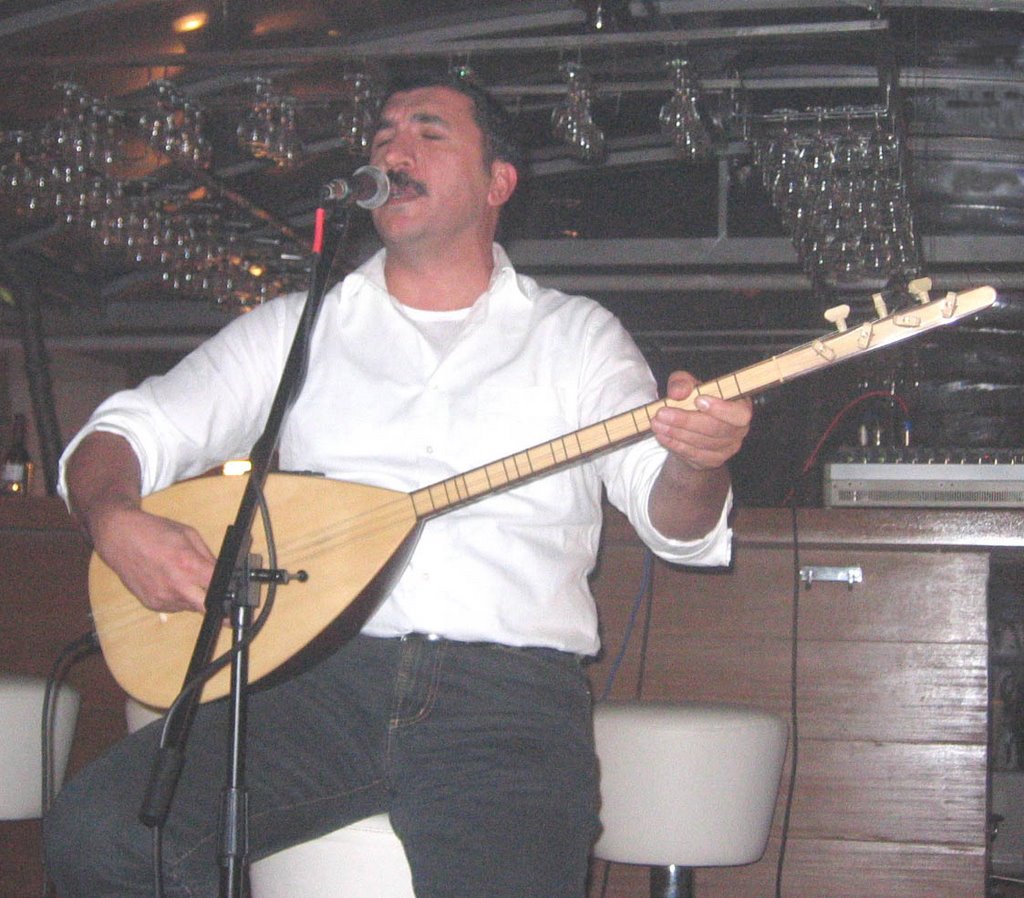
Burkhalter introduced his presentation by the playing the track “Staying Alive” by the group The New Government [top]. During his research, Burkhalter asked The New Government and other “alternative” groups about censorship. He received a variety of responses, ranging from “We don’t care about censorship!” and “There is no censorship!” to “Censorship is everywhere, it depends on how you define it!”

Burkhalter said these answers were “as contradictory as Lebanon itself: a country with loads of problems and some good possibilities. A state with a quite strong civil society with its artistic circles, and a weak government weakened on a daily basis by still too strong clan leaders.”

He noted that while some people say the Lebanese live in the freest nation in the Arab world, “others observe quite correctly that in Lebanon you find states inside the state”, and therefore there are various concepts of what is and is not acceptable.

He asked the musicians whether and how they feel censored or not, from war, the media, Hizbollah, Christian leaders, or from priests or sheikhs who do not like certain kinds of music.


Heavy metal music has come in for harassment and censorship over in Lebanon at various times over the years because of its alleged satanic links. (Similar moves against heavy metal and its fans have been seen in Egypt and Morocco).

Moe Hamzeh [below] leader and founder in 1992 of the Beirut-based rock group The Kordz described to Burkhalter the clampdown on metal music in the 1990s. After the singer Kurt Cobain committed suicide in 1994, a young man in Beirut also killed himself and the authorities claimed he had been influenced to do so by Cobain.

Cyrille Najjar [right] , a co-founder in 1996 of the gothic group The Arcane, recalls how some of his friends were put in prison and beaten up. Burkhalter found that Garo Gdanian, the leader of the Death Metal group Weeping Willow did not seem to care too much about censorship. “At the same time his band practises quite a lot of self-censorship – a strategy that is not unknown in the Lebanese metal scene.” Some albums of metal music are still on a black list.

Xardas, a 24-year-old Lebanese from Tripoli whose real name is Osman Arabi, suffered a striking case of music censorship in June 2006. Xardas is a composer and producer of a genre of electronic music known as dark ambient. In April 2006 he released an album entitled “Acid Vomit. Human Genocide” on the US record label Autumn Wind Productions.

When the US record label sent 150 of the CDs to Xardas they were seized by General Security on the grounds that they were “satanic” and “offensive to people’s morals”. Xardas was summoned by the headquarters of General Security, and had to sign a paper promising he would not send or receive any packages containing “dark, harsh or weird” music. He was warned that if he broke his promise he would be arrested and jailed without trial.

In an interview posted on the Freemuse website, Xardas complains that “as a musician, these acts of censorship are simply putting my creative energies to death, thus making my life with no meaning at all, for I live for music.”

Burkhart said the late Philemon Wehbe, who during the Lebanese civil war severely criticised Lebanese political leaders in his songs, has become “a hero for today’s generation of musicians who do not believe in politics anymore”. They include “sound artists” such as Raed Yassin. Yassin has collected sound material from the civil war and from the latest war, such as political speeches, TV and radio jingles and advertisements, and the sound of bombings. “He created sound collages that criticise Lebanon on various often hidden levels.” He has no problem in releasing his work.

Nor do rap artists such as Wael Kodeih, also known as Rayess Rek, see big problems with censorship. And if a rapper does get censored, “they send this information to the Lebanese newspapers and get promotion for free.”

Burkhalter explained that as long as rappers and other musicians from the music sub-culture stay underground, no one seems to care greatly about censoring them. “The difficulties start when they want to cross to the mainstream media. This seems only possible when an artist has a nice face, good connections – or a name, like the rocker Gassan Rahbani who produced many controversial video clips that criticised Syria and the Lebanese government and were shown on Lebanese satellite TV channels.”

Burkhalter concluded that Lebanon seems to be more open than other countries in the Arab world, but it is very unstable. There are still some taboo lines that musicians should not cross. “The strategy for today’s subcultural music scene seems clear. The musicians produce their music in home studios, create their own websites and blogs and distribute the music within alternative networks – and they do this more and more successfully.”

Freemuse takes a keen interest in music censorship in the Middle East and North Africa, and in Beirut in October 2005 it organised the first-ever conference on freedom of expression in music in the region, in cooperation with the Heinrich Boll Foundation and the Irab-Arabic Association for Music. A report of the Beirut conference was published a few months ago under the title “All That is Banned is Desired”.

Layla al-Zubaidi, the programme manager of the Heinrich Boll Foundation’s Middle East Office, chaired the Middle East and North Africa session at the Freemuse conference in Istanbul. Al-Zubaidi was born Germany to Iraqi and Syrian parents.

Al-Zubaidi said the Beirut conference in 2005 had shown music censorship in the Middle East to be a very complex issue. “Censorship occurs on so many different levels – political, religious and social – and also the countries vary very much from each other. It is very difficult to compare a country like Saudi Arabia to Lebanon because they are completely different societies.”

But the Beirut conference had also shown some common features between Middle Eastern countries. In particular there is “an internalised sense that there are certain issues that should not be challenged too much. There is a certain set of social and religious values which can be summarised as public morals and political power.”

Burkhalter and Al-Zubaidi examined the effect of the Hizbollah-Israel war in changing the attitude of Hizbollah towards music. The war had led to the production of new propaganda music and politicised dabke music, Burkhalter said. After the war some people had asked whether the new popularity of Hizbollah and its allies would lead to a new kind of music censorship, comparable to that in Iran. But Burkhalter has found that many Lebanese musicians don’t seem very worried about this.

Al-Zubaidi noted that there has been a relaxation in Hizbollah’s attitude to music. During the summer 2006 war Hizbollah became more liberal because it “discovered the power of music for mobilisation and propaganda. It used songs from the 1950s and 1960s that appeal to Arabism and Arab feeling.”

She added that Hizbollah knew that people were worried that after the war it would tighten its grip on society. “They tried not to upset people too much and not make them afraid that society would change. This had an effect on music.”

Music groups around the world, such as those in Lebanon, are finding the internet a vital means of distributing their recordings and connecting with audiences worldwide. Internet sites such as MySpace and the video site You Tube are widely used by musicians. But some American participants in the Freemuse Istanbul conference warned that the current freedom and “democracy” of the internet, which gives all users equal access to the internet, is under threat because of the plans of major US telecommunication companies to introduce a “tiered internet” in which those who pay more will have greater and speedier access to the internet.

Another speaker during the Middle East and North Africa session of the Freemuse conference in Istanbul was the prominent Algerian rapper Ourrad Rabah. Rabah described how he had founded the rap group MBS in 1994, at a time when Algerian society was being torn apart by the war between the Islamists and the government. The name of the group stands for “Le Micro Brise Le Silence”, ie “The Microphone Breaks the Silence”.

Rabah gave examples of the censorship of musicians in Algeria including the harsh measures taken against those singing in Berber. The Berber singer Matoub Lounes was assassinated in Algeria in 1998.

Rabah spent seven years in France before moving to Barcelona, Spain, six months ago. “I am convinced we have to fight against censorship…the music must be in the street, where it belongs.” After suffering censorship in Algeria and then in France, Rabah now prefers to distribute his work through the internet rather than through making CDs. Moving to Barcelona has given him the chance to meet South American hip-hop artists, and he has made a recording with a Venezuelan rapper which will be distributed over the internet.

The third speaker at the Middle East session of the Istanbul conference, British classical and flamenco guitarist Jason Carter, has given concerts in countries including Saudi Arabia, Bahrain, the United Arab Emirates, Uzbekistan, Pakistan and Brunei. This has been generally with the support of the British Council. He described some of his amusing experiences while travelling, including an encounter with a censorship committee in Brunei.

Musicians, like other international artists, have been facing increased obstacles to global travel since the attacks of 9/11. Such travel restrictions on musicians are in a sense a form of indirect music censorship. Despite the restrictions on public musical performances in Saudi Arabia, Carter now finds it easier to go to perform in Saudi Arabia than in America. “If I want to play in America legally, I have to apply for visa for $1,000 and the application could be refused in my case” because of the array of stamps from central Asian and other countries in his passport.


[English original of article published in Arabic translation]

Friday, January 12, 2007

first biography of margaret fountaine

'Wild and Fearless': the first biography of Margaret Fountaine

When the English traveller and butterfly collector Margaret Fountaine visited Damascus for the first time in 1901, a young Syrian man, Khalil Neimy, was her guide and translator. Khalil found good butterfly hunting grounds for Margaret and she was thrilled to catch Syrian species of butterfly she had never seen before.

Margaret then employed the young man on a weekly wage to accompany her to Baalbek to look for butterflies. At the time, Margaret was 39 years old and still a virgin, while Khalil, at 24, was 15 years her junior. Yet despite the differences in their age and backgrounds, Khalil was soon pressuring Margaret with his charm and amorous intentions. While they were visiting the ruins of Baalbek he asked her to marry him and she agreed to become Mrs Neimy.

Khalil was Greek Orthodox, so at least he was a Christian like Margaret, but she soon realised that he had traditional views of marriage. As she refused to think of becoming a Turkish subject, they agreed they would live in America after marriage.

She then hired him for a trek on horseback to Jerusalem. In their seven-week trip through Palestine they passed through Nazareth, and went across the plain of Jenin to Nablus and Jerusalem and then travelled to the coast and went to Beirut by steamer.

These were the beginnings of a loving relationship that would last 27 turbulent years until Khalil’s death in 1928. The couple’s many journeys to collect butterflies took them to places including Algeria, the Caribbean, Central America, the Far East, Turkey, India and the USA. They also spent a disastrous period of nearly three years in Australia trying to farm in the rainforest of Queensland.

Sometimes they travelled as “brother and sister” to enable them to share a room, sometimes as “cousins”. He was known as Karl, and then in her later diaries she always called him Charles.

But despite his marriage proposal early in their friendship, the two would never marry. Margaret received a major blow after their first trip together when she discovered that he was already married to a wife in Damascus.

Over the years Khalil would assure Margaret that he was aiming to get divorced and marry her, but it was not until the mid-1920s that he wrote to her from Damascus and said his uncle, Bishop Neimy, had dissolved his marriage and thought English ladies made very good wives. Only after Khalil’s death did Margaret realise the extent to which he had deceived her and led a double life throughout their relationship.

Although Khalil deceived Margaret about his life in Damascus, it is clear from “Wild and Fearless” that he was very helpful to Margaret in her travels around the world and in her work with butterflies. When they were both stricken with malaria in Algeria and she became extremely ill, she said his devoted care had saved her life. In the international world of entomology [ie the scientific study of insects] Khalil became accepted as her companion on her trips, and she always referred to him as “Bersa” in the papers she wrote for entomological journals.

The extraordinary story of the love affair of Margaret and Khalil, is told by the British travel writer Natascha Scott-Stokes in her biography “Wild and Fearless: The Life of Margaret Fountaine”, published recently in London by publisher Peter Owen.

The book is the first biography of a remarkably adventurous, courageous and gifted woman who travelled the world collecting and breeding butterflies and making important scientific discoveries about them, while at the same time having a complicated emotional life.

Although Margaret wrote a detailed account of her life in her diaries, she stipulated in a letter written in 1939 that the box of her 12 leather-bound diaries, kept in Norwich Castle Museum, should not be opened until 1978. This would be 100 years after she started writing them at the age of 15.

After the diaries were opened in 1978, two edited volumes were published, both edited by WF Cater: “Love Among the Butterflies” (1980) and “Butterflies and Late Loves” (1986).

Scott-Stokes is like Fountaine an exceptional solo woman traveller, and she has an enthusiasm for, and sympathy with, the subject of her biography. Scott-Stokes was the first woman to travel alone from the river Amazon’s source high in the Peruvian Andes to the Atlantic Ocean. She wrote about this in her first travel book, “An Amazon and a Donkey” (1991).

Scott-Stokes tells Margaret’s story with spirit and liveliness. She says that when she started reading Margaret’s diaries “I was absolutely fascinated by her experiences and how many similarities there were in our experience, even though there was a hundred years’ difference.” One similarity is the problems the solo woman traveller encounters with men.

The Fountaine family into which Margaret was born in 1862 was one of the oldest families in the county of Norfolk in eastern England. Margaret was a woman of many talents, and she could have been an artist or a singer. The illustrations of the various stages in the life cycle of a butterfly from Margaret’s sketchbook, which are reproduced in Scott-Stokes’ biography, show her gifts as an artist.

Margaret’s twenties were dominated by a hopeless love for a chorister at Norwich Cathedral, Septimus Hewson. He would according to Scott-Stokes “leave a wound in her heart and soul from which she would never really recover.”

When Margaret was 27, she and her sisters inherited a large sum of money from her father’s brother. In his will the uncle said that the money should be held in trust, so as to give each girl an income for life. Margaret was now able to leave Norwich and travel. As Scott-Stokes puts it, the money gave her a unique opportunity to escape the limits society had set.

She went to Ireland in pursuit of Septimus Hewson, who had fled there from Norwich after running up debts. She thought she had become engaged to him, but it ended badly.

On her travels Margaret had many male admirers, as she describes in her diaries. But although she enjoyed flirting and playing games, she never fully succumbed to the attentions of men.

Her travels took her first to countries in Western Europe, and in Switzerland she rediscovered the delights of butterfly collecting. She wrote that it was then that “the love of natural history was strongly implanted in me.”

After she spent three days visiting the great butterfly collector Henry John Elwes in 1895 that she resolved to build up a serious butterfly collection. Her first major butterfly-collecting trip was to Sicily.

Scott-Stokes writes that by the time Margaret was 35 in 1897, she entered the entomological world “fully formed, and in perfect condition, just like one of her butterflies.” Her first article, on Sicilian butterflies, was published in the journal The Entomologist and the Natural History Museum in London added 44 of her butterfly specimens to its collections.

Queen Victoria died in 1901 after a 64-year reign and this marked the end of an era also for Margaret. Scott-Stokes writes: “From now on Margaret would live most of her life far away from England, spending long periods of time in Africa, Australia, Asia and the Americas. It was going to be a time of great personal and professional success, and though Margaret’s path was never straight, even she would have been astonished to hear what fate had in store for her.”

Margaret was very keen to visit the East, particularly the Holy Lands, and she travelled by sea via Marseilles and Alexandria to Beirut, where she spent 10 days at the Hotel Allemand. She also visited the mountains, where she was distressed by the situation of women. In Damascus she was booked into the Orient Hotel, whose proprietors were brothers Georges and Elias Kaouam. They came to collect her by a horse-drawn carriage with their guide and interpreter Khalil Neimy, who had been educated by American missionaries and had then spent four years living in Wisconsin.

Even though Margaret discovered, after her trip to Palestine with him, that Khalil was married, she asked him to be her guide on her first visit to Asia Minor (Turkey). He wrote to say he would tell her his side of the story about his marriage, and he even offered to serve her all his life for no wages at all, just to be close to her.

It was during the trip to Asia Minor that, at the age of 41, Margaret finally lost her virginity to Khalil. He explained his marriage by saying he his father had insisted that he return home from America to marry a young girl of 15, but she had turned out to be the daughter of a prostitute. He claimed his wife had then turned to prostitution and had abandoned their first baby daughter who then died. He told Margaret that when he proposed to her in the ruins of Baalbek he had been sure of getting a divorce, which was why he had not mentioned his marriage, but that the Greek Orthodox Bishop of Damascus had now refused to give him one.

Scott-Stokes notes that Khalil became Margaret’s husband in all but name. At the Second International Congress of Entomology held in Oxford in 1912 Margaret took Khalil with her, for he was her partner in her work and she wanted him to be recognised. She was delighted when he was welcomed by everyone. But then the sister of one of her best entomological friends told Margaret that everybody had been talking about them and wanted to know if she was married to “Bersa”.

Margaret would never know all the details of Khalil’s marriage and family circumstances in Damascus, but she had a terrible shock after his death when she received letters from his mother, sister and a friend Margaret had never heard of. The sister claimed that Khalil’s wife had been very cruel, abandoning him while he was ill and taking their five children with her.

Margaret had believed Khalil when he told her he had finally got a divorce. Nor had she had any idea of the existence of these five children, the oldest of whom was supposedly a son of 22. The sister, Poling, told Margaret that Khalil had promised that Margaret would continue supporting her and their mother. Margaret then she started to get letters from his wife asking for money. Margaret ignored all these requests.

After Khalil’s death, Margaret remained loyal to his memory and recognised his contribution to her work. Her huge collection of 22,000 butterfly specimens in Norwich Castle Museum is called the Fountaine-Neimy Collection. After Khalil died Margaret travelled in the Amazon, and found two new butterflies. She allowed Norman Riley of the Natural History Museum in London to name the butterflies after Khalil, and wrote in a letter to Riley: “Poor Mr Neimy, how pleased he would have been.”


Susannah Tarbush
Published in Arabic translation in Al Hayat 9 January 2007


[the photographs of Margaret in 1886 aged 24 (top) and of Khalil at the same age (the latter photo is shown pasted into Margaret's diary) are among the many images reproduced in 'Wild and Fearless' courtesy of Norwich Castle Museum]


Monday, January 01, 2007

Thursday, December 14, 2006

libyan female graphic novel writer interviewed


On Woman's Hour today, presenter Jenni Murray interviewed a young Libyan woman now living in Scotland, Asia Alfasi, who is author of a two-part autobiographical graphic novel to be published by Harry Potter publisher Bloomsbury. The item is Woman's Hour podcast of the day. Jenni seemed obsessed by the fact that the artist wears a headscarf, and rather a lot of her questioning was about this rather than about the work. Asia was an engaging, fast-talking interviewee, and explained how her work is influenced by manga, the Japanese comic book tradition.

Asia isn't the only Middle Eastern woman to have opted for the graphic novel form. The Iranian Marjan Satrapi is author sof the acclaimed cartoon strip books Persepolis , Persepolis 2 and Poulet au Prunes. Persepolis is being made into a French-language film featuring the voices of Catherine Deneuve and her daughter Chiara Mastroianni among others.

From the Woman's Hour website:

"Cartoons and comic strips have always been politically emotive - the global backlash against cartoons of Muslims published in Denmark earlier this year proved the power of the medium. But the latest sensation to hit the publishing world is a young Muslim woman who says her cartoons are aimed at reconciling cultures and promoting understanding between Islam and the West.

"Asia Alfasi was born in Libya and moved to Scotland with her family at the age of 8. Now aged 22, she’s just signed a deal with Bloomsbury to publish her 2 volume autobiography in the form of a graphic novel. The first volume will be about her life in Libya, the second volume is set in Scotland. Her work draws on themes of family, faith and culture and the central character is a young girl who wears the headscarf. She joins Jenni in the studio. "

Friday, December 08, 2006

freemuse's 3rd world conference held in Istanbul


Freemuse’s 3rd World Conference on Music and Censorship
by
Susannah Tarbush

It was particularly appropriate that the Danish organisation Freemuse, which campaigns for freedom of musical expression, chose Istanbul as the venue for its recent 3rd World Conference on Music and Censorship. Istanbul has one of the most exciting and diverse music scenes of any city in the world today, as shown by the acclaimed 1995 documentary film “Crossing the Bridge: The Sound of Istanbul” directed by Fatih Akin.

But at the same time numerous Turkish musicians, and others involved in the music industry, have over several decades suffered censorship, restrictions, and in some cases arrest, imprisonment and exile.

The two-day conference was held at Bilgi University. Professor Turgut Tarhani, dean of the faculty of law and director of the university’s Human Rights Law Research Centre, described the conference as “one of the important events on the Turkish social and human rights scene in recent years and the months or the years to come.”

On the second day of the conference a new Turkish initiative was launched named ‘Sanatta Sansure Son (SSS)’, meaning ‘End to Censorship in the Arts’. Marie Korpe, the executive director of Freemuse, said in her speech: “The new initiative started among young musicians, but is not limited to music, because other branches of the arts also need such an initiative.” Korpe noted that Turkey is now the only country of the 22 countries represented at the conference to have a specific organisation defending the right of musicians and artists to free expression.

The session on Turkey was one of the most moving parts of the conference. It was presented by the composer and song writer Sanar Yurdatapan, spokesman of the ‘Association for Freedom of Expression’. Yurdatapan has been imprisoned three times and continuously harassed, and for some years he was exiled in Germany and stripped of his Turkish citizenship.

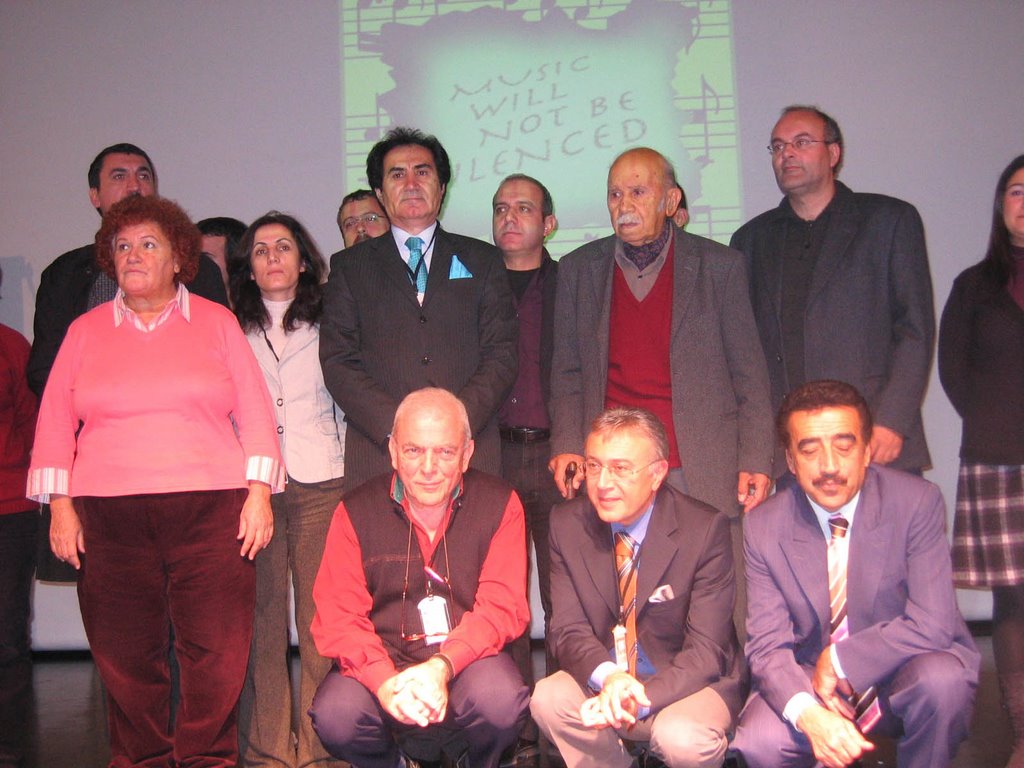
During the session some 15 Turkish singers, musicians, composers, broadcasters and music producers ascended to the platform one by one to give their personal testimony (above). They included the Kurdish singer Selda Bagcan who was known in the 1970s as ‘the Turkish Joan Baez’. She was arrested, tried and imprisoned after the 1980 coup and as recently as May this year was prevented by the authorities at Ataturk airport, Istanbul, from travelling to Canada for a concert.

Another Kurdish singer, Ferhat Tunc (below left), has been banned and imprisoned several times and is still facing court action. Members of the band Grup Yorum, known for its political songs, have been put on trial and imprisoned many times.

Gulten Kayat, widow of the Kurdish poet, singer and artist Ahmet Kaya told of how he went into exile in France in 1999 after announcing at a concert that his next album would be in Kurdish. In March 2000 he was sentenced in absentia to a prison term. He died of a heart attack in Paris in that year and Gulten told the conference: “The only reason he died at the age of 43 was that he was exiled.”

Selda Yesiltepe, editor of the Voice of Anatolia radio station, which is described as “the voice of the oppressed”, spoke of the pressures on the station from the Radio and Television Higher Board. For example the station was closed for three months in 2001 for broadcasting a programme on hunger strikers in prison and in 2003 it was closed for a month for broadcasting a song by Ahmet Kaya.

From an earlier generation, the 87-year-old writer Vedat Turkali told of the five years he spent in prison with the late singer and musician Ruhi Su in the 1950s. Turkali said: “He suffered a lot; they took away his musical instruments.”

The conference was attended by more than 200 musicians, composers, and scholars from 22 countries. It focused on music censorship in countries ranging from Cuba, Zimbabwe and South Africa to Indonesia, China and Afghanistan. In addition, there were sessions on North Africa and the Middle East, and on West Africa.

The conference was also the occasion for the launch of Freemuse’s latest special report, on Belarus. The authors of the report, Lemez Lovas and Maya Medich, found that the regime of President Lukashenko has a “fear of music as potential fuel for revolution and unrest, as in the Ukraine in 2004.” This has led to “restrictive broadcasting legislation and the reinvigoration of a huge bureaucratic system of censorship that is pushing independent musicians back into the role of Soviet era dissidents.”

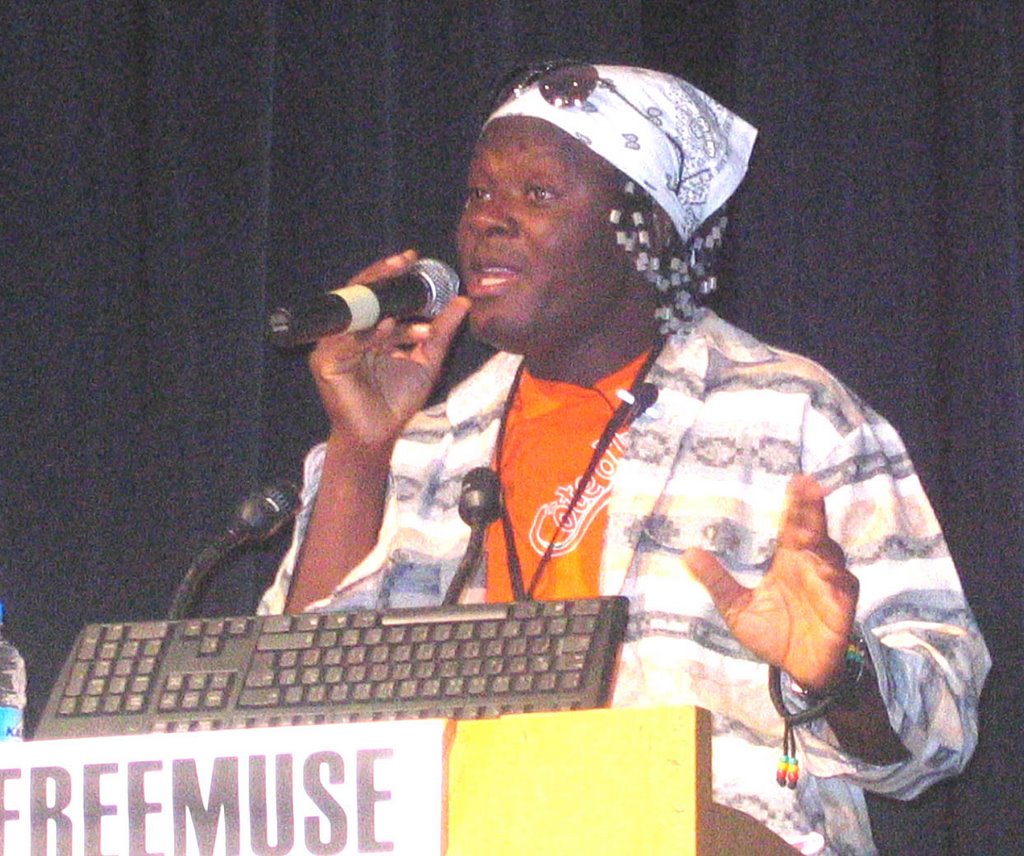
The conference was opened by wonderful unaccompanied singing from the Iranian singer Mahsa Vahdat and her sister Marjan (below, right). Several of the speakers included live musical performances as part of their presentations. The Ivory Coast reggae star Fadal Dey (below right) walked onto the conference platform singing in French, and later performed his new song “Free Iraq”.

As the studies from different countries showed, music censorship is a complex subject. It is for reasons including politics, religion, sexuality, ethnicity or history. It takes various forms, including government legislation and other measures, social pressures and the policies of broadcasters and the recording industry. Added to this is the pervasive and damaging phenomenon of self-censorship.

The Zimbabwean government of Robert Mugabe has adopted a particularly tough and blatant approach towards music censorship. The Zimbabwean journalist Maxwell Sibanda explained: “In 2001 the government decided to record music itself. It put aside some money and said it was going to record music to promote its policies.”

The then information minister Jonathan Moyo coordinated and recorded four music albums, and a fellow minister recorded two music albums and sang on some of the songs that appeared on videos. In all, the government recorded more than 10 music albums. It banned all foreign music from radio, and foreign films from television, and blacklisted all musicians singing against its policies. As the government owns Zimbabwe’s one TV station and all four radio stations, one song produced by the government might be broadcast 72 times in one day, Sibanda said.

The Zimbabwean singer Thomas Mapfumo moved with his family to live in the US for safety reasons after criticising the government in his songs. Musicians from other countries have also been forced into exile. The exiled Uyghur composer, musician and poet Kurash Sultan from East Turkistan (the Xinjiang province of China), who took refuge in Sweden in 1999, had been due to speak at the conference but he suddenly died of a heart attack on 29 October at the age of only 47.

Sultan was imprisoned and tortured by the Chinese authorities and many of his songs, which called for freedom, were banned in East Turkistan. The China session of the conference was dedicated to his memory, and his brother Kaiser Abdurusul travelled from Sweden to give an emotional address about him and to play a video of his virtuoso playing of the stringed lute known as the duttar.

Jeroen de Kloet of the University of Amsterdam noted that in China censorship has loosened tremendously over the past 10 years. For example since 1997 there has been the annual three-day Midi rock festival in Beijing. “China doesn’t really exist – there are many Chinas,” De Kloet said. Thus a musician not allowed to perform in Beijing may be allowed to perform in South China.

But De Kloet referred the complicity of the West in Chinese censorship, with Google for example agreeing to censor sensitive material on its China service.

The session on South Africa was remarkable in that it brought together on the same platform the white musician Roger Lucey and the former secret policeman Paul Erasmus who in the 1980s successfully destroyed Lucey’s musical career as a political folk singer performing songs against apartheid. In 1995 Erasmus went public and admitted what he had done, and in 2001 he was granted amnesty by the Truth and Reconciliation Commission for his activities against Lucey.

Alongside Lucey and Erasmus on the platform were Freemuse’s Programme Officer Ole Reitov and Michael Drewett of Rhodes University, South Africa. Reitov prompted Freemuse to fund an extraordinary film entitled “Stopping the Music: a story of censorship in apartheid South Africa” which tells the story of Lucey and Erasmus, and in which the two men meet for the first time. Drewett researched, co-wrote and produced the film.

In Indonesia the musician Ahmad Dhani, a founder in 1986 of the highly popular rock group Dewa 19, has been challenging religious extremism through his recent music. Andrew Fuller of the University of Tasmania, Australia, explained that Dhani is opposed to the violent ideology of groups such as Front Pembela Islam (FBI) meaning ‘The Front for Defenders of Islam’ - and ‘Laskar Jihad’ (Soliders of Jihad).

In November 2004 Dewa 19 released the CD ‘Laskar Cinta’ meaning ‘Soldiers of Love’. In February this year it released the CD ‘Republik Cinta’ or ‘Republic of Love’. “What Dewa and Ahmed Dhani are doing is using their music to confront the conservatism of a large portion of Indonesian society,” Fuller said.

In addition to the examples of music censorship given during the conference, musicians have been facing increasing problems in getting visas and travelling since the terror attacks in the US on September 11 2001. Freemuse’s executive director Marie Korpe said that the tightening in visa procedures is “a threat to musicians” and is hitting musicians travelling from developing countries, as was seen at Freemuse’s 2nd world conference in Copenhagen in 2002 and now at the Istanbul conference. For example Fadal Dey, the singer from the Ivory Coast, had to travel to Senegal and wait a week for his Turkish visa. And Mario Masvidal, the speaker from Cuba, had to deal with Cuban, Turkish and finally French and Schengen bureaucracy.

Korpe said: “What lies ahead is difficult to say but the question is whether in the future it will be possible to gather people from across the world at a conference like ours today.”

Original of article published in Arabic translation in Al- Hayat newspaper on December 8 2006


Tuesday, November 21, 2006

michael horovitz and moazzam begg poetry reading

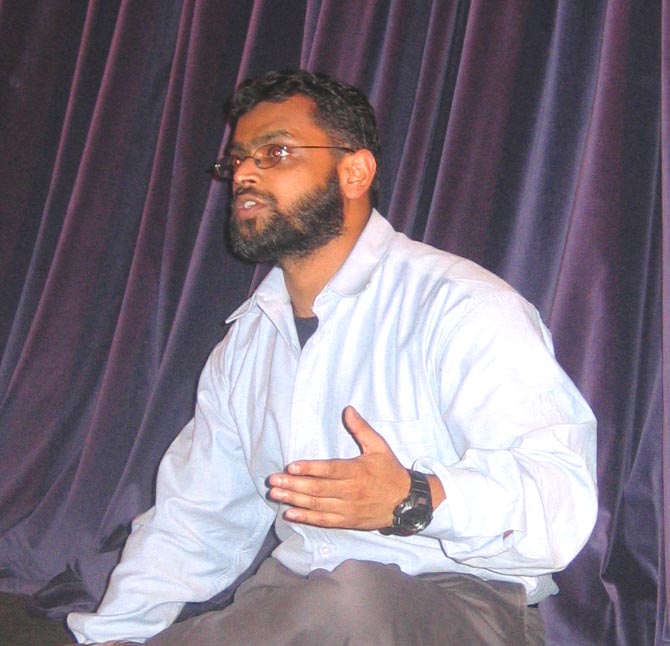
The veteran poet and poetry event organizer Michael Horovitz and former Guantanamo Bay detainee Moazzam Begg (left) might seem an unlikely pairing. But their joint poetry reading last Thursday evening at the Everyman Cinema Club in Hampstead, North London, revealed much common ground.

The reading was organized by Penned in the Margins, founded in 2004 by the young poet Tom Chivers to celebrate the power of words in performance and on the printed page. Chivers said the event would explore questions such as: “Can a poet be political? Can he or she engage with and respond to war and conflict? Should poets take sides, and what happens when poetry arises in the most unusual situations and settings?”

Begg’s poetry grew out of some of the most challenging situations imaginable. In February 2002 he was seized by the CIA in Islamabad and spent a year incarcerated in Bagram air base, and then two years in Guantanamo. It was only in January 2005 that he was released without charge. He witnessed the brutal treatment of fellow detainees, including two killings in Bagram.

“I’d never written poetry until Guantanamo Bay, and I’ve never written poetry after it,” Begg told the audience. The poems were written in solitary confinement, “where I spent two years in a cell measuring eight feet by six feet.”

Although Begg has written no poetry since his return to Britain, poetry was the catalyst for his continuing urge to express himself through words. His memoir “Enemy Combatant”, written in collaboration with journalist Victoria Brittain, was published a few months ago. Saudi publisher Al Obeikan is to publish it in Arabic translation. Begg frequently contributes op-eds to US and British newspapers, and he works for the Cage Prisoner Islamic human rights website at http://www.cageprisoner.com/

Begg found a strange beauty in the most ghastly surroundings. His poem “Chime of the Razor Wire” was inspired by the sound of intertwined barbed wire and razor wire rubbing against each other. “It sounds not unlike wind chimes, and it sounds almost calming, particularly when it’s pushed by a soft Caribbean breeze and particularly at sunset.”

Michael Horovitz has been a leading light in British poetry, and the organizer of major poetry ‘happenings’, for more than half a century. A man of many parts - troubadour, beat poet, songwriter-singer, visual artist - the Open Democracy website describes him as “a one-man poetic antidote to social complacencies”.

Numerous volumes of his poetry have been published, and he is also the editor of several important anthologies, some arising from events he has organized. During the poetry evening he read from some of his earlier work, and from his hugely ambitious new epic poem “A New Waste Land: Timeship Earth at Nillenium”.

This work, which took nine years to write, runs to 250 pages, including illustrations and cartoons, plus 150 pages of notes. Imbued with Horovitz’s characteristic wit, it is his take on New Labour and on national and international events.

Susannah Tarbush

Tuesday, November 14, 2006

national novel writing month

This November more than 77,000 people around the world have risen to the challenge of trying to write a novel of 50,000 words in the space of one month. National Novel Writing Month (NaNoWriMo) goes back to 1999 when a young writer named Chris Baty, living in the San Francisco Bay area of California, decided that he wanted to write a novel in a month.

Baty recalls: “In a more grounded age, my novel-in-a-month concept would have been reality-checked right out of existence. Instead, the very first National Novel Writing Month set sail two weeks later, with almost everyone I knew in the Bay Area on board.”

The 21 people who took part were “undertalented goofballs who had no business flailing around at the serous endeavor of novel writing.” They hadn’t taken creative writing courses or read how-to books on story or craft. “We were in our mid-twenties and we had no idea what we were doing. But we knew we loved books, and so we set out to write them.”

That first year, only six of 21 participants made it across the 50,000 word finishing line. Baty has organized NaNoWriMo every year since. The number of participants has grown rapidly, and this year 77,320 contestants are registered on the website at www.nanowrimo.org.

Participants submit their word counts to the website either through figures they provide, or through an online word counter. Although entire novels in progress cannot be posted on the site, participants can post excerpts. There are no prizes, but all who manage to produce 50,000 words are termed winners. By last Sunday, the participants had written more than 371.6 million words.

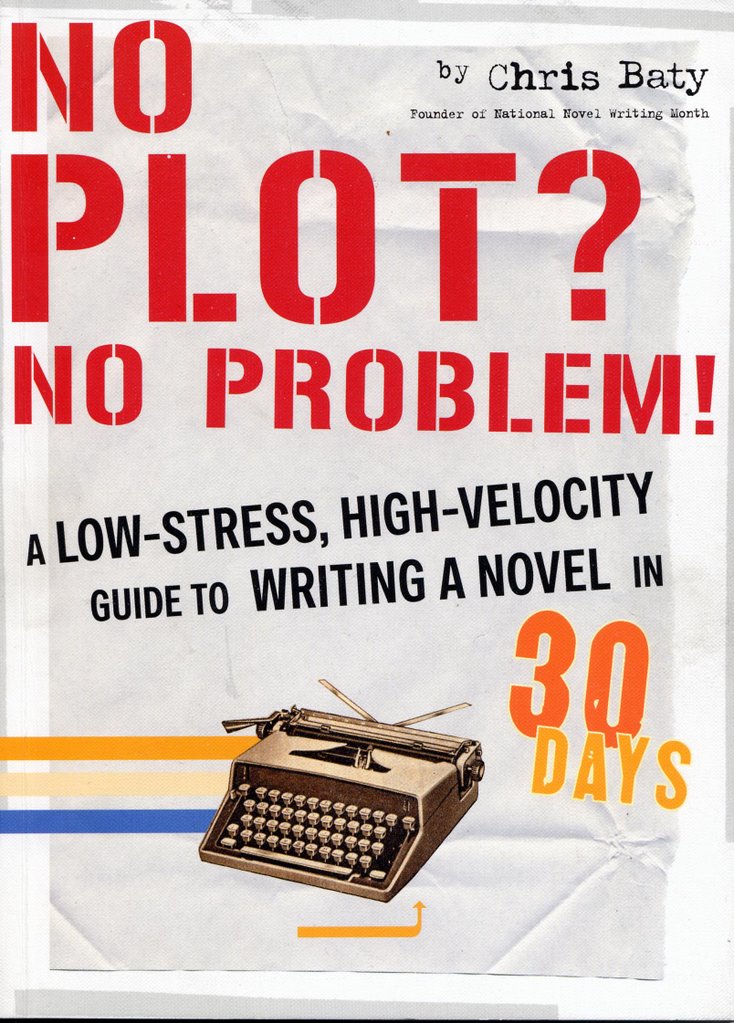
Baty’s breezy approach to fiction writing is reflected in the title of his handbook “No Plot? No Problem! Low-Stress, High-Velocity Guide to Writing a Novel in 30 Days.”
He urges writers to turn off their internal censors, and to regard the month’s output of 50,000 words as a rough first draft. And Baty claims that “plot happens”. He writes: “You don’t need to do research; you don’t need to understand anything about characters or plan out your setting. It’s fine to just start. And making it up as you go along does not require you to be a particularly gifted novelist.”

The website has six registered participants in Saudi Arabia. But only one, a 50-year-old man based in Riyadh, author of a work in progress entitled “As I Remember It”, had posted any word count to the website by last Sunday. His engaging excerpt is in the form of a memoir beginning with the narrator’s birth.

The other Saudi-based writers including 26-year-old Moody Writer with the novel “The Quest of Life”, 15-year-old alludra with “The Boat Maker”, and 60-year-old Dhahran resident jonikxx with “The Great Chunnel Heist” have yet to make their presence felt on the website.

NaNoWriMo may be no guarantor of good-quality writing, but tens of thousands of people worldwide find it a rewarding experience annually and many of this year’s participants are repeat performers from previous years And a few lucky participants have succeeded in having their NaNoWriMo novels published.

Susannah Tarbush, Saudi Gazette November 14 2006

Wednesday, November 08, 2006

saqi's 'sexuality in the arab world'

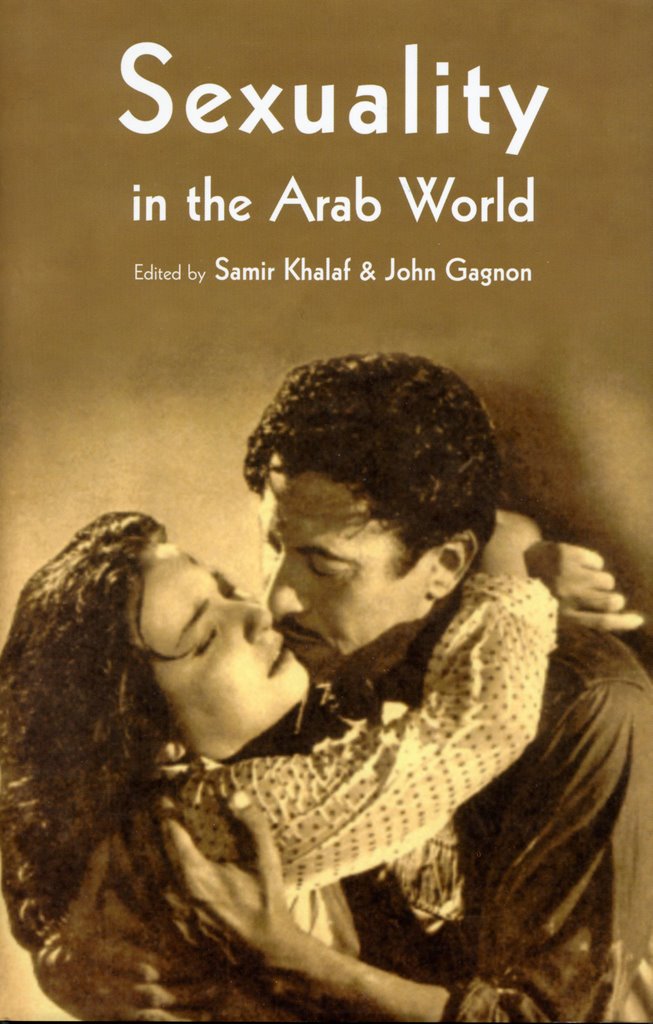
Hot from the stable of Saqi Books comes the new title 'Sexuality in the Arab World', complete with torrid cover. The publication of this book, hard on the heels of Briain Whitaker's 'Unspeakable Love: Gay and Lesbian Life in the Middle East', suggests that Saqi is carving a niche for itself in the vital but understudied (in the academic sense) area of Arab sexuality. The new book is edited by two prominent sociologists: Samir Khalaf, Professor of Sociology and Director of the Center for Behavioural Research at the American University of Beirut, and John Gagnon, Professor Emeritus of Sociology at the State University of New York at Stony Brook, who is described as 'a leading figure in the sexual research field.'

The book is a collection of papers which were presented at the three-day conference on Middle Eastern sexuality held in Beirut in December 2003. That conference was a follow-up to a conference held at St Antony's College, Oxford University, in June 2000 with funding from the Ford Foundation. Khalaf presents a strong case for an open and informed public debate on Arab sexuality. But despite the popular media, feminist groups, human rights advocates, medical and public health practitioners, NGOs and policy makers making repeated appeals to address the dire consequences of some of the problems around sexuality in the Arab world, little has been done to heed such calls. 'Sexuality remains a mystified, taboo and unexplored dimension of Arab culture,' Khalaf writes.

Professors Khalaf and Gagnon have each provided a valuable introduction to the book. In his introductory chapter 'Living with Dissonant Sexual Codes', Khalaf explores the ways in which in the Arab world 'the sexual realm, particularly in recent years, has been subjected to conflicting and dissonant expectations and hence has become a source of considerable uncertainty, ambivalence and collective anxiety.' Gagnon's chapter 'States, Cultures, Colonies and Globalization: A Story of Sex Research' put the study of sexuality in the Arab world in a global and historic context. Even in the US, where research into sexuality was pioneered, the field of sex policy especially in relation to HIV/AIDS is a politicla and religious minefield.

Susannah Tarbush

banipal translation prize


(left: photo of Humphrey Davies by Samuel Shimon)

The art of translation from Arabic to English has taken a major step forward with the awarding for the first time of the Banipal Prize for Arabic Literary Translation. The £2,000 prize went to Humphrey Davies for his translation of Elias Khoury’s “Gate of the Sun.” The translation is published in the UK by Harvill Secker, and in the USA by Archipelago Press.

The new prize puts Arabic on a par with the five other languages which already had annual translation prizes of £2,000 each. All six prizes are administered by the Translators Association and the Society of Authors.

The prizes include the Scott Moncrieff Prize for translation from French, the Bernard Shaw Prize for translation from Swedish, and prizes for translations from German, Italian and Spanish. The awards ceremony for all the prizes took place at the British Centre for Literary translation, University of East Anglia.

The prize for translation from Arabic was established by Banipal, the magazine of modern Arab literature in English translation, and the Banipal Trust for Arab Literature, founded in 2004. It has been wholly sponsored during its first year by the arts patron and publisher Mohammed Al-Sowaidi of Abu Dhabi. The Banipal Trust’s honorary president Peter Clark said the first awarding of the prize was “a memorable event in the reception of contemporary Arabic literature in English.”

The award is Davies’ first prize for translation, although he received support for the translation from English PEN’s competitive Writers in Translation Program. He said the award “represents for me, primarily, recognition of the novel itself. ‘The Gate of the Sun’ is a work of extraordinary strength that non-Arabic readers need to have available.” He added: “I am doubly happy that, in translating it. I have helped to put before the reader of English so compelling an account of the dispossession of the Palestinians.”

Davies has a first-class degree in Arabic from Cambridge University, and also studied the language at the American University in Cairo. He completed his PhD at the University of California, Berkeley. For the AUC Press he has translated Naguib Mahfouz’s “Thebes at War”, Alaa Al-Aswany’s “The Yacoubian Building”, Ahmed Alaidy’s “Being Abbas el Abd” and Gamal al-Ghitani’s “Pyramid Texts”.

Literary journalist Maya Jaggi, one of the award’s three judges, said their choice of winner was unanimous. She added: “Inspired by refugees’ accounts of the Palestinian expulsion of 1948 and its lingering aftermath, Khoury’s ambitious and richly-crafted novel is an epic retelling of myriad individual stories through the central narrative of Khaleel, a doctor tending a comatose former Palestinian fighter in a refugee camp’s makeshift hospital on the outskirts of Beirut.”

The novel “subtly questions the nature of memory and history, literature and imagination, heroism and defeat.” It is “a momentous achievement, whose translation by Humphrey Davies brilliantly captures the nuances and style of the original.”

The other judges were the author Moris Farhi, and the scholar and literary translator
Roger Allen. Farhi commented: “What impressed me most was the natural poetry in the prose…Needless to say, to convey such delicate poetry to an English readership is also a great achievement by the translator.”

Susannah Tarbush Saudi Gazette, November 7 2006

Tuesday, November 07, 2006

the film 'iraq for sale'

left: Edward Sanchez


The newly-released documentary film “Iraq for Sale: the War Profiteers” highlights the way in which a handful of well-connected US corporations have made a fortune from the Iraq war, to the detriment of both Iraqis and US nationals.

The well-researched documentary was shown at the Frontline Club in London last week. Made by Brave New Films, it is directed by Robert Greenwald. According to Rick Jacobs, the chair of Brave New Films, Iraq war profiteering has “alienated Iraqis, killed American soldiers and contractors and damaged American credibility more than the war itself.”

Greenwald examines how the Bush administration has offered no-bid unsupervised Iraq contracts to a small group of US corporations, earning them billions of dollars. He takes the viewer inside the lives of soldiers, truck drivers, widows, children and Iraqi torture victims who have been affected.

His film uncovers the connections between private corporations which have profited, and the decision makers who have allowed them to do so. Greenwald says that before he started working on the film, he was aware that corporations were making enormous profits from the war. “What I didn’t know was the amount of graft and corruption and cheating that was going on. And the big shocker was the fact that corporations, in doing what they do, cutting corners to increase profits, were resulting in people being killed. That was an eye opener to all of us.”

The incidents covered by the film include the killing and mutilation of four Blackwater contractors in Falluja in March 2004, for which the contractors’ families blame Blackwater. Private contractors played a role in the torture at Abu Ghraib prison. An Arab-American former translator for the Titan Corporation, Marwan Mawiri, witnessed “institutionalized waste, lack of employee supervision, incompetence and unethical management of employees.”

In April 2004 several KBR/Halliburton drivers were killed, and many others wounded, when they were sent by KBR into a volatile part of Baghdad. One driver, Edward Sanchez, says the massacre was “totally preventable. There was absolutely no reason for us to be there.” His colleague Bill Peterson says: “We were told repeatedly we were not soldiers, we were noncombatants, not to do anything that made us appear as soldiers or military personnel. And that we would not be sent into any areas of known danger.”

A former KBR water purification specialist, Ben Carter, says that from his first day in Iraq “I started to see just incredible waste and compromised safety standards.” A radio mechanic and former US soldier, David Mann, found that he and hundreds of other soldiers trained to provide logistical support were charged with training KRB contractors. “We shouldn’t have to train them how to do their job,” he says.

Rick Jacobs says he has worked with politicians and groups all over the US trying to promote the message of the film: “That we have to ask questions, to demand that Congress does its job. It appears that to do that, we need to make some serious changes in Washington. I hope and expect that the American public will look at this film and demand change.”

Susannah Tarbush, Saudi Gazette 10 October 2006

Saturday, October 14, 2006

the muslim card in britain

British politicians and the 'Muslim card”'

It is a tradition of British politics that to accuse a politician of “playing the race card is to make one of the most unpleasant allegations possible against a political figure. Such an allegation implies that the politician is stirring up fears about race and immigration for political ends. For example in the May 2005 general election campaign of May 2005, Prime Minister Tony Blair accused the Conservative Party leader Michael Howard of playing the race card when Howard announced a new hardline policy on immigration.

But since the four suicide bombings in London on July 7 2005, in which the young British Muslim bombers killed themselves and 52 other people, the discourse of leading government and opposition politicians have become less inhibited about speaking out on matters relating to race and immigration. Thus the Home Secretary John Reid told the Labour Party conference in late September that mass migration is causing a feeling of “anxiety” and “unfairness” among the British, and that he favours “tighter immigration controls, and identity cards.”

While issues around race, immigration, asylum and community relations are being discussed with increasing frankness by politicians on all sides, the “race card” is increasingly being replaced by the more specific “Muslim card”. It is clear that the “Muslim card” will be a significant factor in the forthcoming contest to succeed Blair as leader of the Labour Party, and in the next general election.

The government’s relations with the Muslim community of between 1.6 and 2 million people have become strained since the 9/11 2001 terror attacks in the US. The tensions have been increased by Britain’s close alliance with the US in the “war on terror”, its military involvement in Afghanistan and Iraq, and more recently Blair’s policy on Lebanon.

The effort to try to detect and combat extremism among some parts of the British Muslim community has become a priority for the government since the terror attacks of 9/11 and July 7 2005.

Since the London suicide bombings, the police claim to have uncovered several other suicide plots. On August 10 Home Secretary John Reid announced that a plot had been disrupted in which suicide bombers were to have blown up several aircraft flying from the UK to the US.

Anxiety about extremism has led the government to abandon the concept of “multiculturalism” on which race relations policies were based for the past 30 years. The emphasis is now on increasing the integration of communities, so that they do not live separated, parallel lives. Such racial segregation was blamed for the serious riots in summer 2001 in Bradford and other northern English cities with large Muslim populations. The government has created a new Commission on Integration and Cohesion, which was launched by Secretary of State for Communities and Local Government Ruth Kelly in late August.

On October 11 Kelly announced that only Muslim groups which prove they are trying to outlaw extremism and to “defend values that the vast majority of us share” will in future receive financial aid and engagement from the government. She strongly criticised those Muslims organisations (meaning primarily the Muslim Council of Britain, although she did not name it) for their refusal to attend the annual Holocaust Memorial Day. The Muslim Council of Britain angrily responded by saying it has had dialogue with the government about this in the past, and has called for it to be named as a genocide memorial day rather than one naming only the Holocaust.

The government has urged the Muslim community to do more to tackle extremism. It was annoyed when in August Muslim politicians and leaders wrote an open letter to Blair warning that British policy is putting civilians at increased risk in the UK and abroad. The letter called for “urgent” changes in UK foreign policy.
Home Secretary John Reid furiously denounced the letter as a “terrible misjudgement” and said no competent government would remain in power if its policies were “dictated by terrorists.”

Since late September several members of the cabinet and other government officials, as well as the Conservative Party leader David Cameron, have made challenging statements about the Muslim community.

The most controversial remarks came from the leader of the House of Commons, and former Home Secretary and Foreign Secretary, Jack Straw who said he would like Muslim women in Britain to stop wearing the “full veil” or niqab.

Straw’s remarks triggered an intense debate in Britain and abroad. He claimed he had spoken out for the sake of community relations, because the “full veil” hinders proper communication between people. But some commentators believed his remarks were really aimed at increasing his chances of becoming deputy leader of the Labour Party.

Tony Blair said it was “perfectly sensible” of Straw to raise the issue. Blair said: “How do we make sure people integrate more, how do we make sure people aren’t wanting to separate themselves out from the mainstream of society?”

The Higher Education minister Bill Rammell in an interview with the Evening Standard published on October 11, backed universities that ban Muslim students and staff from wearing the niqab. Imperial College, part of London University, recently banned the face veil, and Rammell said “I think this is arguably the best decision.”

The Home Secretary John Reid is increasingly being thought of as a possible rival of the Chancellor of the Exchequer (finance minister) Gordon Brown for the Labour Party leadership after Blair departs.

Reid’s tough stance on terrorism and security has enhanced his public image. In his speech to the Labour Party conference, Reid accused the Conservative Party of being “too soft on terror”.

He said there can be no compromise or appeasement with terrorism. “If we are going to ask the decent, silent majority of Muslim men – and women – to have the courage to face down the extremist bullies, then we need to have the courage and character to stand shoulder to shoulder with them in doing it.”

Reid added: “When the terrorists or their loud-mouthed sympathisers tell me that we won’t be allowed to raise our arguments in this or that part of the community, my answer is simple. Yes we will. This is Britain.”

The Home Secretary warned: “There are, and there will be, no ‘no-go’ areas in our country for any of our people, whatever our background, colour or creed. We will go where we please, we will discuss what we like and we will never be browbeaten by bullies. That’s what it means to be British.”

Reid’s reference to there being “no no-go” areas referred to an incident that happened during his first speech to Muslims, on September 20, in the Leytonstone area of East London.

During Reid’s speech a well-known extremist Jamaican convert to Islam, Abu Izzadeen, interrupted him loudly shouting “how dare you come to a Muslim area when over 1000 Muslims have been arrested? You are an enemy of Islam and Muslims, you are a tyrant.” Izzadeen was removed from the meeting by police.

In his speech to Muslims, Reid demanded that Muslim parents keep an eye on their children for signs of radicalisation by extremists. Reid warned: “These fanatics are looking to groom and brainwash children, including your children, for suicide bombings.” But some Muslim leaders accused Reid of asking Muslim parents to “spy” on their children.

In his speech to the Conservative Party conference, the party leader David Cameron also brought up Muslim issues. Newspaper reports were headlined: “Cameron says ‘Ban Muslim Ghettos in British Cities’.”

Cameron called for more contact between communities, and a sharing of common values. He particularly focused on faith schools, and said the new generation of Muslim schools must be “part of our society and not separate from it.” He called on Muslim schools to follow Church of England schools and admit a quarter of their pupils from other faiths.

The Chancellor of the Exchequer Gordon Brown, who until recently seemed certain to follow Blair as leader of the Labour Party, has been emphasising the need for increased “Britishness” and shared values. In a speech to Chatham House on October 10 he said “The debate Jack Straw has encouraged about the veil will continue.”

Brown said anti-terror policies will be a priority in his review of government spending. He announced plans for pre-emptive action to seize the assets of suspected terrorists, on the basis of covert rather than open intelligence material. He will also target “dubious charities”.

The security of a nation and its people has to be the priority of a government. But some of the recent statements by politicians risk raising the temperature and creating an anti-Muslim backlash. There are already signs of this. There has been near-hysteria in the tabloid press, with the publication of sensational stories about Muslims. Some Muslim women have been attacked in public and had their niqabs or hijabs removed since Straw spoke out against the niqab.

Politicians must be very careful how they play the “Muslim card”. A significant rise in anti-Muslim feeling directed not only at the dangerous extremist fringe but at the community as a whole could increase that very extremism that the politicians say they wish to combat.

Susannah Tarbush
Al-Hayat, October 14 2006


Friday, October 06, 2006

'hasta siempre' film on cuba

Cuban music promoter Rodolfo Rensoli

The incapacitation through illness of 80-year-old Cuban president Fidel Castro over the past two months has put Cuba in the media spotlight, with developments in Cuba having major regional and international implications. And yet, in Britain at least, there is little in-depth coverage of the country. A double-bill of documentaries on Cuba at Riverside Studios in West London last week was therefore much to be welcomed.

The first film to be shown was the absorbing “Balseros”, directed by Carlos Bosch and Josep M Domenech, which follows a number of Cubans and their relatives in 1994 before they attempt hazardous sea crossings to the US. The film catches up with them seven years later to find out what became of them.

The second film on the bill was “Hasta Siempre” directed and filmed by Ishmahil Blagrove Jr. The subtitle of the film - “Will the Revolution Survive Tomorrow?” - is increased relevance now. After the film Blagrove fielded questions from the audience together with Sean Mendez, who produced the film with his brother Yannis Mendez.

“Hasta Siempre” was made by London-based riceNpeas Films. This independent film production company aims to make films that accurately represent the live and stories of the people it records, without bias or prejudice.

Blagrove noted that when the film was shown in June at Canning House in London the Cuban press attaché said it was the most balanced documentary made about Cuba. “Some right wing friends that we have also said it was balanced.”

Historian Tomas Fernandez says that the freedom to talk openly about problems has increased, in a way that would have been inconceivable 15 years ago. One problem is racism. Blagrove is black, and he experienced racism first hand when he was stopped and questioned by Cuban police in a way his white colleagues were not.

The 57-minute film, which is full of the color, spirit and music of Cuba, takes us right into the life of the country through its interviewees. They include a psychologist, a Marxist intellectual, a poet, a music promoter, housewives, taxi drivers, rappers, hip-hop artists and a young man desperate to leave Cuba.

After the collapse of Soviet Union in the early 1990s, Cuba opened up to tourism as a means of economic survival. Tourism has brought changes including consumerism, and has exacerbated problems such as racism, prostitution and disparities between those who do and do not have access to tourist dollars.

The interviewees generally express appreciation for the free education and health care brought by the 1959 revolution. Film director Belkis Vega says that her middle class family was hit economically, but in terms of thought, development and human values, “those of us who stayed here benefited from the revolution.”

An elderly former revolutionary is the most critical voice in the film. He describes Cuba as a “socialist dictatorship or, rather, communist,” and bemoans the lack of opposition parties and free elections.

The film shows the attachment of many Cubans to the non-materialistic aspects of Cuban life. Vega says: “If the revolution doesn’t survive Castro, it would be very sad. To have sacrificed so many years for ideals that didn’t survive the human being who initiated them. But he’s not the only fighter. Many Cubans are still willing to defend those ideals.” The poet Jesus con Causse asserts: “If there’s an American invasion of Cuba even the ants will defend the Revolution.”

Susannah Tarbush
Saudi Gazette, October 6 2006

Tuesday, October 03, 2006

'lebanon, lebanon' at new players theatre

Mecca2Medina
The launch of the anthology “Lebanon, Lebanon” at the New Players Theatre in central London last Thursday evening was an opportunity for performers and members of the audience alike to express solidarity with Lebanon following the dreadful war there. The event was organized by Saqi Books, publisher of “Lebanon, Lebanon”, in conjunction with Pen, Index on Censorship and Open Democracy.

The evening saw poetry, prose, music and dance performed by Lebanese, British and other artists. A large screen behind the performers showed an ever-changing succession of images from Lebanon.

Some of the readers, including novelists Doris Lessing, Maggie Gee and Hanan Al-Shaykh, South African writer Beverley Naidoo, poets George Szirtes, Moris Farhi and Hugo Williams, read from their contributions to the anthology.

Novelist Margaret Drabble read from the novel “Dear Mr Kawabata” by her friend the Lebanese novelist Rachid El-Daif. The engaging curly-mopped Lebanese actor Karim Saleh read excerpts from Zena El-Khalil’s perceptive Beirut blog. Saqi founder Mai Ghoussoub, together with Ana Belen Serrano, Tania Khoury and Itzel Mayoral, performed “Texterminators” written and directed by Ghoussoub.

The event was presented by the British musician and record producer Brian Eno, who recalled how his interest in Arab culture in the 1970s had come first from music.
He had particularly loved the song “Ya Tair” (“Oh Bird”) by Lebanese singer Fayrouz.

“It was a huge shock when a few weeks ago I started seeing part of that world of which I am particularly fond, Lebanon, being destroyed. And I started to think why on earth aren’t we stopping this, why aren’t we doing something about this, don’t we realize what a jewel this place is?”

Eno was moved to write a letter to the Lebanese people, which was translated into Arabic and published in two newspapers in Lebanon. In the letter he said he thought millions of people in Britain shared his sense of shame “that my government looked the other way while your country was smashed up”.

The evening included several musical performances. The dancer and graphic designer Anna Ogden Smith performed to an Arab-influenced soundtrack produced by Eno. The Muslim rapper duo Mecca2Medina strode the stage as they declaimed lyrics with a message of tolerance.

Lebanese singer and composer Nadine Khoury accompanied herself on guitar as she sang adaptations of poems by Adonis (“The City”) and Mahmud Darwish (“The Girl/The Scream”).

The Persian writer, singer and songwriter Shusha Guppy sang and played the guitar. The accomplished Syrian qanun player Abdullah Chhadeh gave a spirited rendering of one of his innovative compositions.

Brian Eno hopes “we might find ways between us to work around these monolithic structures that stand between us, called governments.” The “Lebanon, Lebanon” evening was a valuable example of direct people-to-people artistic communication.
Susannah Tarbush
Saudi Gazette, October 3 2006

Tuesday, September 26, 2006

new issue of banipal

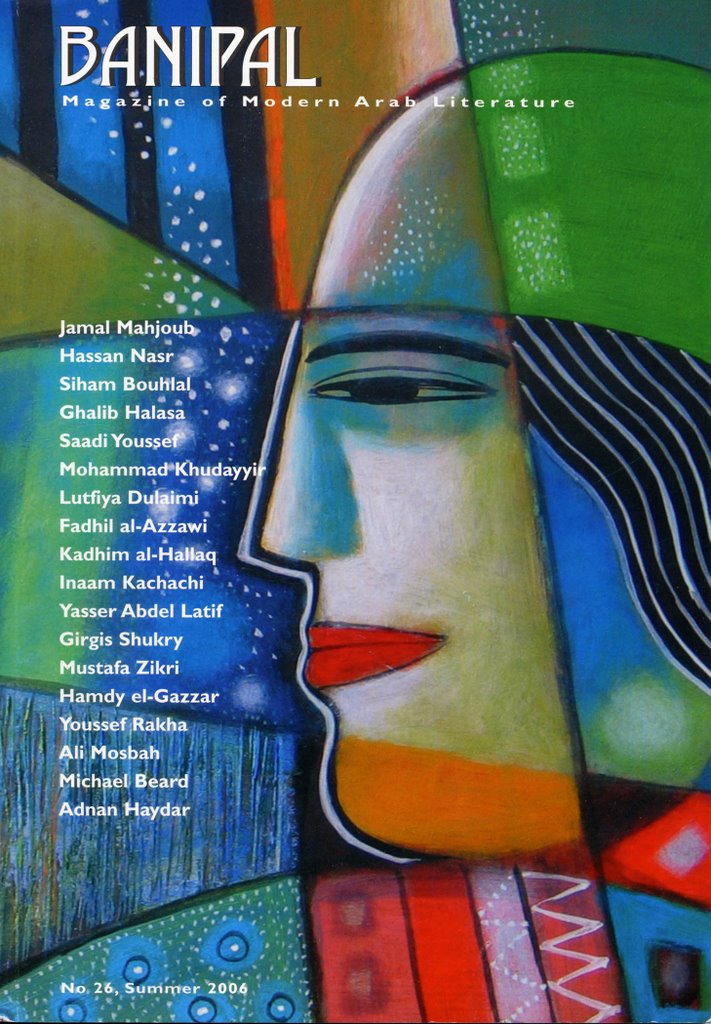
The latest issue of Banipal, the London-based magazine of modern Arab literature, focuses particularly on work by Egyptian and Iraqi authors, with features presenting work by writers from those two countries. But the issue also includes plenty of material by, or about, writers from other Arab countries.

The issue begins with the short story “In the Long Shadows”, written in English by the Sudanese-British writer Jamal Mahjoub. This mysterious and powerful story mixes memory and myth with a dystopian vision of the decaying outskirts of a town and a strange abandoned tower. A traumatized photographer brings back images from a distant western region of “burned villages, barren hills, blackened grass, graveyards.”

There is an extract from Tunisian writer Hassan Nasr’s novel “Return to Dar Al-Basha”, of which the English edition is to be published by Syracuse University Press later this year. Another Tunisian writer, Ali Mosbah, won the Ibn Battuta Prize for Travel Writing in 2004 for his volume “Mudun wa Wujooh”. The magazine includes his chapter on Istanbul.

The magazine’s Literary Influence section was penned by the late Jordanian writer Ghalib Halasa. Halasa died in 1989, but his essay, full of perception and humor, is of lasting interest.

The Iraqi feature comprises excerpts from novels by Saadi Youssef, Mohammad Khudayyir, Lutfiyya Dulaimi, Fadhil al-Azzawi, Kadhim al-Hallaq and Inaam Kachachi. The feature on New Writing in Egypt continues a feature that began in the previous issue. The writers included are Yasser Abdel Latif, Mustafa Zikri, Hamdy el-Gazzar, Youssef Rakha and poet Girgis Shukry,

Syracuse University Press has emerged in recent years as a major publisher of novels translated from Arabic to English. Banipal has an enlightening interview, conducted by the magazine’s editor Margaret Obank, with Michael Beard and Adnan Haydar, editors of the press’s successful Middle East Literature in Translation series.

Syracuse University Press was recently chosen as the new publisher for the winning translation of the Arabic Translation Award, sponsored by the King Fahd Center for Middle East and Islamic Studies at the University of Arkansas.

The books reviewed in the latest Banipal include Saudi writer Mohammad Hassan Alwan’s Arabic second novel“Sophia”, Libyan writer Hisham Matar’s novel “In the Country of Men” (now shortlisted for the Man Booker prize), the bilingual Arabic and English book of stories “Burning in the Past Tense” by Syria-born Suhail Shadoud, and the critical study “Le roman arabe (1834-2004)” written in French by Iraqi-born scholar and poet Kadhim Jihad Hassan who lives in Paris.

October 9 will be a red-letter day for Banipal, as its marks the first occasion on which the newly-instituted Banipal Prize for Arabic Literary Translation will be awarded. The award will be made at a ceremony at the University of East Anglia, at the British Center for Literary Translation’s annual Sebald Lecture on literature in translation.

Susannah Tarbush
Saudi Gazette, 26 Sept 2006

sufi poetry and music evening in london


Amnesty International’s Human Rights Action Center in London was the venue last Tuesday for readings of classical poetry in Arabic, Persian, Turkish and Punjabi, followed by a recital of Afghan music.

The Human Rights Action Center, which opened last year, is the headquarters of Amnesty’s UK Section and also provides space for human rights activists. Its auditorium was packed out for Tuesday’s double bill, which was organized jointly by Amnesty and Poet in the City, a project of the Poetry Society.

The Center is located in the East London area of Shoreditch, not far from the City of London. The holding of the evening there reflects the value that Amnesty places on the arts. In its foyer last week was a retrospective exhibition by the Brighton-based artist Paula Cox. The exhibition was both a retrospective of Cox’s work for as an artist for Amnesty, and a showcase for her most recent project “Celebrating the Life of Palestinian Women”.

The theme of the event was Sufi poetry, and it was presented by the British scholar, linguist and Middle East traveler Bruce Wannell. The multinational audience listened with attentiveness and appreciation to the poetry read in the four Oriental languages by native speakers (Wannell himself read some of the Persian poems), and to the English translations.

The second half of the program was a music recital led by tabla player Yusuf Mahmoud, who since coming to London has established himself as a leading Afghan and world musician. His skills on the tabla are extraordinary, and the audience was enthralled by his high-velocity solos.

Mahmoud performed with Professor John Baily of Goldsmiths College on rubab and dotar, Veronica Doubleday on frame drum and vocals, and Timor Shaiedaie, a new arrival on the Afghan music scene in Britain. Shaiedaie played harmonium and sang in a beautifully melodious, tender voice. The recital ended with a standing ovation.

Amnesty International, Poet in the City and Bruce Wannell are to be congratulated for organizing an event that helped Londoners to see that some of the most war-torn areas on earth have produced some of the world’s most wonderful poetry and music.

Susannah Tarbush
Saudi Gazette, 26 September 2006

john reid's speech to muslims

John Reid


The address by Home Secretary John Reid to Muslims in East London last Wednesday was always bound to be controversial, with his call for Muslim parents to be vigilant over signs that their children are being “brainwashed” by extremists.

But after Reid was heckled loudly and at length by a well-known extremist, Abu Izzedeen, there were accusations from some quarters that Reid’s team had “engineered” the interruption so as to enable the Home Secretary to say it showed how dangerous the views of extremists are.
In his address Reid said: “There is no nice way of saying this. These fanatics are looking to groom and brainwash children, including your children, for one thing: to kill themselves in order to murder others.” He told Muslim parents to “look for the tell-tale signs now and talk to them before their hatred grows and you risk losing them for ever.”

Izzedeen, a Jamaican convert whose original name was Trevor Brooks, interrupted to ask how Reid dared “come to a Muslim area when over 1000 Muslims have been arrested. You are an enemy of Islam and Muslims, you are a tyrant. Shame on all of us for sitting down and listening to him.” Izzedeen was escorted out of the meeting by police, whereupon his associate Anjem Choudary stood up and said: “Muslims do not need British values. We believe Islam is superior, we believe Islam will be implemented one day.”

There was anger among some Muslims at the amount of coverage the media subsequently gave Izzedeen and Choudary, both of whom are marginal, fringe figures, while moderate mainstream Muslims struggle to get their voices heard.

The Respect MP George Galloway wrote in a letter to Reid that Abu Izzedeen is “a well-known and violent extremist from an organization your own government has proscribed. Yet he was allowed within punching distance or the British Home Secretary. How? Why?”

The organization to which Galloway referred is the Al-Ghurabaa group of which Abu Izzedeen was a spokesman and which has been banned under anti-terror legislation. Galloway said Abu Izzedeen is the same man who led “a group of fanatic thugs in the brief ‘hostage-taking’ of myself and my daughter and several innocent members of the public during a general election meeting last year. This is well known to the Special Branch and senior police officers in East London – the very people in charge of your security today.”

Galloway noted that Abu Izzedeen praised the terror attacks of 9/11 and those in London July 7 last year. The MP claimed there were only two conceivable explanations as to how he had been allowed to “hijack” the meeting. Either the police and security services are fantastically incompetent, or “someone somewhere wanted to engineer precisely this confrontation to show you in a certain light and to portray the Muslims of Britain in the most aggressive violent and extreme way possible, as a justification for the utterly counter-productive policies you are following.”

Reid’s call for Muslim parents to monitor their children upset many in the Muslim community. Ahmed. Versi, editor of the Muslim News newspaper, claimed in a press release that Reid was calling for parent to “spy on the behavior of their sons as suspected terrorists” and “trying to divide Muslim families”.

There was widespread outrage when Abu Izzedeen was invited onto the BBC Radio Four Today program on Friday to be interviewed by presenter John Humphrys. He was given a 12-minute interview in the 8.10 am interview slot, which is normally reserved for a cabinet member or other top politician. The decision of the BBC to give Izzedeen such a prime slot to expound his extreme views was condemned by many newspapers and commentators.

Susannah Tarbush
Saudi Gazette 26 September 2006

Wednesday, September 20, 2006

man booker shortlist

When the judges of this year’s £50,000 Man Booker Prize announced last week their shortlist of six novels, only two of which are by well-known writers, one might have expected them to be praised for choosing the finalists solely on the quality of their writing rather than on the basis of their pre-existing reputations.

Instead, literary critics and the media expressed astonishment and some chagrin at a shortlist that excluded the bookies’ top favorite “Black Swan Down” by David Mitchell.

They seemed to forget that some reviews of the novel, though admiring Mitchell's writing, had expressed disappointment that his canvas in this "boy comes of age in an English village" novel had shrunk in comparison with his earlier books, particularly "Cloud Atlas" shortlisted for the Man Booker in 1994.

Nor had some of the other excluded books received unanimously positive reviews on publication. Whereas for example "In the Country of Men" by Libyan Hisham Matar, which is on the shortlist, received widespread critical praise (an exception being a bafflingly ungracious review by Palestinian writer Samir El-Youssef in the New Statesman).

When the bookies give their odds, they perhaps attach too much importance to the bigness of the authors' names, and too little to the merits of their novels. Other favorites from the longlist of 19 books who failed to make the shortlist were Australian Peter Carey (already two times winner of the Booker) for “Theft: A Love Story” and Scottish Andrew O’Hagan for “Be Near Me”. Nor did South African Nobel laureate and previous Booker winner Nadine Gordimer or Jewish comic writer Howard Jacobson appear on the list.

Professor John Sutherland, the chairman of last year’s Man Booker judges, said he was “gobsmacked” by the shortlist, adding that the “bizarre” list may show “we are seeing a turning of the tide, the older generation giving way to the new.” Many of the press reports of the shortlist announcement, referring to the upset over bookies' odds, resorted to racing metaphors. Nearly all the favourites had "fallen at the penultimate fence" wrote Lousie Jury in the Independent.

The only longlisted favorite to appear on the shortlist is “The Night Watch” by Sarah Waters (above), set in London during the Second World War. Waters is now favorite to win, with odds of 2/1 from bookmakers William Hill. "Apart from Sarah Waters, it's a field of dark horses, any one of which has a chance of winning", according to Robert McCrum, literary editor of the Observer,

The other widely-known finalist is the Australian Kate Grenville, shortlisted for “The Secret River”, about a criminal transported to Australia in Victorian times. The novel has already won the Commonwealth Writer’s Prize. Fellow Australian woman novelist, M J Hyland, is a finalist with “Carry Me Down”, about a 12-year-old boy growing up in Dublin.

Hisham Matar's novel “In the Country of Men” is set in Libya in 1979. Matar was the only debut novelist on the longlist, and to be included on the shortlist against most expectations is an extraordinary achievement. The Indian Kiran Desai is on the list with her second novel “The Inheritance of Loss”. She will be hoping for better luck than her mother Anita Desai, who has been shortlisted three times for the Booker but has never won it. Edward St Aubyn is a finalist with “Mother’s Milk”, whose protagonist Patrick Melrose is trying to cope with middle age haunted by a wretched childhood.

The chairman of the judges Hermione Lee, professor of English literature at of Oxford University, said: "Each of these novels has what we as judges were most looking for: a distinctive, original voice and audacious imagination that takes readers to undiscovered countries of the mind, a strong power of storytelling and a historical truthfulness."

The winner will be announced at a prizegiving dinner on October 10. Lee’s fellow judges are poet Simon Armitage, novelist and reviewer Candia McWilliam, actress Fiona Shaw and writer and reviewer Anthony Quinn.

For those who still take notice of bookies' odds, or delight in seeing how poorly predictive they sometimes are, the odds cited in last Sunday's Observer were 2/1 for "The Night Watch", 3/1 for "Mother's Milk", 4/1 for "The Secret River", 5/1 for "Carry Me Down", 6/1 for "In the Country of Men", and 7/1 for "The Inheritance of Loss".

Susannah Tarbush

Saturday, September 16, 2006

palestinian women writers launch 'qissat' in London

( L to R: Adania Shibli, Liana Badr, Huzama Habayeb and Jacqueline Rose)
The publication of ‘Qissat: Short Stories by Palestinian Women’ was celebrated on Thursday night at an event in the Purcell Room, part of London's South Bank Centre, featuring four of the writers included in the anthology. The evening was spirited, thought-provoking and often humorous, thanks to the stories and lively contributions from the four Palestinian writers and the empathetic yet gently provocative chairing by Jacqueline Rose. Rose, a Jewish scholar and writer, is professor of English at Queen Mary's College, London University. Her books include the 1995 work The Question of Zionism, a reply to Edward Said's The Question of Palestine.

The anthology of 16 short stories translated into, or originally written in, English is edited by journalist and radio producer Jo Glanville and published by London-based Telegram Books. The writers are from a wide range of backgrounds, ages and locations. But for all of them Palestine and the Palestinian experience are an ever-present concern and inspiration.

Some of the writers in 'Qissat' are from the younger generation, including Samah al-Shaykh who was born in Saudi Arabia in 1980 and now lives in Gaza and Basima Takrouri who was born in Jerusalem in 1982. Two are deceased: Samira Azzam died in 1967 and Nuha Samara in 1992.

The four writers on the platform of the Purcell Room had travelled from far-flung parts of the world. Liana Badr had come from Ramallah, Huzama Habayeb from Abu Dhabi, Randa Jarrar from Detroit and Adania Shibli from Berlin. The writers read from their own work in English or Arabic, and English translations were vibrantly rendered by the renowned British actress Diana Quick.

Randa Jarrar's story Barefoot Bridge centres around a trip made by a family to Jordan and then the West Bank for the burial of the grandfather. In a text shot through with wit the child first-person narrator observes the tense process of crossing the border. ("First my land, now my Guccis! God damn it" exclaims a trendily-dressed young Palestinian women after an Israeli soldier 'mislays' her shoes which have been removed for security reasons). Later, the child sits with her grandmother Sitto and imbibes her magical tales and recollections.

Adania Shibli's story May God Keep Love in a Cool and Dry Place brilliantly dissects the disintegrating relationship of a woman in love for the first time and living with her lover. Her "tolerance of his mistreatment of her has run out." The pair had first met at the fiftieth anniversary of the Palestinian Nakbbah, the Catastrophe. The details of preparing and eating a meal evoke wider resonances, and the viewpoint shifts between the man and the woman.

In Other Cities, Liana Badr takes the reader on a hazardous journey by service taxis from old Hebron to Ramallah, through Israeli-occupied territory littered with military checkpoints. The journey is made by Umm Hasan whose children have implored her to take them to Ramallah. "Little by little, the idea had begun to take hold in her mind. To actually go to Ramallah. To thumb her nose at Israel, and go - whether her husband, Abu Hasan, liked it or not. " The journey takes on epic proportions, and is a journey of self-discovery for Umm Hasan herself. At one point the narrative shifts to the thoughts of an Israeli captain, when Umm Hasan has the guts to march up to him to tell him that her baby is sick and that he should let the cars through. "For an electrifying moment he felt that he was only punishing himself, out here in this hostile wilderness."

Huzama Habayeb's story A Thread Snaps has earned a certain notoriety in Jordan for the frank way in which it handles a girl's growing awareness of her bodily desires. The story is set in a Palestinian refugee camp in Jordan, as the girl does the family washing by hand, and Habayeb told the audience in the Purcell Room that it shows the economic, social and sexual suppression experienced by men as well as women in this environment. There is a sense of blockage: "even the water is blocked." The issue of Al-Katiba magazine in which the story was first published was banned in Jordan, as was the collection of her stories in which the story subsequently appeared.
In her introduction to 'Qissat' Jo Glanville says that when she began looking for stories for the anthology, she wanted to find work by young, emerging writers to add to stories by some of the most distinguished and established Palestinian women writers. She also felt it important to look for writers not only in Palestine but also in the disaspora.

The four writers invited to London for the launch represent a cross-section of the roster of contributors to the collection. Liana Badr, who is married to Palestinian politician Yasser Abd Rabbuh, is the writer with the most direct involvement in Palestinian national politics. She lived in Beirut during the Lebanese civil war, and her early published works reflect the Palestinian predicament during that conflict. She is a filmmaker as well as a fiction writer, and was from 1995 to 2003 General Director of Arts at the Palestinian Ministry of Culture in Ramallah.

Randa Jarrar was born in Chicago to a Palestinian father and Egyptian mother, grew up in Egypt and Kuwait, and is now a single mother living in Austin, Texas. She has received the Million Writers Award for best short story, and her first novel will be published in 2007. Adania Shibli, born in Palestine in 1974, has twice won the Young Writer's Award from the A M Qattan Foundation. Huzama Habayeb was born in Kuwait and has never set foot in Palestine. She won the short story prize at Al Quds Festival for Creativity in 1993 and the Mahmoud Seif El Din Al Irani prize in 1994.

Glanville notes that in the past few years there has been in increasing appetite for Palestinian memoir. While such memoirs are powerful testimonies, "there is also a danger that so long as the world outside limits its interest to factual accounts, then Palestinians will only ever be viewed in terms of the conflict, while culture, the wider society, remains unseen." Her collection certainly succeeds in fulfilling the aim of offering "the chance to engage with a broader perspective - through the literary imagination."

Susannah Tarbush

(L to R: Randa Jarrar, Adania Shibli, Liana Badr and Huzama Habayeb)