Saturday, October 15, 2011

interview with Libyan writer Mohamed Mesrati

An interview with the Libyan writer Mohamed Mesrati
"The only thing I’m in life for is to be a writer."

Mesrati at the London Book Fair seminar 'The Hidden Face of Libyan Fiction'

Around five years ago the London-based Iraqi writer and journalist Samuel Shimon – founder of the Arabic literary website Kikah.com and cofounder of Banipal magazine – received by e-mail a short story from a then unknown Libyan writer named Mohamed Mesrati living in the northern English city of Manchester

Shimon found Mesrati’s short story “fantastic”, and had no hesitation in publishing it in a prominent position on Kikah. He asked Mesrati to send him more stories, and said he might arrange for some to be translated into English and published in Banipal, the magazine of modern Arab literature of which Shimon is now editor.

Shimon also asked Mesrati to send him a photograph of himself, and recalls his astonishment when a picture of “a young boy” arrived. He asked Mesrati how old he was: “Sixteen” came the answer.

Mesrati, who turned 21 in July, has amply lived up to this early promise. He has had a succession of stories published in Kikah and an array of other online publications and websites, in al-Quds al-Arabi newspaper, and on his own blog Merciapide. Shimon praises both the story-telling skills and style of Misrati’s “really beautiful short stories”. And unlike those of some other Arab writers, Mesrati’s stories need virtually no editing when submitted for publication. Shimon thinks Mesrati has benefitted from his wide reading, including of English-language writers, and other writers in English translation.

The prominent Libyan short-story writer and translator Omar al-Kikli names Mesrati as one of the nine Libyan short-story writers “who have gained most prominence in the first decade of the new century”. Al-Kikli made his comment in an essay on the Libyan short story, published in Banipal’s first-ever special feature on Libyan fiction – published, fortuitously, not long after the Libyan uprising erupted in mid-February.

The 135-page special feature includes an excerpt from Mesrati’s novel-in-progress Mama Pizza, translated into English by Leri Price. Rich in comic touches, the novel has an 18-year-old first-person narrator and is set among Libyan fast-food workers and menu deliverers in the town of Runcorn, near the north-west English port of Liverpool. The excerpt features a Libyan leftist “pizza-making veteran and professional menu deliverer” named Ali Guevara.

Mesrati’s novel enters new territory for Anglo-Libyan and Anglo-Arab fiction: that of Libyan and other Arab refugees and workers struggling to get by in a northern English town, seen from the perspective of a teenage Libyan worker.

Mesrati is a writer from the Arab Spring’s Facebook Generation we hear so much about, eager and restless for change. He is an engaging, funny, outspoken character, playful and erudite. His Twitter profile reads: ‘Writer, journalist, blogger, and REBEL!’ His tweets have recently included irreverent observations on the new political players in Libya.

Mesrati has had a high profile as a writer during the Libyan revolution. He is one of four Libyan fiction writers based in the UK who have been much in demand for conferences, broadcasts, interviews and articles. They were the panellists at the London Book Fair’s groundbreaking ‘The Hidden Face of Libyan Fiction’ seminars in April. The other three writers are prizewinning novelist Hisham Matar, the short-story writer Giuma Bukleb (born in 1952 and imprisoned with other writers in Libya for ten years from the late 1970s), and the short-story writer, surgeon, essayist and prizewinning blogger and podcaster Ghazi Gheblawi.

with Samuel Shimon at the London Book Fair seminar

Is it possible to sum up how the past eight months have been for you, as a Libyan and as a writer? Did you think the revolution would turn out the way it has?
It has been a strange eight months. From the beginning of the uprising in Tunisia, followed by the Egyptian uprising, and then the Libyan, I was all the time wondering if Libyans would make it one day and bring Gaddafi down. I had a big question mark in my mind as did most Libyan intellectuals. I was following many Libyans who were writing and preparing for February 17th as the day of the Libyan revolution, and I was wondering how it would be.

In fact, Libya is not Egypt, nor Tunisia; Gaddafi killed our history and our identity - our flag, street names, national anthem. That was horrible, but it was amazing when we finally saw the independence flag waving over Benghazi in the protests. When I was at school we were taught that our history started from 1969, that we just had Italian colonisation and then Gaddafi came in 1969. Before I came to Britain in 2005, I didn’t know that there had been a kingdom of Libya. And it was only then that I saw our old flag of independence, on opposition websites.

From the beginning of the revolution, we knew that one day Gaddafi and his regime would be a memory – a bad one –from the past. We knew it would take a long time - to be honest, six months is a very short time to bring down a regime that was deeply embedded inside the country, but we are proud to have brought down the whole regime and not only the president. Libyans have reclaimed their identity and everything they lost since Gaddafi took power, and what did we discover in the end? That Gaddafi’s regime was Muhawala Inqilab Fashela – ie A Failed Coup Attempt.

Have you been able to find time for writing during this period?
During the revolution I wrote a lot of essays and fiction. I wrote an essay for an anthology which will soon come out in English entitled Alsh’ab Yurid – The People Demand – and an article for the Lebanese magazine Kalamon. I also wrote short stories that I published mainly on my blog. Most of the short stories I wrote during the revolution are about dictatorship. I wrote and posted a story, entitled Rats in the Big Brother’s Alley about Gaddafi’s 22 February speech, and his phrase Zanga Zanga (alley by alley). Another story, The Origin of Dictatorship, is a fantasy about the night that Gaddafi’s dad slept with Gaddafi’s mum, and the sperm that made Muammar Gaddafi. In the story I ask what if Gaddafi’s mother hadn’t wanted to have sex that night, what would have happened to the sperm that Gaddafi came from? Maybe his dad would have lost it somewhere in the desert!

How do you think the revolution will influence the future path of Libyan literature and Libya’s literary life in general? How do you see the prospects for Libyan artistic and creative life, and what do you hope for?
In Benghazi, just eight months after its liberation, we see more than 100 newspapers and magazines coming out. The same thing will happen in Tripoli and Misrata, but it is still too early to talk about literary magazines. I have a positive vision of Libya’s literary and cultural future. I believe that people were suffering to build a literary community, and now, here you go, you have the space to fill and you have the ideas and the materials – so go for it and do your project. There are literary cafes already in Tripoli as well as in Benghazi, and I can see intellectuals standing up again to improve the culture situation. On the other hand, I have my own vision of the Tripolitan literary side. I hope to see a real theatre and culture centres, like London’s South Bank Centre, full of events, creative works and the warm blood of creation. I’m asking to have festivals in cinema, art and books. And can you imagine that we don’t have a cinema industry to make films in Libya? It’s bloody ridiculous in a country that is rich in stories and history that could easily be turned into scripts for the big screen.

Are you planning to go back to Libya soon, at least for a visit? And do you see your long-term future as being there, or here in the UK, or where?
No, it’s still early for me to go even though I’m dying to go there and see my family and friends. Some friends and family members fought during the uprising, and a number of them were killed. Some are still missing. After we left Libya in 2005 and claimed political asylum in Britain my family and I couldn’t go back, because of Gaddafi – we were against the regime. Our asylum claim was at first rejected, and we had to appeal in court – but we had the evidence to back it up. Now that Libya is free, people are going back and some of them already started making projects in media and culture - but I still feel it is too hard to go back. I am basically not ready yet to see Libya without my childhood friends. I’m not ready to see the land that never left my mind since I left it. I built somehow a romantic image of Libya in my mind, and I’m sure that I still need time before I go there and destroy this image by the reality. In the future, I see myself still in Europe, maybe still in London, but if not you will probably find me somewhere between Naples and Rome – two of my most favourite cities in the world.

How do you think the revolution may influence your own writing?
Oh hell, it will change my writing in every way. The revolution depended on people, some of whom I personally know, joining the revolution and holding weapons, and I already feel that the big amount of harm and stress we got from this revolution changed my writing. I can’t tell how, but I can feel there is something strange going on whenever I write. I have planned two novels on the liberation war of Libya and all I need is time to write them. One of the novels has five characters, each with a story from different places, meeting up in Misrata. It will try to show all aspects of the revolution, including a female perspective and a Gaddafi soldier’s point of view. The other novel is a bit personal, about me and my friends inside Libya.

Please say something about your trip to post-revolution Egypt. I understand you were hoping to get into Libya from there, but were turned back.
I promised myself to keep this trip away from any conversation or interview until I publish a book about it. It’s longer than any interview can hold … it basically changed my life 100%.. Before Egypt I was one person, and after it I turned into someone else.

I think you were working in a bookshop, but gave up your job when you went to Egypt.
I left my job at one of the Fergiani book company’s three London bookshops –Queens Park Books – when I went to Egypt. I am now working in journalism as a freelancer and I recently started working part-time in the bookshop again. The customers ask me about Libya, and about my family, and sometimes invite me out for a drink or wave to me through the shop window. I feel very close to home in that environment, and in Queen’s Park – where I used to live.

Queens Park Books

Where were you born?
I was born in Tripoli in July 1990. My family is originally from Misrata but my father and then I were born in Tripoli. My dad was born in Fashloum. I was born in a street whose name was changed every time the regime changed: the Italian colonialists called it Via Italia. After independence it was called December 24th (the date of Libyan independence) Street, and when Gaddafi took power on September 1st 1969 he called it September 1st Street. Now, after the fall of Gaddafi, suddenly people started to call it February 17th Street. The conclusion is that I was born in a street that lost its identity, the same as me.

Were your parents involved in the arts?
My father is a play actor and was in many international plays but he focused on the subject of freedom, like any young revolutionary in the 70s and 80s. He learnt much from Moroccan theatre and developed what they called ‘The Suffering Theatre’ and ‘The Poor Theatre’ and then ‘The Free Theatre’. They were making plays from their own money. They had a challenging approach and were trying to make a new kind of theatre, but as you know, under military control nothing like that could really happen. For example, in 1984 my father acted an international play, Dracula, and they came and arrested him at night because, they said, “you mean Gaddafi is like Dracula”!
My mother is a musician and journalist. She plays oud and piano, but she found herself in journalism – especially after she came to England, where she could breathe freedom and could write freely about the regime in Libya.

Have you done any acting yourself? – you seem to enjoy playing with different images and so on.
I acted in plays when I was at school, and before I decided to be a writer I dreamed of being an actor. When my dad went out in the evenings, back in Tripoli, I would look through his shelves and read old scripts of plays or series he acted in – I used to read them out loud. Even now I’ll stand in front of a mirror and change my style and act things. Sometimes I sit by myself thinking about a story I would like to write, or a novel, and when I am planning it I choose a scene and start to act it before writing it down. Who knows, maybe one day I will be an actor!


During the London Book Fair Libyan fiction seminar you vividly described the northern English town of Runcorn, near Liverpool, where your novel Mama Pizza is set. How come you went to live there and where else have you lived in Britain?
I lived in Runcorn for a while. I went there because it was summer and I needed to work and get money. It’s a nice small town, and in the old town there are many pizza and kebab shops - I used to work in one of ‘em. That’s the place I chose to write my novel about. It’s a fascinating place and I met many different Libyans there with very interesting stories that I thought it would be enjoyable to share. I think British culture and literature need to know more about this side of Britain. For example, have you ever seen a kebab and pizza shop menu in your post box and thought about the person who delivered it? Who knows, he could be me, because I was a menu distributor for more than two years of my life, in Runcorn, Liverpool, Leeds and Manchester. I would put headphones on, listen to music and go from house to house posting menus and dreaming of being a writer one day – and not only a writer, but an international writer. I imagined writing MY Ulysses and I would calm myself down every time a racist person came out of his/her house, shouting at me to go back to my country, by imagining that that this person would one day read my books and would love them. Moreover, kebab and pizza shops are now a part of the British society and as a writer who worked in them I need to write about them.

I lived in Manchester between my parents’ house and my girlfriend’s studio until I turned 18, then I moved to London, it was 2009. I moved to London just to have more freedom and torture myself, like many great poets and writers did ages ago, so that I could then write good literature!

Runcorn Old Town
Is your novel autobiographical?
Mama Pizza draws a lot on my time working in Runcorn as a pizza maker and menu distributor. I had many troubles there. I faced racism, cultural misunderstanding, I found myself in a small Libya! I saw how people treated me badly when I was posting advertising leaflets to their houses and I was sure that these people didn’t know that I was human and had dreams, and would like to have a fine house and family like they did. This is what I talk about in the novel. I also try to show another face of England, a side that people are always facing but never think to go deep inside, either in fiction or in the media. It’s the weird life of a pizza and kebab maker.

What role did literature play in your life when you were younger?
Literature meant a lot to me from when I was a boy and trying to be an actor. I loved plays so much, and my dad’s library was full of them, and I didn’t read anything else. In the days when I was reading plays, I liked Syrian author Saadallah Wannous and Moroccan playwrights such as Mohamed Elmeskin and Elmeskini Alsagher. However I became passionate about literature in general when I watched an Arab TV series called An End of a Brave Man and read that it had been taken from a novel of the same title by the Syrian novelist Hanna Minah. I went to Fergiani Bookshop in Tripoli and bought it - I remember I was 11 or 12 at the time - and when I read that novel I said that I definitely wanted to be a novelist. I continued to read Hanna Minah for a long time until I started reading Naguib Mahfouz and so on. I remember going to small bookshops and I remember one owned by an old man where all the books were dusty because no one went there. The owner supported my interest in literature and he used to let me borrow books, as long as I took them back. My grandfather -my mother’s father - had a very big library. His brother was a well-known writer and judge, Mohamed Kamel al-Houni. He had many books, and gave his library to my grandfather. My grandfather encouraged me to be a writer.

When did you start writing fiction?
I started writing stories when I was around 12. I used to write short stories at home – my mum would see me writing in the afternoon and think I was doing school homework. The short-story writer Ali Mustafa al-Musrati [born in 1926] used to walk in the street in Tripoli – everyone would recognise him. When I was 13 years old I went up to him, gave him some of my writing and said “here’s a story”. He said “I’ll read it and come back to you.” About a week later I went to his house at 2 pm and rang the bell and his daughter said he wasn’t at home. I waited until 5 pm and rang the bell again and his daughter said she had forgotten that he had gone to Tunisia. A few days later he recognised me in the street and told me: “You story was very good, but it is not ready to be published.” He gave me a signed copy of his new collection: he was the first author ever to sign one of his books for me. I read most of his stories when I was young.

Ali al-Misrati
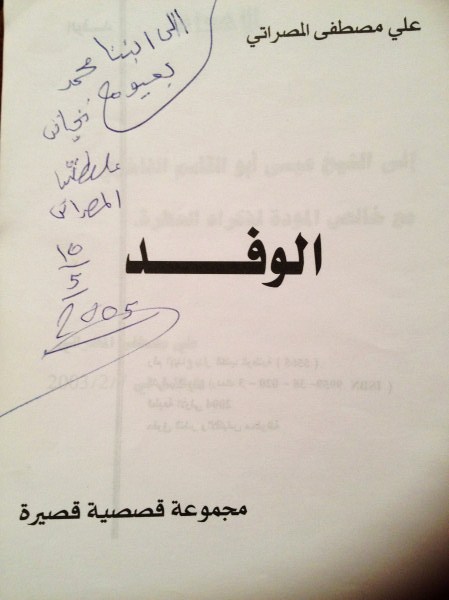
 the inscription from Ali al-Musrati to Mohamed Mesrati

How did your writing develop after you came as a refugee to Britain?
I came to England when I was 14 years and 10 months and went to North Manchester High School for Boys. All the time I was at school in Libya I was in mixed sex schools, and I thought in Britain schools were mixed, so was surprised to find myself in a boys-only school. I then went to the Manchester College where I did more GCSEs and some media studies. I started reading deeply and wrote my first stories in Manchester Central Library, which happens to be where Hilary Mantel wrote her first novel. The first story I sent Samuel Shimon for Kikah was called Asafeer Sharesa, meaning Fierce Birds – it’s about two brothers trying to kill their uncle and grandmother. I was 16 at that time. I had other stories published on Kikah, and two stories and a couple of articles published in Al-Quds al-Arabi newspaper. But like most of the writers I know of my generation much of my work was first published on blogs and websites; my generation’s writers only write for newspapers to get money. I have published often on the websites jeel-libya.net and libya-watanona.com –Ibrahim Ighneiwa’s website – and also on Libya Today at libya-alyoum.com

Considering all the work you have had published online, is publication in book form still important to you?
For me, the only thing I’m in life for is to be a writer. And no one can consider himself to be a writer until he has had a book published.

What happened with your first collection of short stories, which you had prepared for publication?
My experience of trying to have my first collection of 15 short stories published is a long saga that will stress me out if I remember it here. I gave up with it after realising that publishing in Arabic is killing creativity. Publishing houses in the Arab World are one of the biggest problems in destroying the meaning of reading. There are no rights for the author, and we young writers have to pay money to have our writing published. Normally the publisher looks at your wallet rather than at your work.

Banipal’s special feature on Libyan fiction l has an excerpt from your novel-in-progress Mama Pizza in English translation. How far is the novel autobiographical, and when do you expect it to be completed? Is it your first novel?
Mama Pizza is not my first novel. I finished my first novel a year ago – I wrote it in 2006-2010 – but I hate it. I like to make tragedy funny in my writing, but this novel was only tragic. It covers three generations of Libyan history, through a grandfather, father and son. It’s short, at 35,000 words. Mama Pizza will be completed and ready for publication, first in Arabic, in summer 2012. I have put something autobiographical in all my writing. I believe that any author should have something autobiographical in any writing he or she does.
By the way, that Banipal special feature on Libyan Fiction was long overdue: we had been waiting for it for more than 7 years! And when Banipal Books published an anthology of short stories from North Africa, Sardines and Oranges, in 2005, it didn’t include a single story from Libya among its 26 stories.

What form of Arabic do you use in Mama Pizza?
As well as its Libyan characters, the novel has two Algerian and four Syrian characters, and the Arabic text of Mama Pizza includes Libyan, Algerian and Syrian dialects I use informal Libyan in the dialogue. I believe authors from other countries translated into English should use some of their own language phrases in the translation. This shows the culture they are talking about and make the text more easily envisioned. Mama Pizza and other fiction work that I will write will be dressed by the Tripolitan and Libyan dialect in general, especially given that Tripolitan Arabic is a mixture of Arabic and Italian, which makes conversations and dialogues rich.

Will Gaddafi’s departure and the new situation in Libya make any difference to the writing of Mama Pizza?
I never hid my hatred of Gaddafi and I have written about him in many of my previous works. Most of the characters in Mama Pizza left Libya and went to Runcorn just because of Gaddafi’s regime. I have already made the plan for the novel, and I don’t think his end will change anything in it. It’s already an anti-Gaddafi novel, most of my writing even before the 2011 revolution was anti-Gaddafi.

Do you have a particular writing routine?
I used to write daily in the train travelling between Leyton, in East London, and my work at the Queens Park bookshop. The journey took an hour. Now I can’t write every day, but some days I write from nine in the morning to five in the afternoon while listening to jazz.

Do you do much rewriting?
I rewrite a lot, I wrote some chapters of Mama Pizza three or four times, and then I compare and see what’s the best and what to add and cut. I do this before showing my work to anyone, and more editing comes up after showing my writing to friends or to my agent, Nemonie.

When do you think will Mama Pizza may be published in English?
I’m not sure when the novel will be published in English, but I believe it will be important for the British reader to have it and read about people he sees almost everyday!

The excerpt in Banipal was translated by Leri Price. Are you continuing to work with her, eg is she translating the whole novel?
Leri Price did a good translation but unfortunately I don’t have any contact with her and my agent found a good translator, Robin Moger. He has previously translated one of my non-fiction works and I thought, as did my agent, that he would be a good translator for Mama Pizza.

What have you been reading during your time in England?
When I came to England I read mostly Arabic, especially classical poetry. I went on to read in English, and I started reading British and American literature and literature translated into English from French and other languages. Now I’m reading many different books at the same time. I’m not really in a mood to read on one book at a time. I reread quite a bit nowadays, books including Kitab al-Tugra (Book of the Sultan’s Seal) by Egyptian Yousef Rakha and The Savage Detectives by Chilean Roberto Bolano. I read in English a lot of literature which has never been translated into Arabic, and a lot of post-modern literature. Roberto Bolano is one of my favourites, and he has not been translated into Arabic.
I also reread Matahat - Autobiography - by Libyan author Kamel Hassan Maghur. In fact I love this book, it talks about the biography of the author by telling the stories of his friends and neighbours in Tripoli during the 50s and 60s. I’m fascinated with this period of Libyan history.

a favourite book

Tell us something about your blog and about the Imtidad cultural podcasts which you co-produce and co-host with Ghazi Gheblaw. When did you first meet him, and what sort of subjects do the two o f you cover?
I started my blog under the title ‘My Camomile Tea’ in December 2009 – I have since changed its name to ‘Merciapide’, meaning Sidewalk . My posts focus on culture and literature, and include reviews of books, cinema and music - subjects on which the Imtidad podcasts also focus. I got to know Ghazi’s writing when I read his first published short-story collection when I was still in Libya, and then I met him in person in December 2007 after I came to Britain.
Ghazi and I select topics from our experiences –for example a recent film we have watched or books we have both read. We have put a huge amount of work into developing Imtidad. Ghazi spent a lot to make a small professional studio and we also pay the rights for the songs we choose for the episodes. We have tried to work to very professional and high standards, and have succeeded. We need more comments and other support to help us improve the show by introducing new subjects and involving more people. We plan to make the project bigger in the near future. We still have hope.

How important is the internet for you and other Libyan writers?
Hell, without the internet there wouldn’t even have been a revolution in Libya. It’s difficult to answer this question; I’ve never been in a situation to ask myself how life could be without the internet as a Libyan writer, it’s like a writer without a pen. But it made publishing much easier than before.

You have been doing a creative writing course at London University’s Birkbeck College. Do you think creative writing courses are a real help to writers, especially those starting out?
I am studying creative writing and culture at Birkbeck, and will be changing my subjects to journalism and media next academic year, starting autumn 2012. It was a challenge to study creative writing, but so far I have not found an undergraduate course in creative writing to be a good way to improve your writing. An author, especially a young author, needs to have freedom in writing and in making a new style in writing. A young author should experiment in many ways and feel free to write, but a course or degree in creative writing may limit a young author’s creativity and put him or her on a professional path that will hamper the creative. A creative writing course is best suited to a professional writer who has already discovered their style and who reads a lot.

It is sometimes said that it is almost more difficult for a writer to get taken on by a literary agent than by a publisher. You have been taken by an agent at a distinguished literary agency whose clients include Doris Lessing, Elizabeth Jane Howard, Len Deighton and the estate of Sir Arthur Conan Doyle. How did you and your agent get to know about each other and what are you jointly hoping for in terms of writing and publication?
My manager in the bookshop where I was working introduced my agent Nemonie Craven Roderick –a director of Jonathan Clowes Agency – to me in March this year. We exchanged a couple of emails, and she read some of my short stories in English translation, and the Mama Pizza extract in Banipal, before we met for the first time during the London Book Fair at the Libyan fiction seminar. As a first assignment for her I wrote an essay about the Libyan revolution and the struggling of Libyans for the last forty-two years. I believe she liked the essay, and we signed a contract. We in fact hope to introduce a new kind of fiction and novels, but the most important thing is that both of us believe in my work. She is an amazing agent, and we have worked very well together so far. We are even good friends now. Nemonie will be handling publication rights for the Arabic edition of Mama Pizza, as well as of the English translation. Hopefully I will continue working with her for the rest of my novels.

Waguih Ghali's novel

When did your fascination with the Egyptian writer Waguih Ghali start? You have said you identify with him in some ways.

I heard about Waguih Ghali for the first time in the middle of last year from my friend Ghazi Gheblawi who watched the programme on Ghali’s editor Diana Athill in the BBC’s Imagine series. Later, in autumn 2010, I heard his name again from various writers from the Middle-East who write in English and I started Googling him and bought Athill’s memoir of him, After a Funeral. Later still in 2010 when his novel was republished by Serpent’s Tail and I read it for the first time I was sure that I should have been the person who wrote Beer in the Snooker Club! Waguih’s personality in Diana’s book, and even in Beer in the Snooker Club, has a lot of similarities with me. All my life in Libya, for example, I tried to pretend that I was as rich as my cousins who were living in good areas of Tripoli and wearing fine clothes, studying abroad and speaking foreign languages. At the same time I was closer to the poor people in the area where I used to live. I cared about myself and what I looked like. I was a rebel against traditions, family life, society and God’s dictatorship. Also I was well read and I had many troubles because of my cousin who seems to be like Munir in Beer in the Snooker Club. I believe Waguih and I have a similar sense of humour.
For all these reasons and more, I started thinking of writing a biography of Waguih. His life still has many unknowns, especially his time in Egypt. I have often asked myself whether he still has family in Cairo, who they are, and whether they knew him. Moreover, when I visited Cairo a few months ago, I went to Groppi and after a tea there (they stopped serving the fine whiskey Ghali writes about!) I had a long walk to Zamalek as described by Waguih in his novel. I put my hands in my pockets and walked along the Nile, imagining the buildings and streets as they were in the 1940s and 50s. “Nothing changed” I told myself when I arrived in Zamalek, “Only people changed”.

Are you planning to write a memoir?
A memoir! Hmm, I think it’s still early to think about writing a memoir, but most of my essays are autobiography.


It seems that until the uprising in Libya – with the massing of Libyan demonstrators from Manchester and other cities outside the Libyan embassy in London – few Britons realised how large the Libyan community in Britain is. Is this your impression?
There are a lot of Libyans in England, especially in the north. There are more than 20,000 Libyans in the UK I believe. Some of them are students, and there is a small community of Libyan Jews, but the majority are asylum seekers, the same as me. Most Libyans here used to hide their nationality for one reason: if a Libyan said he or she is from Libya, the only image that came to the mind of the person they were taking to was that of Muammar Gaddafi – or they might not even know where this bloody Libya was. Some of my friends used to say they were from Lebanon, not even from Libya. Now, after the February 17th revolution, the image has started to change. In Manchester I saw cars of Libyans with the independence flag waving on ‘em, and sweet and sexy Libyan girls wearing clothes in the colours of the flag. I have seen someone in Manchester’s Piccadilly Gardens screaming ‘I’m Libyan, I’m Libyan and proud’. It was an emotional moment, until I fell down on my knees laughing when I heard a homeless person crossing the garden saying: “Then go back to your country!”

Do you see yourself as, say, a Libyan émigré writer, or an Anglo-Libyan writer?
I believe that I am an immigrant writer, lost in identity between Britain and Libya. I believe both countries are like two ladies who hate me and I am still keeping the secret relation between me and them. They hate me but I need to stay with them.

interview conducted by Susannah Tarbush


Thursday, October 13, 2011

launch & review of jad el hage's novel 'one day in april'


The Lebanese writer and journalist Jad El Hage’s latest novel One Day in April was launched at the Mosaic Rooms in central London, at the invitation of El Hage’s legendary octogenarian Palestinian publisher Naim Attallah, chairman of Quartet Books. The evening event included a book signing and a reception with drinks and Arab snacks.


Attallah [pictured above] presides over one of the few remaining independent London publishers, and takes a hands-on approach to the selection of titles. “I met Jad only through the telephone – we were talking for about the last six or eight months and we became friends; yesterday was the first time I met him face to face,” he said. “When I got the manuscript I read it over the weekend and thought it was marvellous. So I rang him the next day and said ‘we’re going to publish it’. And everyone else at Quartet loved it. He came all the way from Lebanon to attend this launch – so please I urge you buy many copies, give it to all your friends! Pass the good word because he deserves it.”

The guest speaker was Jihad el-Khazen [pictured below], the distinguished Al-Hayat newspaper journalist, columnist and former editor-in-chief. There were readings from the novel by El Hage and by Lebanese actress Valerie Sarruf, a one- time member of the Royal Shakespeare Company (RSC).

El-Hage has worked for two decades at Al-Hayat, first in London and then in Lebanon, and el-Khazen hailed him as a colleague and as a friend. El-Khazen said reading the novel was for him “a trip down memory lane: there were things that I remembered from my life in Lebanon during the civil war on every page.”


El-Khazen recounted a number of anecdotes from his days as a journalist in Lebanon. He noted that the newspaper for which the book’s first person narrator, Armenian photo-journalist Koko Krikorian, works is the Daily Sun, while “I was editor-in-chief of the Daily Star, the only English-language newspaper in Lebanon.” He paid tribute to the prominent role played by Armenians in news photography in Lebanon.

The book is set on 13 April 1977 and is divided into two halves, Morning and Afternoon, plus an Epilogue. The afternoon section is set in the wilds of the Bekaa Valley where Koko Krikorian goes to team up with with his former friend but now enemy Nader Abi Nader for a journalistic assignment. The two had fallen out after Nader stole Koko’s great love, the painter Najla Helou.

El Hage writes well of love, friendship and fatherhood, and the passage he chose to read at the launch told of how during his time in the Bekaa Koko misses his Armenian wife Arsiné and his baby son, who that morning took his first steps.

Jad El Hage and Valerie Sarruf

El-Khazen said Najla and Nader “come across in the book as unreliable and spaced out, and I think they deserve each other.” El-Khazen found the book’s second part with its wedding and a blood feuds, particularly interesting. He spoke of visiting the Bekaaa, “one area of Lebanon with which I am very familiar”, and of the valley’s code of honour and revenge killings among the clans. El Hage’s description of the Bekka is lively “and anyone who doesn’t know the area will find something to make them continue reading .”

Review of One Day in April from Banipal issue 42

Lebanese author and journalist Jad El Hage’s new novel completes what his publisher terms his “informal civil war trilogy.” The trilogy began with The Last Migration (Panache Publications, 2002), exploring the Lebanese émigré experience in 1990s London. Next came The Myrtle Tree (Banipal Books, 2007), which takes the reader to a village in Lebanon early in the 1975-1990 civil war.

One Day in April is set in Lebanon on 13 April 1977. Its first-person narrator is an acclaimed Lebanese-Armenian photojournalist Krikor Krikorian – known as Koko – who works for the Daily Sun newspaper in Beirut.

On the morning of the day in question the newspaper instructs Koko to travel to the Bekaa Valley where he is to meet the writer Nader Abi Nader in order to cover a big wedding. The two men are to go to a village that hosts a number of fugitives, among them former prisoners who freed themselves from Raml prison.

Koko is aghast at being given this joint assignment with Nader, “the bastard who’d robbed me of my first love”. At the beginning of the civil war Koko had been close to Nader, who had studied experimental theatre in Poland, and had worked on Nader’s film project portraying the Mediterranean as the “Blue Pirate”.

But the friendship had turned to hatred after Nader and Koko’s free-spirited painter lover Najla Helou betrayed him. Najla vanished from Koko’s life and Koko married Arsiné, a childhood friend and fellow Armenian. He is now the devoted father of a baby son who on that day in April has taken his first steps. And yet “the imprint of my time with Najla still lingers inside me, a shard of unfinished business.”

El Hage has set his novel on the second anniversary of the killing of Palestinians on a bus in the Ain al-Rummaneh suburb of Beirut, a massacre that is widely seen as the spark of the civil war. And April is also the month in which massacres of Armenians in Turkey began in 1915. Koko observes: “April is the cruellest month indeed, the month of genocide, when Armenians throughout the world remember their massacred forefathers ...”

As in his previous novels, El Hage delights in the details of everyday life. He brings a strong human dimension and a humorous touch to his portrayal of characters caught up in the chaos and bloodshed of the Lebanese civil war. Writers, filmmakers and artists try in vain to use their creativity to combat the growing sectarianism. The real-life restaurateur and cultural activist George Zeenny organises an anti-war arts festival in the streets of Beirut.

During his drive to the Bekaa Koko recreates in flashbacks his passionate love for the notorious red-haired Bohemian artist Najla, who believed “monogamy was hypocrisy and marriage a silver coffin for cowards.” And he recalls his Nader and their shooting of scenes for the never-completed “Blue Pirate” in Tyre from where boatloads of refugees were fleeing Lebanon.

In the Bekaa , with its wild landscape, thriving cannabis industry, outlaws, and glimpses of a so-called white witch, Koko enters a different world. He encounters a now-vulnerable Nader, and must decide how to deal with this detested love rival. He learns that the Bekaa wedding is intended to reconcile feuding tribes and that the fugitives from prison have proposals to stop the escalation of violence in Lebanon.

The narrative is occasionally over-crowded with information, as in some almost ethnographic descriptions of Bekaa life and traditions. But Koko holds the reader’s interest right up to the novel’s disconcerting, even shocking, conclusion. The novel is a fitting finale to El Hage’s accomplishment in producing a highly readable trilogy, which gives unique visions of Lebanon and of a civil war which has continuing repercussions.

Susannah Tarbush

Wednesday, October 12, 2011

British Museum boosts its acqusitions of modern M Eastern art

Endless Prayers by Y Z Kami, 2008

The British Museum has highlighted the role being played by recent new funding in its collecting of contemporary Middle Eastern Art, in an announcement released yesterday in London.

The Museum has been collecting modern and contemporary art from the Middle East since the 1980s. To date, this collection contains works by over 200 established and emerging artists from across the region, many of which featured in the influential Word into Art exhibition in 2006 (which travelled to Dubai in 2008).

The Museum has been a pioneer in the acquisition of this material and now, in its fourth decade of collecting, it houses the pre-eminent collection of art from this region in the UK. Modern artworks in the British Museum collection are principally works on paper, and are selected to complement the historical collections because they ‘speak of their time’. The collection of modern and contemporary Middle Eastern art, therefore, represents social and historical realities of the modern Middle East.

"The Museum has been fortunate in its efforts to develop and expand this collection with assistance from generous individuals and foundations," the Museum's announcement says. "Most recently, in early 2011, Maryam and Edward Eisler provided significant funding to help us expand our activities in this area. This adds to the generosity of the Contemporary and Modern Middle Eastern Art (CaMMEA) acquisition group, which was formed in 2009."

Since its inception, the CaMMEA group of individuals has established an annual fund which has allowed the Museum to acquire modern and contemporary artworks by more than 50 artists from the Middle Eastern region as a whole. Some members of the group have also chosen to make additional and substantial anonymous donations. "This funding allows the Museum to respond quickly to the contemporary art market and to be strategic in its collecting policy."

The Eisler fund is enabling the acquisition of important works by Iranian artists, which include the modernist Nicky Nodjoumi, calligraphic scrolls by Golnaz Fathi, a photographic work by Sadegh Tirafkan and plans for an acquisition of a rare work by Charles Hossein Zenderoudi are in the pipeline. These works will complement the existing works by Iranian artists in the British Museum collection, including those featured in Word into Art, as well as those acquired through the CaMMEA acquisition group, such as Bita Ghezeyalagh, Rokni and Ramin Haerizadeh,Y.Z.Kami and Timo Nasseri.

The Eisler donation has also sponsored a one-year curatorial position to work with the senior curator on researching, administering and developing the modern and contemporary collection at the British Museum, and has also provided for a report being commissioned from curator and writer Vali Mahlouji to create a strategy for collecting Iranian art for the future.

Beyond Iran, the Museum continues to collect works by artists from across the Middle East. Since the Word into Art exhibition, the CaMMEA acquisition group and other private donations have also allowed the Museum to continue to expand its collection of Arab, Turkish and Central Asian art. Over the last two years,it has acquired works by Ahmed Moustafa, Huda Lutfi (Egypt); Marwan Kassab Bachi and Monif Ajjaj (Syria); Jean-Marc Nahas, Mounira Al-Solh (Lebanon) and Kholoud Sharafi (UAE), to name a few.

The Museum has also acquired a number of works by Palestinian artists, such as Steve Sabella and Suleiman Mansour, alongside 35 Years of Occupation, a collection of 35 prints by a collective of Palestinian and Israeli artists. Recent acquisitions also include drawings by Hajra Waheed and Imran Mudassar, two artists of South Asian origin, as well as a series of photographs by American-born John Jurayj (a first-generation Lebanese artist based in New York) and a set of paper sculptures by Michael Rakowitz (an American artist of Iraqi origin).

Untitled diptych by Sabhan Adam

In the same timeframe, over a dozen artworks have been donated to the collection by donors, collectors and artists, and these include an important selection of works by the well known Turkish Modernist, Burhan Dogancay, a large painting by Mehrdad Shoghi (Iran), a photographic triptych by Lalla Essaydi (Morocco), two photographs by Rula Halawani and Yazan Khalili (Palestine), a sculpture by Mona Saudi (Jordan) and works on paper by Fathi Hassan (Sudan/Egypt), Adel Siwi (Egypt) and Sabhan Adam (Syria).

"This kind of collecting is of critical importance to the Museum as we seek to ensure that the collections continue to reflect world cultures both ancient and modern." the Museum says. "It is extremely important to place the Museum’s Middle Eastern collections in context and to show the influences of historical traditions on the emerging artistic trends of today. The Museum is in a unique position to place contemporary Middle Eastern art in the broader context of ancient and modern global culture, and is an invaluable resource for students seeking first-hand study of artworks as part of their research."

Maryam Eisler comments: “The reach of a global institution such as the British Museum will be a useful tool in ensuring that their collection will include a broad cross section of Middle Eastern artists, who are today poised to conquer previously unchartered territory." She adds: "My hope is that through our joint efforts great Iranian contemporary art will become readily accessible to a wider Western audience."

The launch of the CaMMEA acquisition group also encouraged the Art Fund to support a collection of Middle Eastern photography, which is a joint project with the Victoria & Albert Museum (V&A), now nearing completion. The Art Fund have contributed a large sum to assist both museums to collect photographic works and this shared collection will be displayed in Light from the Middle East, a major exhibition at the V&A opening at the end of 2012, alongside other photographic works from both museums. The Museum will continue to work closely with institutions such as the V&A and Tate in order to consolidate interest in this area, create complimentary collections and host joint events.

No. 1 (from the series The White Cube), by Walid Siti (2010)

Examples of contemporary works from the British Museum collection will be displayed during the forthcoming major exhibition ‘Hajj: Journey to the heart of Islam’, such as a drawing from the Kurdish artist Walid Siti’s White Cube series, a photogram entitled Road to Mecca by Maha Malluh, and a series of photo-gravures by Ahmed Mater, both Saudi Arabian artists. These works will be displayed alongside historical material to show how artists today are inspired by the Hajj. . Other examples from the collection can be seen in the current display of modern Syrian art in the John Addis Islamic Gallery, which includes pieces by five Syrian artists from the second half of the twentieth century and the first decade of this century. These are shown alongside pieces by the famous Syrian Modernist poet Adonis and four artists’ books by fellow Arab artists, which are directly inspired by Adonis’ poetry. This display showcases a number of recent acquisitions, such as a donation made to the museum in 2010 and two works purchased through the CaMMEA acquisition group.

The British Museum’s collection of Contemporary and Modern Middle Eastern Art is accessible through the collections online database –via britishmuseum.org – or is available to view by appointment through the Middle East study room.

Tuesday, October 11, 2011

Harvill Secker Young Translators' Prize

Briony Everroad (R) awards the Young Translators' Prize to Wiam El-Tamami

The climax to the award ceremony for second annual Harvill Secker Young Translators’ Prize, held some days ago at Foyles bookshop in London, was the announcement that the £1,000 award had gone to 27-year-old Egyptian Wiam El-Tamami.

The announcement was made by the prize’s founder, Briony Everroad, who presented Wiam with the £1,000 prize for her Arabic-English translation of the short story ‘Layl Qouti’ (‘Gothic Night’) by Egyptian writer Mansoura Ezz Eldin.

El-Tamami is a freelance editor of literary translation at the American University in Cairo (AUC) Press. She has lived in Egypt, Kuwait, England and Vietnam and obtained a BA in English & Comparative Literature from AUC in 2004. She subsequently did an MA in Writing for Children at the University of Winchester, England.

El-Tamami said she was thrilled at her win. “The story was a wonderful choice for a translation competition — it presented just enough technical challenges while leaving plenty of room for creative interpretation. I really enjoyed travelling through the author’s text and mine to find the right mood, voice and style.'

El-Tamimi’s entry won out of 92 entries from translators based in 18 countries. The figure was a decrease from the first year when the designated language was Spanish and there were more than 230 entries.

Everroad founded the Young Translators’ Prize last year to mark the centenary of Harvill Secker in its first incarnation: publisher Martin Secker Ltd. Harvill Secker itself was born in 2005 when Secker and Warburg merged with the Harvill Press. Everroad is an editor at Harvill Secker, where she has worked for five years. Her authors include two major Norwegian thriller writers, Jo Nesbo and Karin Fossum, and Ukrainian novelist Andrey Kurkov (who writes in Russian).

The prize aims to help young translators make the leap to a career in the difficult-to-enter literary translation arena. The prize has an age restriction of 18 to 34, and is limited to entrants who have not previously translated, or been contracted to translate, more than one full-length work for print or online publication. Rather than make the prize specific to one source language, it was decided that the language should change each year. And rather than being judged on the basis of existing published translations, like most literary translation prizes, the Young Translators’ Prize requires all entrants to translate the same piece.

Everroad noted that the winner of the prize in its first year, Beth Fowler, had at the time been working as a commercial translator. Fowler was interested in becoming a literary translator, and her prize helped her make the vital transition. Her first-full length translation, of the 2006 debut novel Open Door by Argentine writer Iosi Havilio, will be published by Any Other Stories next month.

Everroad said: “The really nice thing about this prize is that a whole bunch of people got excited by it and have come on board and wanted to join in one way and another. This year, for instance, Banipal is very kindly giving the winner a subscription to the magazine, and offering an opportunity for the winning translator to do some work for them. Also, in the future we have plans to work with some kind of mentorships.”

For this year’s prize Harvill Secker teamed up with Foyles. El-Tamami’s cash prize was supplemented by a selection of Harvill Secker titles and by £100 worth of Foyles tokens. The prize also has support from Granta magazine, which published El-Tamami’s winning translation on its website the day after the prize was awarded (an interview with El-Tamami was subsequently added) .

At the prize-giving Everroad announced a new partnership between the prize and the Crossing Border Festival, held annually in the Netherlands and Belgium. Winners of the prize will from now on be invited to participate in the festival’s ‘Chronicles’ project which invites four writers and six translators to be writers and translator in-residence for the duration of the festival.

Beth Fowler will attend this year’s Crossing Border festival being held on 15-19 November. Wiam El-Tamimi will be invited to next year’s festival.

The prize giving was preceded by a panel discussion chaired by Daniel Hahn [pictured], programme director of the British Centre for Literary Translation, and an award-winning translator. Hahn introduced Everroad as “a great champion of literary translation. Those of us who translate complain about publishers quite a lot – but we don’t complain about this one. We like Harvill Secker, which has always been a very good friend to – and celebrator of – really fine literature in translation.”

It was Hahn who suggested that Arabic be selected as the language for the prize in its second year. The organisers of the prize consulted the Iraqi writer Samuel Shimon, co-founder and editor of Banipal magazine over the choice of the text for the competition. He suggested Ezz Eldin’s ‘Layl Qouti’ .

Ez Eldin is one Egypt’s leading young writers. She was shortlisted for the International Prize for Arabic Fiction (IPAF – the Arabic Booker) in 2009 for her second novel Beyond Paradise. She is also one of the Beirut39 writers – 39 Arab writers aged 39 or less selected from more than 450 names by a jury in 2009.

The panel at the prize giving included two judges of the prize – Everroad, and the eminent literary interviewer, journalist and critic Maya Jaggi. Jaggi, who has judged many literary competitions, said she had been pleased to be asked to be a judge for the Young Translators’ Prize. This was because “I review a lot of translations, and I’m aware of how little is coming out in translation – and Arabic in particular is so badly served.”

Also on the panel was Professor Paul Starkey, head of the Arabic Department at the University of Durham. Starkey is well acquainted with Ez Eldin’s work, having translated her first novel Maryam’s Maze (AUC Press, 2007). He also translated her story Déjà Vu for the anthology Emerging Arab Voices (Saqi, 2010). Next month Interlink Publishing Group imprint Clockroot Books publishes Starkey’s translation of Palestinian Adiana Shibli’s novel We Are All Equally far from Love.

The judges of the prize included one Arabic-English literary translator: Anthony Calderbank. Calderbank was previously British Council deputy director in Saudi Arabia, but was recently appointed as the Council’s director in South Sudan, the newest country in the world. The judging process was conducted over speakerphone to South Sudan.

The fourth judge, the prize-winning British novelist Penelope Lively, was unable to attend the prize-giving for health reasons. Lively was born in Cairo in 1933 and her girlhood in Egypt is the basis of her memoir Oleander, Jacaranda: A Childhood Perceived (Harper Collins, 1994). Her novel “Moon Tiger”, which won the Booker Prize in 1987, is set partly in Egypt.

A major issue discussed by the panel was that question of what the judges had been looking for in the translations. Everroad said it was crucial that a translation read well. “It needs to be a wonderful piece of writing that any reader in a bookshop of anywhere else is going to engage with.”

She said: “Wiam not only rose to the challenges of the text, fully comprehending the author's Arabic, but also produced a beautiful piece of writing. The translation displayed an elegance of style alongside fidelity to the Arabic original, yet the story is wonderfully articulated in the translator’s own voice.” The story had presented many challenges to the translator with its “shifting tenses and a dreamlike structure which was far from straightforward. Translators needed to manage the English text very carefully in order to maintain a sense of narrative logic.”

Rather than present the judges with all 92 stories, the organisers weeded out weaker entries in an initial in-house process. Everroad said a fascinating part of the judging process was that when the judges got down to the smaller number of stories, with each new translation “you really want to keep reading the story even though you’ve read it many times before. It creates a new tension for you even though you know the ending and so on. If it flows well it’s almost like reading it afresh, which is a really good sign.”

Hahn asked Jaggi what, as a judge who does not know Arabic, she had looked for in judging the translation as a piece of English. Jaggi said the brief had been “beautiful expression and voice in English” and that “first impressions matter a lot, because when you’re reading without knowing the original, you’re thinking ‘if you can’t write, you can’t translate’.”

The judges were looking for a translator who was also a “writer” in English, and “that type of writing involves a range of vocabulary. And you’re looking for someone who has a nuanced approach and an appreciation of language itself.” Beauty of expression “doesn’t have to be smooth or elegant –it could be staccato and jarring, and in different registers depending on the original.”

The three judges who did not read Arabic depended on the fourth, Arabic scholar Tony Calderabank, for accuracy. “He actually ruled out a couple of things and we deferred to him – because if there were inaccuracies, not simply stretching interpretations, then that was a real problem because editors need to know what they’ve got to work with is accurate,” Jaggi said.

Starkey said although there is a temptation to assume that the first quality in translation of Arabic is a wonderful knowledge of the language, that alone “doesn’t actually get you anywhere in producing a piece of English which people want to read, and if people don’t want to read it, publishers won’t want to publish it.”

Starkey said that theoreticians have tried to formulate the qualities required to be a translator “and you get things like the translator must have equal knowledge of the source language and target language, and of the source culture and the target culture. It gets extraordinarily tedious that sort of theorising, especially if you have to teach it, as I do. But none the less there is something behind it.”

Briony said one of the challenges for the non-Arabic reading judges was repetition in the Arabic. “We liked the versions where people had found creative solutions around that and came up with more adventurous vocabulary to vary that.”

Starkey said there a number of characteristics of Arabic prose that commonly cause problems, including repetition of vocabulary, or related root items, and long sentences. Combine these problems with “the very carefully worked out vocabulary and phraseology that Mansoura uses and you get quite a lot of problems in translating it [her story] into decent, feasible English.”

from L to R: Banipal publisher Margaret Obank, Wiam El-Tamami, Samuel Shimon and Maya Jaggi

The panel was asked about the current state of Arabic translation into English, given Jaggi’s comment that it was “badly served”. Starkey said that although only a small proportion of Arabic literary works find their way into English, “the temptation is to be slightly too pessimistic”. He pointed to a number of developments in recent years including the Arabic Booker (International Prize for Arabic Fiction – IPAF), the Saif Ghobash-Banipal Prize for Arabic Literary Translation, and “a number of smaller exercises” such as the workshop for young writers that is associated with the Arabic Booker. “A number of publishers are taking more interest in Arabic literature. More could and should be done, but my feeling is that things are getting better not worse, so I’m not in total despair on this matter.”

Jaggi noted that the number of entries for the Saif Ghobash-Banipal prize has grown since the prize was inaugurated in 2006. In addition, English-language publishers and literary agents have attended the annual IPAF awards ceremony in Abu Dhabi in the four years of its existence. They are interested not only in the winning entry, but in other shortlisted novels.

Starkey was asked whether enough attention is paid on Arabic-English translation courses to the development of English writing skills.. He said that at Durham University, the MA in translation is mainly taken by Arab students paid for by their governments. “They are not interested in literary translation – they’re interested in legal translation, in business translation, and that sort of thing. You find the odd one who is keen on literary translation, but as far as formal teaching goes, it is a very marginal activity.”
Susannah Tarbush

Monday, October 10, 2011

garnet secures english rights to yemeni wajdi al-ahdal's novel 'a land without jasmine'


Garnet Publishing of Britain has announced that it has acquired the world English rights to the novel A Land without Jasmine by the renowned Yemeni novelist, short-story writer, screenwriter and dramatist Wajdi al-Ahdal. The novel was published in Sanaa in 2008 by Markaz Abbadi in 2008 under the title Bilad bila Sama, meaning A Land without Sky. The English translation, by William Maynard Hutchins, is due for publication in autumn 2012. (Two excerpts from the translation appeared in the 160-page special feature Literature in Yemen Today published in issue 36 of Banipal magazine in late 2009; the picture above appeared in the feature).

Garnet provides an enticing résumé of the novel:
“A Land without Jasmine is a sexy, satirical detective story about the disappearance of a young woman student from Yemen’s Sanaa University. Each chapter is narrated by a different character, beginning with Jasmine herself. The mystery surrounding her disappearance comes into clearer focus with each self-serving and idiosyncratic account provided by an acquaintance, family member, or detective.

“The hallucinatory ending, although appropriately foreshadowed, may come as a Sufi surprise for the reader. Less mystically inclined readers may want to reread this tale to construct an alternative ending. This short novel has echoes of both the Sherlock Holmes stories and The Catcher in the Rye, because in addition to the mystery and a murder, the novel contains candid discussions of coming of age in a land of sexual repression, in a land without Jasmine. Wajdi al-Ahdal is a satirical author with a fresh and provocative voice and an excellent eye for telling details.”

Al-Ahdali’s other novels are Qawarib Jabaliya (Mountain Boats, Beirut, 2002), Himar Bayna al-Aghani (A Donkey Among the Songs, Beirut 2004), and Faylasuf al-Kurantina (Quarantine Philosopher, Sanaa 2007), which was longlisted for the International Prize for Arabic Fiction (IPAF - the Arabic Booker) in 2008. Al-Ahdal is one of the 'Beirut 39' - 39 Arab writers aged under 40 who were selected from more than 450 entrants by a panel of judges in 2009 as being of particular merit.

Mountain Boats aroused a storm of controversy. Garnet says: “An extremist campaign against the book drove al-Ahdal into exile, and the book’s publisher [Ubadi] faced charges. When the German Nobel Laureate Günter Grass visited Yemen in December 2002 for a cultural conference, he was received by the Yemeni President Ali Abdullah Saleh, to whom he mentioned Wajdi al-Ahdal’s plight, asking the President to protect the author. Al-Ahdal was then allowed to return to his country.

“Himar Bayna al-Aghani is dedicated to Günter Grass in appreciation. Although al-Ahdal’s passport was seized at the Sanaa Airport in the spring of 2010 he was later allowed to travel. At present he is in Sanaa, with electricity one hour a day.”

Al-Ahdal, who was born in 1973, has a degree in literature from Sanaa University. He won the Afif prize for the short story in 1997, a gold medal for a dramatic text in the Festival for Arab Youth in Alexandria, Egypt, in 1998, and the youth prize of the Yemeni President for the short story in 1999. He currently works in the National Library, Dar al-Kutub, in Sanaa.

In addition to al-Ahdal’s novels, several collections of his short stories have been published: Zahrat al-Abir (The Passer-by’s Flower Sanaa 1997), Surat al-Battal (Portrait of an Unemployed Man, Amman 1998), Ratanat al-Zaman al-Miqmaq (Gibberish in a Time of Ventriloquism, Sanaa 1998), and Harb lam Ya‘alam bi-Wuqu‘iha Ahad (A War No One Knew About, Sanaa 2001).

Al-Ahdal’s screenplay al-Ughniya al-Mashura (The Enchanted Song) was published in Sanaa in 2006. His play al-Suqut min Shurfat al-‘Alam (Falling off the Balcony of the World) was published in Sanaa in 2007.

Susannah Tarbush

Saturday, October 01, 2011

countering al-qaeda in london & debate on 'non-violent extremism'

Controversy in Britain on claims that “non-violent extremism” leads to terrorism
by
Susannah Tarbush
[Arabic translation published in Al-Hayat 1 October 2011]

In Britain a battle is raging over the question of whether “non-violent Islamist extremism” leads to violent extremism and terrorism. British Prime Minister David Cameron believes that non-violent extremism does indeed lead to violence and terrorism. He laid the foundations of the government’s new direction towards fighting violent extremism in his speech in February to the Munich security conference, in which he said: “To those who say non-violent extremists actually help to keep young vulnerable men away from violence, I say nonsense.”

Cameron rejects claims that Islamist terror threats are fuelled by poverty and by foreign policy grievances. He asserts that as evidence emerges about the backgrounds of those convicted of terrorist offences it is clear that “many of them were initially influenced by what some have called ‘non-violent extremists’, and they then took those radical beliefs to the next level by embracing violence.”

He said governments must think much harder about those Muslim groups with whom it is in the public interest to work. Cameron asserts that governments should not engage “non-violent extremist “Islamist groups. They should not receive public funding, should not share platforms with ministers, and “we must stop these groups from reaching people in publicly-funded institutions like universities or even, in the British case, prisons.”

The British government’s new policies within the Preventing Violent Extremism programme – know for short as “Prevent” – announced during the summer reflect Cameron’s drive against non-violent extremism. For example, government funding has been being withdrawn from Muslim organisations and individuals considered to support non-violent extremism.

In a speech on 19 September in New York at a UN symposium on counter-terrorism, the British home Secretary Theresa May outlined the new Prevent programme and stressed the need to defeat not only terrorist organisations but “the terrorist ideology”.

Among the policies Britain is adopting is using “community groups, local councils, health workers, teachers and other professionals to help identify those people who may be vulnerable to radicalisation.”

Solutions to the problems of terrorism and radicalisation must be found in homes, schools, mosques, universities, hospitals and “even in prison”. The solutions “rely on local communities, professionals, families and friends.”

Critics of Cameron and May’s new Prevent policies say they are counterproductive, and unfairly demonises certain Muslim organisations and individuals who have in fact played an important role in fighting Al-Qaeda influence. The prevent policies could further alienate British Muslim communities.

And there is much unease at the government’s saying that for example doctors, university teachers and those working with prisoners should identify those who may be “vulnerable” to Islamist radicalisation. Are doctors, teachers and other professionals, as well as parents and other family members, supposed to become spies and informers - and how are they supposed to identify those who might be “vulnerable” to radicalisation? Won’t this for example destroy freedom of speech on university campuses and destroy relations of trust between students and their teachers?

One of the most outspoken critics against the new Prevent policies is Dr Robert Lambert [pictured], a retired policeman who was for the 30 years 1977 and 2007, a policeman at Scotland Yard. He spent most of that time within Special Branch, which deals with terrorism and political violence in the UK.

It might seem surprising for a former Scotland Yard policeman, with many years of experience fighting terrorism, to be so passionate in his defence of groups and individuals whom many, including top levels of British government, see as non-violent Islamist extremists and thus potentially having a dangerous influence.

But Dr Lambert bases his beliefs on his practical experiences in the last years of his career at Scotland Yard, when he and a police colleague set up the Muslim Contact Unit (MCU). The idea of the MCU was to establish partnerships with Muslim community leaders to assess and combat the spread of Al-Qaeda’s influence in London. This partnership fought the influence of such dangerous violent-minded extremists in London as Abu Hamza, Faisal Abdullah, Abu Qatada, who were convicted and sentenced by courts.

Since 2009 Lambert has been the co-director of the European Muslim Research Centre (EMRC) at Exeter University in south-west England. He is also a part-time lecturer at the Centre for the Study of Terrorism and Political Violence at the University of St Andrews in Scotland.

Now Lambert has written a book on his experiences, which was published by the independent London publisher Hurst and Company on the 10th anniversary of the 9/11 attacks in the US. The book is entitled “Countering Al-Qaeda in London: Police and Muslims in Partnership”. It is based on the thesis Lambert wrote for the PhD Exeter University awarded him in 2010.

The book describes in much detail how Muslims in the community played a vital role with the police in challenging and reducing the threat of Al-Qaeda influence in two main projects. One was at the Finsbury Park Mosque in North London which was under the sway of the Egyptian self-styled preacher Abu Hamza al-Masri, who with his one blind eye and his two hooks instead of hands was a familiar figure in the British media. In 2006 he was sentenced to seven years in prison for terror-related offences. (Although he has completed his sentence (he had been held in prison since 2004) he is still held there on remand while the US seeks his extradition on terror-related offices in the US.)

Abu Hamza exerted a pernicious and lasting influence on his followers at Finsbury Park Mosque. In 2003 he was ejected but continued to pray outside in the street with his followers. Lambert examines in detai in his book the joint Muslim-police work that led to the ousting of Hamza’s supporters from the mosque in 2005.
The other major project aimed at countering Al-Qaeda influence was in Brixton in south London where local Salafis successfully countered the influence of Al-Qaeda-influenced violent extremists such as Abu Qatada and Abdullah el-Faisal.

In relation to Brixton, Lambert is today highly critical of the fact that as part of its policy of not funding organisations or individuals it sees as “non-violent extremist”, the government has withdrawn much of its previous funding from the organisation Strategy to Reach Empower and Educate Teenagers, known for short as STREET. STREET combats violent gang warfare in the Brixton area and thereby aims to make young Muslims less vulnerable to violent extremism. The director of Street is Dr Abdul Haqq Baker, leader of the Brixton Salafi community – and under the government’s new Prevent policy a Salafi, even if non-violent, is seen as an extremist. The slashing of funding threatens to undo all the positive work that STREET did in the community – work that earned it much praise last autumn from the think tank Centre for Social Justice which was set up by former Conservative leader Iain Duncan Smith.

Lambert’s book has received much attention in the media, and among security and political analysts. Among the events related to its publication, the author has made presentations and discussed his book at two prominent London-based think tanks; the International Institute for Strategic Studies, and Chatham House.

In an interview with BBC Radio, Lambert declared that British government policy on how to combat Islamist terrorism is wrong. The policy “is demonising [[ie portraying as evil, or as devils]] some of the most effective Muslim groups and organisations against Al-Qaeda,” he said. He worked with such groups while at Scotland Yard and “these were Muslim individuals who showed great bravery in support of the safety of this country and many of them achieved outstanding results. For them to be demonised as extremist is not only unhelpful, it is seriously unjust.” Such people should never be demonised under any circumstances, he said.

Lambert added that such people had been effective partners of the police in counter-terrorism, and had shown bravery in confronting the real violent extremists – people who have been convicted of violent extremism, such as Abu Hamza and Abdullah al-Faisal.

Lambert pointed to the influence on the government of the book “Celsius 7/7” by the Education Secretary Michael Gove. The book was published after the four suicide bombings on the London transport system on 7 July 2005 in which 52 innocent people were killed (the attacks are known as 7/7).

Gove, who is an ardent supporter of Israel, plays an influential part in government arguing for tough measures against Islamists. His book looks at the roots of Islamist terrorism and at the Islamist “threat to civilisation” and warns against the “appeasing” of Islamism.

Lambert noted that to mark his retirement from the police, a celebration was held in Lambert’s honour at Scotland Yard at which the guests included 40 to 50 Muslims “who are individuals who are now being regularly demonised as extremists.”

The book was launched in London at an event at Portcullis House, at the Houses of Parliament.. The event was chaired by the Labour MP Jeremy Corbyn well-known for his leftist and anti-war positions and involvement against Islamophobia – the hatred and fear of Islam and Muslims.

Robert Lambert presented his book and outlined its contents. The other speakers were Chris Doyle, director of the Council for Arab-British Understanding (CAABU); Ibrahim Hewitt [pictured], Chairman of the British charity Interpal (the full name of which is Palestinian Relief and Development Fund,) and Anas Altikriti, Chief Executive Officer of the Cordoba Foundation. Hewitt and Altikriti are often described as Islamists, and are the type of people the government no longer wishes to work in partnership with.

The European Muslim Research Centre at Exeter University, of which Lambert is co-director, has attracted considerable controversy. The Conservative MP Robert Halfon sought information about the Centre’s Funding under a Freedom of Information inquiry earlier this year, and found that it had received £50,000 from the Cordoba Foundation and £50,000 from IslamExpo.

Halfon complained that these funders of the centre share the political objectives of the Muslim Brotherhood. But a statement from Exeter University said: "No one in the research team has any link whatsoever to companies or organisations with a political interest in the subject. The analysis and reporting of the findings is independent. The University of Exeter is not aware of any relationship between the Cordoba Foundation, Islam Expo and the Muslim Brotherhood."

Halfon also found that the Centre received a gift of £35,000 from Al-Jazeera Satellite Network, and asked for an explanation for this from the university.

Another source of controversy over the European Muslim Research Centre was that it had to publish an apology in relation to the first study it published, on Islamophobia and Anti-Muslim Hate Crime in the UK. The study identified the local MP in the Tower Hamlets area of East London, Jim Fitzpatrick, and some Tower Hamlets Labour councillors as Islamophobic – ie people who hate Islam and Muslims. The apology said that the university had not found the actions or intentions of these individuals were Islamophobic or racist in any way.

The European Muslim Research Centre is opposed to the position of the Quilliam Foundation. Set up as the world’s fist counter-terrorism think tank by two former members of Hizb ut-Tahrir, Ed Husain and Maajid Nawaz. They claimed that having been at one time Islamist extremists themselves, they understand Islamism from the inside. Quilliam has received generous government funding and has much influence on government thinking. It stresses the need to fight Islamist ideology; Ed Husain is fond of saying that non-violent extremists provides the “mood music to which violent extremists dance”.

As well as opposing Quilliam, Lambert is also critical of “powerful neoconservative think thanks” such as Policy Exchange, which equate support for the Palestinians with backing for Islamist movements.

Britain continues to face a substantial terror threat, as the recent arrests of seven young men and a woman in the English city of Birmingham in relation to a suspected terror plot shows. The controversy over whether non-violent extremism does or does not lead to violent extremism looks set to continue and intensify given the growing presence of voices on both sides of the argument.