Tuesday, July 19, 2005

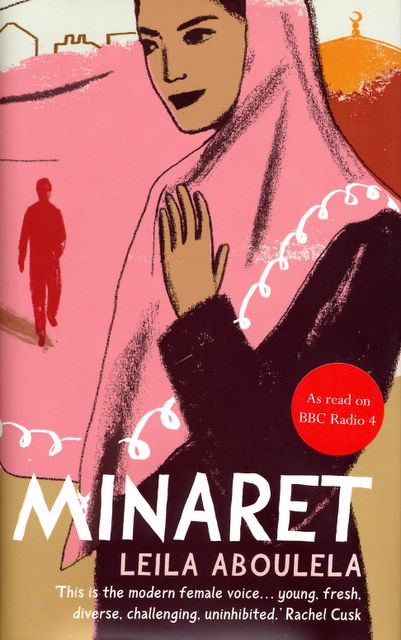
leila aboulela's 'minaret' on BBC


By a quirk of timing, BBC Radio 4's serialisation of Sudanese-Egyptian writer Leila Aboulela's novel "Minaret" was broadcast in the Book at Bedtime slot during the period following the bomb attacks in London on July 7.
It is hard to think of a more appropriate book for this time when understanding between Muslims and wider British society is under huge strain. The serialisation was wonderfully rendered by actress Adjoa Andoh, who brought a lively variety of voices to her reading.

Aboulela has a gift for writing from the interior experience of a Muslim woman, and "Minaret" takes us deep into the life of her Sudanese first-person narrator Najwa. Aboulela approaches the story with her customary grace and skill, and her characters are subtly drawn. We learn what it is that brought Najwa to a renewal of her religious faith, and to the decision to start wearing the Islamic headscarf.

The novel, published recently by Bloomsbury, constantly moves in place and time between Khartoum and London, in a time frame from the mid-1980s to today. The minaret of the title is that of Regent's Park mosque, glimpsed by Najwa as she waits to enter the flat of her new employer Lamya whose small daughter she looks after.

Najwa tells us at the beginning of the novel "I've come down in the world." Born to a privileged family in Sudan, and with her father close to the president, she mixes with a Westernised partying crowd of young people in Khartoum in the mid-1980s. At university there is a mutual attraction between her and Anwar, a young radical who is critical of her father and the family's well-off lifestyle.

Disaster befalls the family after a coup in which Najwa's father is arrested. Najwa flees to London with her mother and twin brother Omar and her father is tried and hung. Najwa's twin Omar, who has long been a worry to her, ends up in prison.

While working for Lamya, Najwa develops a close friendship with Lamya's brother Tamer, which causes her conflicting emotions.

Aboulela was in 2000 the first winner of the Caine Prize for African Writing for the short story "The Museum". She was longlisted for the Orange prize for women's fiction in 2000 with her first novel "The Translator". Her collection of stories, "Coloured Lights", was published in 2001. She has had several dramas performed on BBC Radio.

Aboulela's writing exemplifies the capacity of fiction to touch readers and encourage empathy in ways that straight reporting can never do. Such imaginative leaps are needed now more than ever.

Susannah Tarbush
Saudi Gazette
July 19 2005

Tuesday, July 12, 2005

afolabi of nigeria wins the caine prize


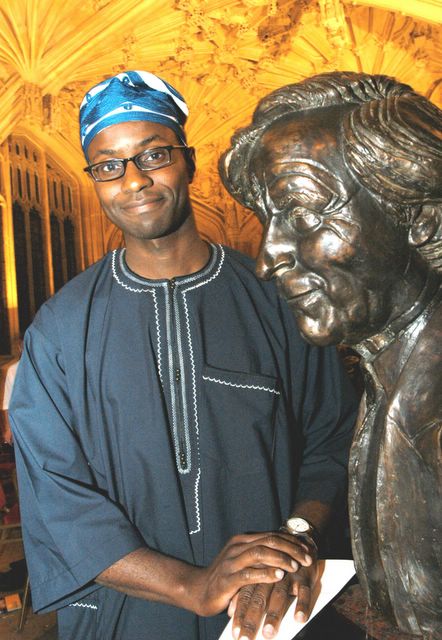
Segun Afolabi with bust of Sir Michael Caine Posted by Picasa

This year's winner of the $15,000 Caine Prize for African Writing, Nigerian-born Segun Afolabi, has had a succession of stories published in some of the most prestigious literary magazines in Britain. They include the London Magazine, Wasafiri, Edinburgh Review and Pretext.

Afolabi won the prize for his story "Monday Morning", published in the spring 2004 issue of Wasafiri. He is set to make a high-profile debut in the book world when Jonathan Cape (part of Random House) publishes his short story collection "A Life Elsewhere." The collection was due to be published next April, but now that Afolabi has won the Caine Prize the publication date may be brought forward. The collection will be followed by Afolabi's first novel, "Goodbye Lucille", due to be published by Cape in early 2007.

The Caine Prize was established in 2000 in memory of Sir Michael Caine, the businessman lover of literature and of Africa who was for nearly 25 years the chairman of the Booker Prize management committee.

The chairman of the judges, Baroness Young, announced that Afolabi had won the prize at the prize-giving dinner held on July 4 in the Divinity School at the Bodleian library, Oxford University.
She described "Monday Morning" as "a very fresh, elegantly written tale which gave us an insight into the perspectives of a family who escaped torture and mutilation in their own country to arrive in London, which for them is a city of misunderstandings and hostility."

When I met Afolabi the day after the won the prize, he told me that he is halfway through the year he has taken off from full-time employment in order to write his second novel. He has been trying to get by on as little money as possible, and the prize has come as a "big boost". Afolabi's past jobs have included working as a subeditor on the Radio Times and as an assistant content producer for BBC digital radio.

Afolabi was born in Kaduna in 1966. His father's work as a diplomat took the family to live in countries including Congo, Canada, Indonesia, Japan and Hong Kong. When Afolabi was nine, he was sent to school in England and later on he read management studies at Cardiff University, Wales.

While at school Afolabi developed a passion for literature, and he continued to read voraciously at university, getting through the entire works of James Baldwin, Toni Morrison, John Steinbeck and others. His favourite writers today also include Caryl Phillips, Jamaica Kincaid, Lorrie Moore and Jhumpa Lahiri.

It was while working in a London bookshop that Afolabi attended evening classes in creative writing at the City Lit Institute, under the tutorship of the poet and novelist Alison Fell. His first published story, "Jumbo and Jacinta", appeared in the London Magazine around 10 years ago. It is a quirky tale about a very overweight husband and his nagging wife, from St Lucia, visiting Niagara Falls in Canada.

One recurring theme in Afolabi's stories is people moving to other countries and "trying to negotiate their lives." His novel "Goodbye Lucille" is set in Berlin, Nigeria and London. The central character is a young Nigerian photographer, and the novel is informed by Afolabi's experience of living in East Berlin where his father was posted in the mid-1980s before the fall of the Berlin Wall. The novel has comedic aspects and "I set it in Berlin partly because it is a very eccentric city."

Afolabi is halfway through the first draft of his new novel, but smilingly fends off enquiries with "I tend not to talk about a work in progress." He is greatly looking forward to attending the Caine writers' workshop to be held in Kenya next year.

Susannah Tarbush
Saudi Gazette
July 12 2005

Friday, July 08, 2005

caine prize at rosl


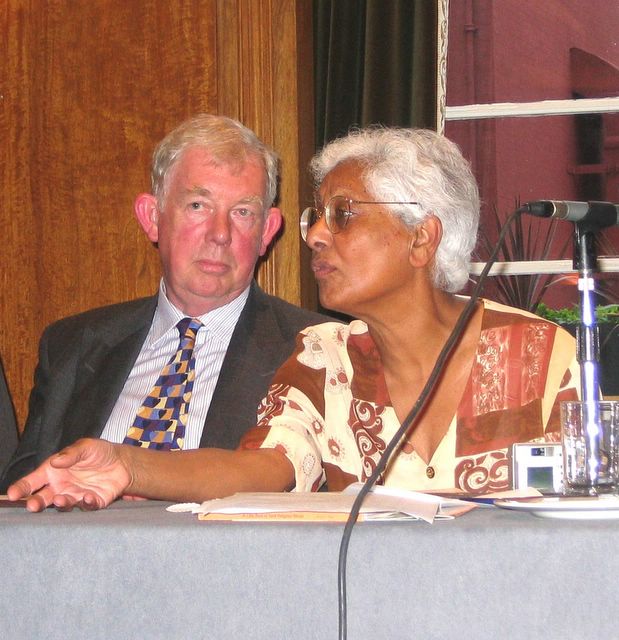
Nick Elam and Muthal Naidoo Posted by Picasa

The final phase of judging for the annual $15,000 Caine Prize for African Writing, during which the shortlisted writers are invited to London for some days, always includes an evening at the Royal Over-Seas League (ROSL). The writers read excerpts from the stories for which they have been shortlisted and there is then a question and answer session.

Nick Elam, administrator of the Caine Prize since its launch in 2000, said at the ROSL last Friday that the ROSL evening is "one of the most delightful of the occasions that we have during the Caine prize programme each year."

With his unflappable manner, friendliness and quick humour, Elam has a way of making the shortlisted writers who have travelled to London feel at home. He said that this year more stories than ever arrived - over 100 - that were suitable for submission to the five judges. This year the judges are chaired by Baroness Young, chair of the arts advisory committee of the British Council.


At question time the Jamaican-born writer Patrick Wilmot set the cat among the pigeons. He said he had read all the stories and was quite impressed by them, and by the quality of the prose. "But if I didn't know you I would have thought it was someone my age who was writing," said the 63-year-old writer, who taught sociology in Nigeria for 18 years and has turned from writing academic textbooks to writing novels. He described the stories as "polished, middle class, quiet, sedate prose… I like your stories, but next time you're writing let's have some fireworks."

The Ugandan writer Doreen Baingana responded: "As a writer you can't really write to demand, we all have our individual styles. Hopefully, some people can appreciate our styles."

Doreen was shortlisted for the Caine Prize last year, and is the first author to be shortlisted two years running. Her story "Tropical Fish" is hardly "sedate" in its subject matter, being the explicit first-person account by a young Ugandan student of her physical relationship with a white man 15 years her senior. Before starting to read, Doreen joked: "I hope you're all over 18!"

The Sudanese novelist Jamal Mahjoub's story "The Obituary Tango" is also a first-person narrative, of a middle-aged Arab man located in London. The man's observations and grumbles, especially about Africans and Arabs in Britain, met with appreciation and amusement.

Nigerian writer Segun Afolabi's story "Monday Morning" explores the efforts of a refugee family to settle in London. South African Muthal Naidoo's story "Jailbirds" depicts the tension between two black women in prison. One of the women was detained for organising a demonstration on the release of Nelson Mandela, and the other is her jailer.

The other shortlisted Nigerian, Ike Okonta, started to write fiction in the early 1990s when, as a political journalist and oppositionist, he was forced to go underground. Okonta explained that he enjoys "the push and pull between fiction and fact in the creative process". The central character in his story "Tindi in the Land of the Dead" is a journalist who visits a village devastated by a strange and terrible illness. The precision and sensitivity with which the story is told may not have "fireworks" in the Patrick Wilmot sense, but the story has a cumulative power and sense of horror.

Susannah Tarbush
Saudi Gazette
July 5 2005

Tuesday, July 05, 2005

serpentine pavilion


Visitors strolling in London's Kensington Gardens during the next three months will notice an intriguing new architectural structure on the lawn of the Serpentine Gallery. The striking building is the latest of the Serpentine's annually commissioned summer pavilions. With its segmented, armoured appearance it resembles something from the animal world.

The Pavilion has been variously compared to an armadillo, a dinosaur, and a cross between a turtle and a millipede. Its impermeable shell (a translucent polycarbonate material on a timber lattice) stops 1.3 metres above the ground, giving the impression that the Pavilion hovers over the lawn.

The Pavilion opened last Saturday and remains in place until early October when it will be dismantled. As well as viewing the Pavilion from outside, visitors can go inside for a cup of coffee or a meal. The pavilion is a café and restaurant by day, and a space for learning, debate and entertainment by night.

The Pavilion was designed by Portuguese architects Alvaro Siza and Eduardo Souto de Moura, together with the deputy chairman of Arup, Cecil Balmond, and his team. Siza is regarded as the greatest living Portuguese architect, and has received many awards. In designing the Pavilion he tried to establish a "dialogue" between it and the contrasting Neo-classical architectural style of the Serpentine Gallery.

The Pavilion is based on a rectangular grid, skewed into a dynamic, curving form. It is constructed of interlocking timber beams. This use of timber gives the structure an organic character, and evokes the relationship between the Pavilion and the richly treed Kensington Gardens.

The first Serpentine Pavilion was designed in 2000 by the London-based Iraqi architect Zaha Hadid. Hadid's structure, which marked the gallery's 30th anniversary, subverted the conventional idea of a tent or marquee.

In the years since, the erection of the Serpentine Pavilion has been a highlight of the London summer. The Serpentine has commissioned some of the world's most distinguished architects to design pavilions. In summer 2001 the architect was Polish-born American Daniel Libeskind.

In 2002 the commission went to the Japanese architect Toyo Ito, and in 2003 to the great Brazilian architect Oscar Niemeyer - who was 96 years old at the time. Last year there was no summer pavilion because the Serpentine was trying to raise money for the highly ambitious scheme of Dutch architects MVRDV to build an artificial grass-covered mountain to completely enclose the gallery. This is MVRDV's novel concept of a summer pavilion, but the project has proved costly and technically challenging and has been postponed until 2006 at the earliest.

Susannah Tarbush
Saudi Gazette 5 July 2005

Wednesday, June 29, 2005

paula cox's palestine prints


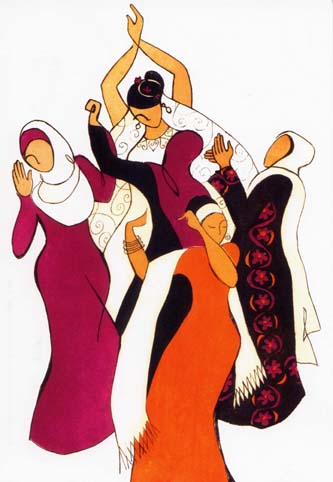
Palestinian Wedding Dance © Paula Cox Posted by Picasa

Unsung Heroines
by Susannah Tarbush

Palestinian women are in a sense the unsung heroines of the extraordinarily difficult circumstances in which the Palestinians find themselves. "Celebrating the Life of Palestinian Women", an exhibition of prints by British artist Paula Cox, pays tribute to their role. The show opened at the Kufa Gallery in West London last Wednesday and runs until 5 July.

Cox was awarded a grant by the Arts Council in spring 2004 to go to Palestine as an artist in residence. She has worked with Amnesty International since 1988 as a painter on human rights, and says her art project in Palestine "allowed me a sensitive insight into the rich but devastated Palestinian culture as I attempt to document the daily lives of women who are the innocent victims of a brutal conflict, whose most basic rights are being eroded by life under Israeli occupation."

As a woman artist she was "able to share a special intimacy with the women from a predominantly Muslim culture. I spent time in towns villages and refugee camps in the West Bank but because of the extremely volatile situation I was unable to visit Gaza."

Cox's pictures, with their eloquent fluid lines, reflect the texture of the women's lives. In some pictures women are engaged in everyday tasks such as harvesting olives and preparing bread, vine leaves and other foods. In others they talk with their friends, pray or dream.

In the caption to the colourful print "Palestinian Wedding Dance", Cox recalls how she and Fatimah bought orange, pink and white carnations to take to Fatimah's friend's wedding celebrations in Bethlehem. The groom's brother was not at the wedding; he is in an Israeli prison and has been adopted as a political prisoner by Amnesty International.

The picture "Percussion of falling olives", an assembly of three images, has as its caption a delightful poem by Cox on these "ancient ancestral trees" and "the sweet bitter smell of olives baking in the hot sun/Shovelled by beautiful strong hands/into hessian sacks, sewn up with a huge needle and string."

In "Stuffed Vine Leaves" women share their secrets as they prepare vine leaves for the Ramadan feast. "Mervat's aunt" depicts a woman from Tulkarem refugee camp bringing delicious date and sesame biscuits, and telling of her work as a volunteer in the Palestine Red Crescent Society.

In "Moment of Peace" a woman gazes out beyond a blue door. "Women sitting in their doorways in the villages and refugee camps often look malnourished by the poverty of their situation" Cox says. "I try to bring to life, with line and colour, the beauty and nobility of these strong, generous people who have had their land and human rights stolen from them."

The exhibition embarks on a tour of Palestine in October, starting in Bethlehem. Cox hopes the exhibition will be shown in Gaza, at A M Qattan Foundation's Centre for the Child. She also hopes that a tour of France, the US and some other Western countries can also be arranged.

Saudi Gazette
June 28 2005

Tuesday, June 28, 2005

Istanbul women's festival


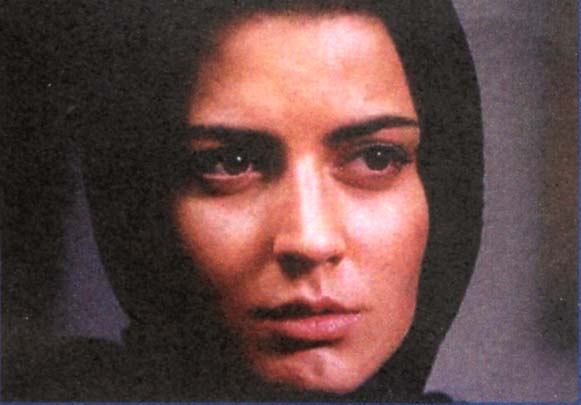
Leila Hatami Posted by Picasa

picture of Haifa Al-Mansour Posted by Picasa

Women of the East
by
Susannah Tarbush

The women's festival held earlier this month in Turkey was a remarkable assembly of Middle Eastern women intellectuals and artists, but it seems to gone largely unnoticed by the British and presumably other Western media. I heard about it only by chance from one of the participants, the Palestinian singer Reem Kelani, who gave an evening concert during the event.

The "Eastern Women" festival took place in Istanbul from 11 to 17 June. Music events were sprinkled liberally through the programme. The opening concert on the first evening was given by Lebanese singer Jahida Wehbe, who is regarded as one of the great classical Arabic singers performing today.

From Iran came the singer Sima Bina. Born in Khorasan, Bina started her singing career on Iranian radio at the age of only nine under the direction of her father Ahmad Bina, a master of Iranian classical music and a poet who wrote many of Sima's early songs. Another Iranian singer, Sussan Deyhim, gave the closing concert of the festival.

Women filmmakers were present in force at the festival. Saudi filmmaker Haifa Al Mansour showed two films, the prize-winning "The Only Way Around," and "Women Without Shadows". The latter film was recently shown privately at the French consulate in Jeddah where its theme of the covering of women's faces in public elicited a variety of reactions.

The Iraqi filmmaker Maysoun Pachachi (daughter of the veteran politician Adnan Pachachi) showed her films "Journey to Iraq" and "Return to the Land of Wonders." Pachachi has lived in London for many years. In 2004 she co-founded a free-of-charge film-training centre in Baghdad.

"Return to the Land of Wonders" documents her return to Iraq with her father after the 2003 war and Adnan Pachachi's work as head of a committee drafting a new constitution. The film shows how Iraqis were trying to survive and to rid themselves of a sense of despair and defeat.

Egyptian filmmaker Hala Khalil showed "The Best of Times", which has won several prizes. The Iranian film actress and director Rakhshan Bani Etemad hosted a film showing, and Iranian actress Leila Hatami also participated in the festival.

Writers at the festival included Hoda Barakat and Iman Humaydan Younes from Lebanon, Iranian writer Shiva Arastui, Iraqi poet Amal Al-Jubouri, Egyptian novelist Miral Al-Tahawi, Syrian poet Lina Tibi and UAE poet Maysoon Al-Saqr.

The festival's opening panel was entitled "Heritage of the Women of the East." There were also panels on music, cinema, poetry and literature.

It is clear from the festival that Middle Eastern women are very active at the new frontiers of the arts. Given the misconceptions about Middle Eastern women in the West, it might be an idea to stage a similar festival, with the addition of Turkish women artists, in London and other Western cities.

Saudi Gazette
June 28 2005

Tuesday, June 21, 2005

sharq magazine launched in london


Why do British Arab men go back to their home countries to find brides rather than marrying Arab girls brought up in the UK? This is one of the topics covered in the first issue of “Sharq”, a new glossy magazine of British Arab Culture.

In her article “Takeaway Bride”, Layla Maghribi argues that only an Arab girl raised in Britain can understand the bi-cultural upbringing of an Arab British man.

She asks: “What is it that our fellow compatriots have on the Arab continent that is sending the men over, away from the local and familiar women?” She blames among other things the laziness of Arab men, who take the easy option, and the snobbishness and unapproachability of many Arab women in Britain.

In their countries of origin, British Arab men are viewed as a “fine catch indeed.” And they may think women back home make “better wives”, and are more likely to be “pure.” But Maghribi says that girls back home could actually have a more “colourful history” than Arab girls in London.

The content of “Sharq” is a mixture of features, interviews, fashion shoots, beauty, travel, regular columns, reviews and listings of forthcoming events. The magazine has an agony Tante, Suhad Jarra, and a Girl About Town, Ranya Khalil.

The cover of the first issue is graced by a photograph of the musician, model and broadcaster Mona Ibellini. The caption reads: “Mona Ibellini: the New Alicia Keys?”

Sharq’s Editor in Chief and Creative Director is Reem Maghribi, who writes in her editorial: “I have had the pleasure of meeting some fabulously talented and generously spirited Arabs over the past few months.”

She mentions among others Isam, Waqas and Lenny, the members of Danish group Outlandish whose hip-hop is inspired by their Honduran, Pakistani and Moroccan origins.

The magazine includes a features by Judith Brown on “The Image of Arabs in the British Media.” The chairman of Arab Media Watch, Sharif Nashashibi, gives a first hand account of the daily ordeal of travelling around Palestine, and also contributes an interview with Dr Yahya Aridi, the director of the new Syrian media centre in London.

There is a review of the play “My name is Rachel Corrie”, based on the life of the American peace activist killed by an Israeli bulldozer in Gaza in March 2003. On a lighter note, in the Dating, Courting & Relationships section four women “tell all about blind dates, arranged marriages, a slapper and a mother-in-law.”

“Sharq” is sold by subscription and at hotels and newsagents in areas of London frequented by Arabs. It is to be welcomed as giving a voice to the new generation of Arabs brought up in Britain, provided it survives the tough challenges involved in establishing a new publication.

Susannah Tarbush
Saudi Gazette June 21 2005

Tuesday, June 14, 2005

sowing seeds of peace


On Thursday June 22, the Curzon Cinema in the Mayfair area of central London is to host the UK Gala Premiere of "Seeds", a full-length documentary highlighting an attempt to reconcile young people from some of the world's hottest areas of conflict.

The film was produced by the Al Madad Foundation, which was founded in 2000 as a UK-registered charity by Faiza Alireza of Saudi Arabia with the support of her daughters Basma and Yasmin.

Al Madad is dedicated to the relief of poverty in the developing world, with a particular emphasis on the welfare of children. It raises financial support for cultural, medical and educational projects.

Guest speaker at the premiere is CNN's chief international correspondent Christiane Amanpour, winner of numerous awards. The film's producer and director, Marj Safinia and Joseph Boyle, will introduce the film and answer questions afterwards. The £50 tickets for the premier include a buffet dinner at Al Sultan restaurant in Mayfair.

"Seeds" is an account of the work of Seeds of Peace, the organisation established in 1993 by author and journalist John Wallach.

Seeds of Peace brings teenagers from regions of conflict together for three weeks every summer at an international camp in Maine. The idea is that through getting to know and listen to each other, the young people will learn mutual respect and the skills needed to make lasting peace.

At the Maine camp teenagers meet those from the "other side" whom they would ordinarily be unable to get to know. They include Palestinians and Israelis, Americans and Afghans, Indians and Pakistanis.

"Seeds" focuses on ten of the 166 teenagers at the camp, and chronicles the often difficult and emotional process of reconciliation from the perspective of the children themselves. As one of the Seeds says: "In order to make peace with your enemy, you have to go to war with yourself."
The film has been part of the official selection at some 30 international film festivals. It was runner up in the Audience Award category at both the Palm Springs and Cleveland film festivals.

The world premiere was as the opening night film at Silverdocs, the documentary film festival of AFI/Discovery Channel.

The project to make "Seeds" first took root in February 2002 after Marj Safinia was invited to a Seeds of Peace fundraiser in New York. She and Joseph Boyle subsequently drafted a film proposal and approached John Wallach - little realising that nine other filmmakers had approached Seeds with similar proposals.

Seeds of Peace gave Safinia and Boyle permission to film, and in just over five weeks they and producer Hana Alireza succeeded in raising more than $70,000 for production. They immediately set off for the camp in Maine, and had just three weeks to tell the story with its dramas and twists of fate.

There have been some glowing tributes to the film. Chris Walny of Detroit Documentary Festival described it as "one of those films that just might change the world." Judy Woodruff of CNN said it is "a spectacular film…truly impressive."

Susannah Tarbush
Saudi Gazette June 14 2005

Tuesday, May 24, 2005

palestinian echoes


Reem Kelani and her ensemble Posted by Hello

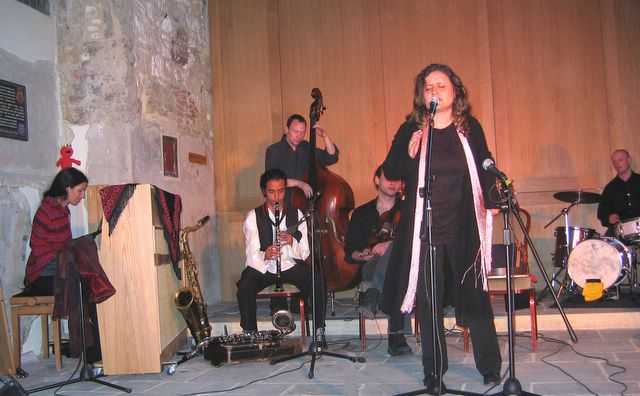
The concert given by Palestinian Reem Kelani and seven musicians in London last Thursday night was an example of synergy and ensemble playing at its best. Each of the musicians is well-established in their own particular musical spheres, and each made a significant contribution in complementing Kelani’s rendering of Palestinian songs.

The venue was St Ethelburga’s Centre for Reconciliation and Peace located in Bishopsgate in the financial heart of the City of London. The small church was badly damaged by an IRA bomb 12 years ago and has been extensively restored.

Kelani first performed at St Ethelburga’s six months ago, and the fact that she has been invited to give a return concert so soon reflects the enthusiasm with which her previous appearance was received.

In introducing the concert, the director of the centre, Simon Keyes, said that the previous Friday the great novelist, critic and painter John Berger had attended an event in his honour at the centre. Berger had “made two remarkable observations. One was he said ‘us’ and ‘them’ are the two most dangerous words in any language, and the other thing was he had just come back from Palestine and said he couldn’t wait to get back there because he had found it such a moving place to be.

“The reason for that, he said, was that more than anyone else in the world, the Palestinians have really learnt to live in the present moment. They have faced up to the most extraordinary, appalling history, but they are here, and they are living now today, and they are really beginning to move forward.”

The concert lived up to it billing as “Middle Eastern Harmonies: an Evening of Music and Laughter with Reem Kelani and Friends.” There was plenty of humour, but at the same time there was much passion and pain in Kelani’s moving delivery of traditional improvisations and settings of contemporary Palestinian poetry.

The musicians included jazz pianist Zoe Rahman and her saxophonist brother Idris, who have emerged as important forces on the British jazz scene. Zoe Rahman has her own jazz trio, and also works with many prominent musicians. Idris Rahman is co-leader of the London-based band Soothsayers which plays jazz, African and Caribbean music.

On violin was Egyptian Sami Bishai and on double bass Oil Hayhurst. Iranian Fariborz Kiani played daff and tombak. Salah Dawson Miller played frame drums, and Patrick Illingworth was on drum kit.

Kelani and the ensemble are now in the process of recording tracks for her first CD, which is due to be released in October.

Susannah Tarbush
Saudi Gazette 24 May 2005

Tuesday, May 10, 2005

the naomi shemer affair

"Even the Song is Stolen"
by Susannah Tarbush

When Israeli composer Naomi Shemer was on her deathbed last year, she made a startling confession to a friend: her song “Jerusalem of Gold”, sung by Israeli forces to celebrate the capture of East Jerusalem in the 1967 war, was derived from the melody of a Basque lullaby.

“Jerusalem of Gold” is not the first composition to be involved in a case of musical plagiarism. For example the late former Beatle George Harrison lost a lawsuit in which he was accused of using the melody of The Chiffons’ 1964 hit “She’s So Fine” in his composition “My Sweet Lord”. But the Middle East political angle has made Shemer’s admission a particularly hot talking point.

“Jerusalem of Gold” was Shemer’s most famous composition, and after the 1967 war it became a sort of unofficial national anthem. Shemer was often asked over the years whether she had plagiarised the Basque melody, but she always angrily denied this. In 2000 in an interview with the newspaper Yedioth Aharonoth, she insisted that the two songs didn’t sound the same at all.

Shemer finally came clean in a letter to fellow composer Gil Aldema written just a few days before she died last June. News of her confession surfaced a few days ago, and Aldema explained to Israeli Army Radio that although Shemer had agreed that her secret should be revealed after her death, he had allowed some time to pass before doing so.

In her letter, Shemer said that in the mid-1960s she had heard a well-known Basque lullaby in the mid-1960s, sung by her singer friend Nehama Hendel.

“In the winter of 1967 when I was working on the writing of ‘Jerusalem of Gold’, the song must have creeped into me unwittingly,” she wrote. “I also didn’t know that an invisible hand dictated changes in the original to me…it turns out that someone protected me and provided me with my eight notes that grant me the rights to my version of the folk song. But all this was done, as I said, unwittingly.”

Shemer told Aldema that she regarded “the whole matter as an unfortunate work accident – so unfortunate that maybe this is what caused my illness.”

A few days after the news of the confession broke, Haaretz newspaper quoted the famous Basque singer Paco Ibanez as saying he had sung sang the Basque melody in question at a performance in Israel in 1962, and perhaps Shemer had heard it then.

Ibanez said his mother used to sing the melody to him when he was small. He recorded it in his volume “Songs I heard from my mother”. As soon as he heard Shemer’s song in summer 1967 he recognised it as his song “Joseph’s Hair.”

He said he was sad to hear of Shemer’s guilt feelings over basing her song on the Basque folk melody and not admitting it. “It is a shame. She had no reason to feel guilty.”

Many Haaretz readers e-mailed messages to the newspaper on the Shemer case. Some of the messages were supportive, and pointed out that classical composers have often used melodies from folk songs. Several noted that the Israeli national anthem Hatikva is based on a melody from Czech composer Bedrich Smetana’s “Moldau”. Others observed that singers such as Bob Dylan and Joan Baez have borrowed folk melodies.

But there were also some more critical comments, with “Arik” from Toronto writing: “Even the songs are stolen…just like everything else …the land you live on….the water…everything.” Others noted that Shemer had become a patron of the settler cause after 1967 and that her song had become the anthem of the settlers.

One Basque wrote he felt ashamed for the use of the Basque lullaby as a war hymn, and he criticised Shemer for stealing Basque folklore for war purposes. Another reader said part of Shemer’s estate should be seized and given to the Basques.

Saudi Gazette, 10 May 2005

Tuesday, May 03, 2005

new issue of Banipal


Banipal: cover picture by the Iraqi Kurdish artist Sadradeen Posted by Hello

Overcoming language barrier
by Susannah Tarbush

One of the pleasures of reading Banipal, the magazine of modern Arab literature, is the opportunity it offers of discovering authors who have through translation overcome the language barrier.

In the spring issue of the magazine, which has just been published, one such author is Algerian writer, journalist and musician Aziz Chouaki who has lived in France since the political upheavals in Algeria in the 1990s.

Banipal carries an excerpt from Chouaki’s novel “The Star of Algiers”, written in French and translated into English by Ros Schwarz and Lulu Norman. The novel was published in English by Graywolf Press, USA earlier this year. To judge by the extract, Chouaki is a fresh, original voice.

While Chouaki is new to English translation, some of the names in the latest issue of Banipal are long-established. From Tayeb Salih, the Sudanese writer, we have the story “If She Comes”, set in an office, translated by Shakir Mustafa.

The Saudi writer, poet and novelist Ali al-Domaini is represented through an extract from his novel “The Grey Cloud: Parts of the Biography of Sahl al-Jabali”. The novel was published in Arabic in Beirut in 1998, and the extract, which is set in a prison, has been translated by Issa Boullata.

Al-Domaini has been in prison in Saudi Arabia since last year. Last week, at a ceremony in New York attended by many prominent American and international authors, PEN conferred a 2005 ‘PEN/Barbara Goldsmith Freedom to Write Award’ on the Saudi author.

Issa Boullata is a writer as well as a translator, and Banipal includes his short story “A Forgotten Gentleman”, which is set in Canada.

There are in all seven short stories in the issue. The story “Wind”, by Tunisian Ali Mosbah, who lives in Berlin, gives a powerful metaphorical account of the effects of winds on the inhabitants of an area of Tunisia.

The poets featured in the issue include Palestinian medical doctor Fady Joudah, who won the $1,000 first prize in the River City writing awards in 2004. Joudah lives in Houston and is an active member of Medicins sans Frontieres. There are also love poems by the Lebanese poet Inaya Jaber.

One of Banipal’s regular sections is Literary Influences, in which a writer tells of the books he or she has read since childhood, and the influences on their work. In this issue the writer is the Syrian Rafik Shami, who lives in Germany. His parents originally came from the village of Malula where the ancient language Aramaic is spoken.

In its section on literary events, Banipal has a report on the awarding of the 2004 Prince Claus Awards, with the principal prize going to Palestinian poet Mahmoud Darwish. Darwish’s eloquent acceptance speech is published in full.


Banipal is at: www.banipal.co.uk

visions of Palestine

Behind the Wall
by Susannah Tarbush

At the Visions of Palestine evening in the Royal Geographic Society last Tuesday, journalist Lauren Booth – half sister of Prime Minister Tony Blair’s wife Cherie – spoke with passion about her recent first-ever visit to the West Bank and Gaza.

The bouncy journalist, who writes, inter alia, for the Mail on Sunday, New Statesman, and Observer, read from the diary she kept on her trip – expressing for example her amazement at the size of Israeli settlements, and her dismay at the sight of the town of Kalkilya surrounded by the so-called security wall and barbed wire, making the Palestinians like foreigners in their own land.

She found Nablus “stunning”, and fell in love with Ramallah, “the Beverly Hills of the occupied territories” where she felt “a lot safer than in the streets of Haringey” (a borough of London known for its guns and street crime). Throughout her trip she was overwhelmed by the hospitality and generosity of the Palestinians.

Visions of Palestine was organised by the Council for Arab-British Understanding and raised funds for four charities. It was chaired by the journalist Yasmin Alibhai Brown, who is a columnist in the Independent, a frequent commentator on radio and TV, and the author of several books.

The 20-year-old Palestinian singer Shadia Mansour, dressed in a traditional embroidered Palestinian dress, added a musical flavour to the evening with her unaccompanied singing.

Palestinian writer Adania Shibli, whose work has been published in literary magazines in the Arab world, read one of her short stories. She has twice been awarded the Young Writer’s Award – Palestine by the A M Qattan Foundation.

British photographer Tom Craig displayed on a screen some of the photographs he took in Gaza while accompanying the actor Daniel Day-Lewis as part of a Medecins Sans Frontieres (MSF) project. Day-Lewis’s article on Gaza and Craig’s photographs were published in the Sunday Times colour magazine a few weeks ago.

During their visit Day-Lewis and Craig saw the work MSF is doing to help traumatised children. Craig’s photographs are full of scenes of rubble and shattered buildings, and of children who have suffered physical and emotional damage. And yet the spirit of the people, especially the children, shines through.

Gaza was a main focus of the evening. The distinguished Gaza-born artist Laila Shawa, who has lived and worked in London for some years, presented some of her striking images based on the children and graffiti of Gaza.

Dr Eyad El-Sarraj, the Palestinian psychiatrist who is founder and medical director of the Gaza Community Mental Health Programme, gave a humanitarian discourse on how a solution to the conflict can be achieved once Israel starts to see Palestinians as equal human beings and treats them as such.

Israeli-Dutch filmmaker Benny Brunner showed extracts from two films. One was his latest documentary, “The Concrete Curtain”, in which he looks at the impact of Israel’s separation barrier on Palestinian life in Jerusalem.

The other film was Tama Goldschmidt’s “Qalandiya Checkpoint Report” which conveys the frightening crush of Palestinian women and children struggling to get through the turnstile which is the entrance to their refugee camp while Israeli soldiers look on.

At the end of the evening a visibly moved Yasmin Alibhai Brown told the Palestinians: “I am absolutely humbled by your struggle and what you go through. I salute your courage and your spirit.”

Saudi Gazette, 3 May 2005

Arab blogging catches on

Blogging Their Way
by Susannah Tarbush

If anyone wanted proof of the increasing attention being paid in the West to the views of Arab bloggers, they need only have listened to last Sunday’s edition of the BBC radio current affairs series Broadcasting House.

In his report from Cairo on the political situation in Egypt, the BBC correspondent chose to interview not a mainstream analyst or politician, but a prominent blogger known only as “Big Pharaoh”.

Big Pharaoh is just one of a growing band of Arab bloggers whose blogs are widely followed and commented on by other bloggers and the media. Blogging in the Arab world has come a long way since Iraqi “Salam Pax” became the first internationally known Arab blogger after starting his blog in September 2002.

Word of Salam Pax’s blog spread quickly around the internet, and he gained a huge readership. He was eventually invited to be a columnist for the London-based Guardian newspaper, and Atlantic Books and Guardian Books jointly published the book of his blog.

Now Salam Pax makes regular film contributions to BBC TV’s Newsnight, and in February he won the innovation award from Britain’s Royal Television Society.

Arabs, particularly members of the techno-savvy younger generation, have become enthusiastic users of services such as Blogger and Live Journal through which a blog can be set up free of charge. The blogger can disclose as much or as little about their identity as they wish, which increases the sense of freedom in expressing their views in their online diaries. But at the same time the use of pseudonyms can create suspicions about who is “really behind” a particular blog.

The number of Iraqi blogs has mushroomed over the past two years, and they play a unique role in giving readers an insight into what life is like in different parts of the country, at a time when it has become very difficult for Western journalists to get around.

There are sizeable blogger communities in a number of other countries, such as Lebanon, Bahrain, Kuwait, Jordan and Egypt. Sites such as Jordan Planet and Bahrain blogs have links to numerous blogs.

The importance of blogging in encouraging freedom of expression has led Reporters sans Frontieres (English name Reporters Without Borders) to organise the Freedom Blog Awards in partnership with Deutsche Welle.

Sixty blogs have been chosen divided into six geographical categories, and internet users can vote by the closing date of 1 June, with the results announced two weeks later.

One category is devoted to Iranian blogs, and no fewer than 21 of the 60 blogs up for voting are in Farsi. In the Middle Eastern and African category, there are eight Arab blogs - three of them in Arabic, three in English and two in French. There are two blogs from Bahrain, two from Egypt and one each from Morocco, the UAE, Tunisia and Iraq.


Saudi Gazette, 3 May 2005

Sunday, May 01, 2005

waiting for mordechai


© Jenny Morgan


pro-Vanunu demonstrator with gag Posted by Hello


Waiting for Mordechai
by Susannah Tarbush

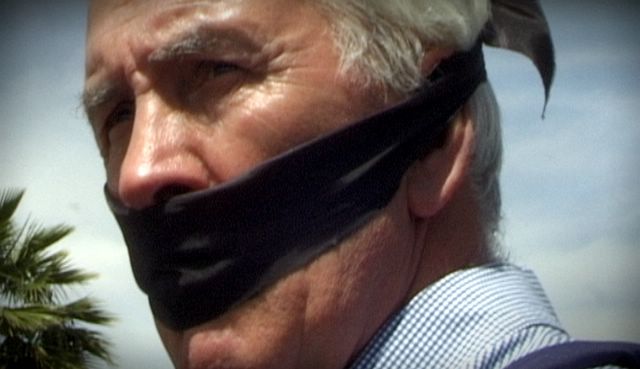
The tense and drama-filled days surrounding the release of Israeli nuclear whistleblower Mordechai Vanunu from prison last April are the focus of “Waiting for Mordechai”, the latest film by London-based filmmaker Jenny Morgan.

Morgan filmed, directed and produced “Waiting for Mordechai”, which follows a group of international campaigners who arrived in Israel a few days before Vanunu’s release from Ashkelon prison on 21 April. She brings humanity, integrity and the eye of an artist to her 30-minute film.

The campaigners fought during Vanunu’s 18 years in prison (11 ½ of them in solitary confinement) for his release, and for a nuclear-free Middle East. In London, they held a weekly vigil outside the Israeli Embassy from 1992, and organised various fund-raising events.

“Waiting for Mordechai” had its first screening at London International Film School in Covent Garden in early February, and was shown on 21 March at a meeting in the House of Lords organised by the Campaign to Free Vanunu. It will be screened in West London on 12 April at a meeting organised by the Palestine Solidarity Campaign.

The campaigners were harassed by security personnel when they landed in Israel. Among 11 people delayed at the airport were British actress Susannah York and Liberal Democrat MP Colin Breed.

On the day of Vanunu’s release, the campaigners joined the crowd outside the prison. Many in the crowd were extremely hostile to Vanunu. Some hoped he would be killed, and posters of him were set alight.
Vanunu’s release was not the end of his ordeal. The film records Vanunu’s brother, Meir, learning shortly before his release that he was to be subject to tough restrictions, including bans on leaving Israel and speaking to the media.

Now Vanunu is facing trial, accused of violating some of the restrictions. The first court hearing will be held on 6 April.
An international delegation is travelling to Israel on 16 April to mark the first anniversary of Vanunu’s release, and to support him over his trial. The coordinator of the British Campaign, Ernest Rodker, told Saudi Gazette that the delegation will try to go to Dimona nuclear reactor where Vanunu worked, and where he secretly took photographs. “It is very difficult to get permission, but we hope to get to Dimona if we can,” he said.

The final scenes of the film (shot by Adeline O’Keeffe) show Vanunu after his release in the guest house at St George’s Anglican cathedral in Jerusalem where he has lived ever since (he had converted to Christianity before his arrest). He was recently elected rector of Glasgow University, Scotland.

At the end of the film Vanunu says:. “The Israel government continue to pursue me, don’t want to let me go free after 18 years. I don’t have any more secrets, so the Israeli government should realise this case is over, dead – they should let me go.”

The film is available on DVD and video, and clips can be downloaded, from the London-based distributor Journeyman Pictures at: http://www.journeyman.tv/

Saudi Gazette
5 April 2005

©Jenny Morgan


anti-Vanunu demonstrator burns poster Posted by Hello

Tuesday, April 26, 2005

caine prize shortlist


shortlisted writer Jamal Mahjoub


Caine Prize shortlist announced

The shortlist for this year's Caine Prize for African Writing, announced last week, includes the Sudanese-English writer Jamal Mahjoub. Mahjoub is the author of five novels including the acclaimed Travelling With Djinns published in 2003.

Although the Caine Prize was in 2000, its first year, won by Sudanese-Egyptian writer Leila Aboulela for her story The Museum, very few writers from Arab Africa have made the shortlist since then, so Mahjoub's appearance is particularly welcome.

The shortlisted writers will be invited to London for a round of events related to the prize, and on 4 July the winner will be announced at a celebratory dinner at the Bodleian Library in Oxford.

The $15,000 prize is awarded for a short story by an African writer, published in English, of between 3,000 and 15,000 words. Mahjoub is shortlisted for the story The Obituary Tango, published in the special summer 2004 20th anniversary issue of Wasifiri magazine.

Wasifiri's spring 2004 issue is the source of another shortlisted story, Monday Morning by the Nigerian S A Afolabi. The Nigerian Helon Habila won the Caine in 2001 and Nigerian writers have often featured on the Caine shortlist. They include also this year Ike Okonta, whose story Tindi in the Land of the Dead was published in Humanitas, the journal of George Bell Institute, Queen's College of Birmingham, England.

For the first time, a writer is shortlisted for the second year in a row. She is Doreen Baingana of Uganda, whose story Tropic Fish appeared in African American Review in 2003. The fifth shortlisted writer is South African Mutual Naidoo for the story Jailbirds from Botsotso, Botsotso Publishing 2004.

Baroness Emma Nicholson established the Caine Prize in memory of her late husband, Sir Michael Caine, who was the former chairman of Booker plc and Chairman of the Booker Prize management committee for nearly 25 years. Baroness Nicholson is the president of the Council of the Caine Prize.

The chairman of this year's panel of judges, Baroness Lola Young, a member of the House of Lords, said: "The entries for this year's Caine Prize for African Writing are a rich mixture - everything from folk to urban grit. The shortlist encompasses a variety of styles and perspectives and represents a really good read."

The other judges are Professor of English at Howard University in the US Victoria Arana, Sri Lankan novelist Romesh Gunesekera and senior lecturer in African Literature at the School of Oriental and African Studies, London University, Dr Nana Wilson-Tagoe.

Susannah Tarbush
Saudi Gazette April 26 2005

shariah TV

Saudi Gazette 26 April 2005

Young, British and Muslim
by Susannah Tarbush

In recent days Channel 4 has been screening daily one-hour programmes in the Shariah TV series, in which young British Muslims discuss with scholars issues of particular relevance to them. This is the second series of Shariah TV, and in the run-up to the general election one might have expected it to generate interest among non-Muslims also.

After all, there is constant media speculation over how Muslims will be voting on 5 May, and the decisive role they could play in deciding the result in certain marginal seats. At the same time a vocal minority of Muslims has resorted to disruptive tactics to try to discourage Muslims from voting at all.

So it was disappointing to find that Channel 4 had pushed the series into a graveyard slot beginning at five minutes past midnight.

In the programmes a studio audience of young Muslims poses questions to a panel of three Islamic scholars, with a different audience and panel for each of the eight programmes. The presenter is So Rahman, who was born in Chester England and has won various TV awards.

The series shows that young British Muslims are a more diverse and open-minded group than they are often portrayed in the media. Some of the women wear hijab, others are in casual clothing. Some of the men are in traditional Islamic garb and headdress.

The exchanges between the young people and the scholars give a flavour of the debates taking place between Muslims in Britain and in the wider world. Among the subjects tackled in the series are the clash of civilisations, the environment, art and culture, women and families, Islam in the modern world, and what it is to be young, British and Muslim.

The first programme, on politics and leadership, considered whether Muslims in Britain should participate in political activity, and what form such participation should take.

The panellists were Timothy Winter, a Cambridge lecturer and convert to Islam, the principal of the Muslim College Dr Zaki Badawi and Professor Tariq Ramadan, who teaches philosophy and Islamic studies in Switzerland, at the College of Geneva and the University of Fribourg.

The panel disagreed with those who thought Muslims should not vote in non-Muslim Britain, and said that, on the contrary, voting is a duty and maybe an obligation. Asked if political activism is a form of jihad, the panel said voting, protesting, campaigning and working to make the world better are all forms of jihad.

Should Muslims become involved in secular political parties? The panel considered that although obeying the party whip could be a problem for a Muslim MP, it is worth becoming involved and inserting Muslim values into policies and political culture.

When asked if the Shariah can guide Muslim as to how to vote, the panel said Muslims should look at the ethics of those for whom they vote. “Consider general principles, such as social justice and human rights. Don’t ask your imam how to vote!”

british book awards

Saudi Gazette 26 April 2005

Commercial Considerations Overtake Literary Merit
by Susannah Tarbush

The British Book Awards held last Wednesday at the Grosvenor House Hotel, and screened on Channel 4 TV two days later, lived up to their claim of being “the Oscars of the book trade” and the tables were packed with literary and other celebrities.

But at the same time the glitzy gathering, held annually since 1990, was disconcerting proof of the extent to which commercial considerations now dominate the publishing world . When the novel “The Da Vinci Code” by American author Dan Brown won the Book of the Year award, this was more for its phenomenal sales, 2.4 million paperback copies in the UK alone, than for any literary merit.

And unlike the annual televised Man Booker prize ceremony, where each shortlisted novel is discussed before the winner is announced, the British Book Awards whisked through the shortlisted and winning books at such speed that no in-depth assessments of books were given.

The husband and wife TV presenter couple Richard Madeley and Judy Finnegan hosted the event. The couple have had a dramatic impact on book sales since moving from ITV to Channel 4 in 2001 to host the daily Richard & Judy Show. They have attained a success with their book club comparable to that of the Oprah Book Club in the US.

The winners of the 12 awards were presented with giant gold pen nibs, which have earned the awards the nickname of The Nibbies. There was also a lifetime achievement award, won by wheelchair-bound 82-year-old John Mortimer, creator of the fictional lawyer Rumpole. Mortimer’s Hollywood actress daughter Emily had flown over from the US to present him with the award

The evening was particularly rewarding for novelist David Mitchell. His novel Cloud Atlas, which was beaten in last autumn’s Man Booker prize by Alan Hollinghurst’s The Line of Beauty, won the Literary Fiction award.

Cloud Atlas also won the Richard & Judy Best Read of the Year prize. This prize was voted for by viewers of the Richard & Judy Book Club.

There was a poignant moment when footballer Paul Gascoigne stepped up to receive the award for Sports Book of the Year for his book Gazza – My Story. The former tearaway, whose book describes a hell of drink, drug and relationship problems, was a shadow of his previous self. In a tearful acceptance speech he spoke of the depression from which he is suffering.

Actress Sheila Hancock received the Reader’s Digest Author of the Year award for The Two of Us, her memoir of her marriage to actor John Thaw. Thaw, best known for his TV role as Inspector Morse, died of cancer in 2002.

This year’s awards saw the launch of the new Decibel Prize, supported by the Arts Council, for the writer of African, Caribbean or Asian descent who has made the most important contribution to the literary scene during the past year. The winner was Hari Kunzru, author of the novels Transmission and The Impressionist.

Do black or Asian British writers really need a special prize? There is something rather patronising and politically correct in arguing that they do - especially given their success in winning mainstream literary prizes. Think of Andrea Levy, Hanif Kureishi, Zadie Smith, Caryl Phillips, Ben Okri, Aamer Hussein and Monica Ali among others.

Thursday, April 21, 2005

london tries to be tokyo

radio addict

Christopher Baily, December 2001

I am a radio hypnotic
The voices of experts
Scientists, doctors, politicians
Spiral into the room
Making a sort of
Aural fog
In which I swim like
A hump-backed whale.

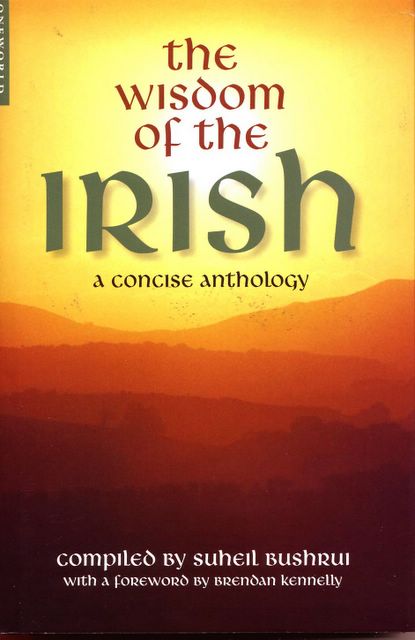
bushrui on Irish wisdom


Original of review published in
Al-Hayat newspaper in Arabic translation on 20 April 2005


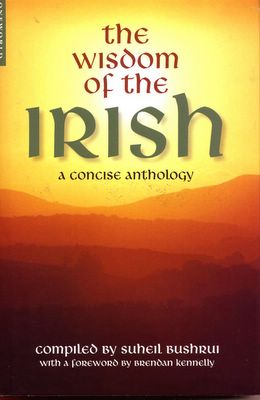
The Wisdom of the Irish: A Concise Anthology
Compiled by
Suheil Bushrui
Oneworld Publications, Oxford, England
200 pages

review by Susannah Tarbush

At first sight, it might seem surprising that the anthology “The Wisdom of the Irish: A Concise Anthology”, which was published recently by Oneworld Publications of Oxford, England, was compiled by a Middle Eastern rather than an Irish or European scholar.

But the scholar in question is the renowned author and literary critic Professor Suheil Bushrui, who is widely regarded as the leading translator and interpreter of Anglo-Irish literature in the Arab world, and who was from 1985 to 1988 the chairman of the International Association for the study of Anglo-Irish Literature.

The famous Irish poet and media personality Brendan Kennelly writes in his foreword to the anthology: “As an Arab, he enjoys and explores a special perspective on Irish culture. Sometimes, an interested outsider can see things more clearly than an impassioned insider. And it is precisely that fresh, detached perspective, together with a deep knowledge of Irish life and literature, that makes this book of wisdom such an intellectual and emotional experience.”

Professor Bushrui was the first Arab national to be appointed to the Chair of English and Anglo-Irish literature at the American University of Beirut, and his publications on Irish literature include critical studies of W B Yeats, John Millington Synge, James Joyce and Samuel Beckett.

He currently holds the Bahai Chair for International Development and Conflict Management at the University of Maryland, and describes himself as “an adopted son of Ireland”.

Kennelly, who was for 30 years until his recent retirement professor of Modern Literature at Trinity College, Dublin, describes “The Wisdom of the Irish” in his foreword as a book that “readers will return to again and again because it is full of verbal jewels that shine in the darkness of the heart and mind.”

Although the book’s subtitle is “A Concise Anthology”, its 200 pages contain an extraordinarily rich assembly of words of wisdom from more than 125 Irish figures – among them poets, novelists, playwrights, philosophers, politicians, statesmen - plus traditional verse, proverbs, songs, blessings and prayers.

Some of the extracts were written in English, others are translated from the Irish language. They range in time from the distant past to contemporary voices including that of the Nobel Prize-winning poet Seamus Heaney.

The book is a tribute to the contribution the Irish have made to the thought and culture of the world, quite out of proportion to the island’s modest size, and its small and scattered population.

Among those famous sons and daughters of Ireland who are represented in the anthology, in some cases with several quotations, are W B Yeats, Samuel Beckett, George Bernard Shaw, Jonathan Swift, Richard Brinsley Sheridan, J M Synge, Oscar Wilde, George Berkely, Edmund Burke, Oliver Goldsmith, Patrick Kavanagh, Seamus Heaney, Brendan Behan and the cultural champion Lady Gregory. From the patron saint of Ireland, Saint Patrick, we have a number of passages including moving lines from “The Deer’s Cry.”

But Bushrui has also included thinkers and writers who may be less known to the general readership. And then there are those many people whose names are unknown but whose words echo down to the present day in their songs, verses and proverbs.

Bushrui’s passion for the study of Irish literature was first kindled by the book “The Genius of Ireland” by George Townshend, published in 1930. This “became a sacred book for me and led me to discover through the study of Irish literature and civilisation a whole universe of learning, not of discursive reason but of the Imagination. I entered the world of a great living mystery in which all things spoke of unity.”

Bushrui pays tribute to the late poet and literary scholar Kathleen Raine: “My ‘Ireland’ is not the Ireland of historians, of literary critics, of political scientists, of archaeologists, of folklorists, or of anthropologists: my Ireland is that Ireland of the Imagination which my friend Kathleen Raine described…”

It was this “landscape of the heart” that spoke to him when he first visited Ireland. “It was Holy Ireland, her spiritual tradition and perennial wisdom that captured my imagination.”

Professor Bushrui first visited Ireland in 1960 as a founding scholar of the first International Yeats Summer School, which has been held every year since. “In the West of Ireland, particularly in the Yeats Country around Sligo, I found my true spiritual home.”

The Institute of Anglo-Irish Studies in the English Department at the American University of Beirut undertook valuable work in English and Arabic. For example in 1970 the Institute undertook the first translation of W B Yeats’s poetry into Arabic, “Shai’un min Yeats.” In the same year, “Images and Memories: a Pictorial Record of the Life and Works of W B Yeats”, edited jointly by Professor Bushrui and J M Munro, was published by Dar al-Mashreq.

In 1971 the Institute organised a John Millington Synge Centenary Exhibition and two books were published - one in English, “Sunshine and the Moon’s Delight”, edited by Bushrui, and the other in Arabic, “Shai’un min Synge.”

Bushrui published the “International Companion to the Poetry of W B Yeats” in 1976. In February 1982 there was a four-day James Joyce Centenary Commemoration, and publication of “James Joyce: An International Perspective; Centenary essays in honour of the late Sir Desmond Cochrane” edited by Bushrui and Bernard Bernstock. The Arabic volume “James Joyce”, a study and selection of prose and poetry translated by Bushrui, was also published.

In the introduction to “The Wisdom of the Irish” Bushrui gives an enlightening account of the relationship between Ireland’s turbulent history and its literature, and highlights the importance of the Irish literary renaissance in the late 19th and early 20th centuries. This renaissance included translations from the Irish Gaelic language into English, and it also expressed a vision of national unity and religious amity in a new language, ‘Anglo Irish’.

Professor Bushrui has assembled the anthology with a great deal of thought and sensitivity. The book is different from a conventional “book of quotations”, and
rather than organise the quotations by for example author, or chronologically, Bushrui has organised them into six main thematic chapters; Art and Literature; Ireland and her People; Divine Life; Ethics; Daily Life, and Forging a Nation. Each chapter is further subdivided into sections.

The chapter headings and the sections reflect Bushrui’s sense of what is most valuable in the Irish heritage, literature and life. Under Daily Life for example we have sections on men and women; love and romance; family and nation; beauty and truth, and life and death. Rather than clutter up the words of wisdom with footnotes and details of dates and background, Bushrui has preferred to let the selections largely speak for themselves.

Given the Irish appreciation of the ability to express the funny side of life, it is appropriate that there is a section on wit and humour. As J M Synge wrote: “Of the things which nourish the imagination humour is one of the most needful, and it is dangerous to limit or destroy it.” From Sheridan’s play “The School for Scandal” comes: “Wit loses its respect with me when I see it in company with malice.”
From Brendhan Behan we have: “There’s no bad publicity except an obituary.”

Bushrui has over the years come to know personally many Irish writers and thinkers, and the first quotation in the anthology comes from Samuel Beckett, who said in conversation with him: “The word is immortal. The word continues. What has helped me to continue is my faith in the word. And if the word comes to an end, everything comes to an end. The word is an anchor.”

Beckett also told Bushrui: “The work is finished. I am both happy and sad. It is a strange feeling. Others discover in my writing a secret of which I am unaware. It is a secret which is hidden from me. Many people come to see me, and I am the only one who does not know why.”

Bushrui’s friend Gearoid O Clerigh, an Irish ambassador who served in the Arab world, wrote to him in a letter: “To be sure I do not deny that imagination can lead the intellect astray but I cannot conceive of an appreciation of beauty without a cultivated imagination.”

Bushrui has very positive memories of his meeting with President Eamon de Valera, then in his late eighties, in summer 1971 when he presented him with the book “Images and Memories: A Pictorial Record of the Life and Work of WB Yeats” on behalf of the American University of Beirut.

Bushrui writes: “It seemed to me then, as if does now almost thirty-four years later, that I was in the presence of a deeply religious and spiritual man. There was something mystical in him; he was a teacher in every sense of the word, but above all I saw him as the father of the nation.”

“The Wisdom of the Irish” includes several quotations from de Valera. In 1918, while imprisoned by the British, he wrote: “Silence is preferable to mutilated statements”. In 1942 he wrote: “To partition the territory of an ancient nation is one of the cruellest wrongs that can be committed against a people.”

Many of the poems in the anthology sing of the love of Ireland – the “Emerald Isle” - and are enormously evocative of the mysterious ancient countryside, the sea, the mountains, the spirit of place. Katherine Tynan writes: “Magical country, full of memories and dreams,/My youth lies in the crevices of your hills…” An Irish blessing says: “Ireland, it’s the one place on earth/That heaven has kissed/With melody, mirth/And meadow and mist.” People the world over know at least the first line of the traditional Irish song “When Irish eyes are smiling”.

The question of the Irish language has a section of the book to itself. Thomas Davis wrote: “A people without a language of its own is only half a nation…A nation should guard its language more than its territories…To lose your native tongue, and learn that of an alien is the worst badge of conquest – it is the chain on the soul.”

The anthology includes numerous quotations from WB Yeats, and also from his painter and lawyer father John Butler Yeats. In a letter to his son, John Butler Yeats wrote: “A man is born solitary and dies solitary. Only the poet lives solitary.”

John Butler Yeats also had some wise words on marriage: “I think a man and a woman should choose each other for life, for the simple reason that a long life with all its accidents is barely long enough for a man and woman to understand each other; and in this case, to understand is to love. The man who understands one woman is qualified to understand pretty well anything.”

On the subject of literature, W B Yeats wrote: “Literature is, to my mind, the great teaching power of the world, the ultimate creator of all values, and it is this, not only in the sacred books whose power everybody acknowledges, but by every movement of imagination in song or story or drama that height of intensity and sincerity has made literature at all.”

Professor Bushrui’s book will broaden the cultural and literary horizons of its readers, and is likely to stimulate many of them into exploring further the literature and thought of the Irish. The book is also likely to have a particular resonance in the Middle East, where readers will identify with the mixture of poetry, political turmoil, passion, humour and love of language that is characteristic of the Irish.
Wednesday, April 20, 2005

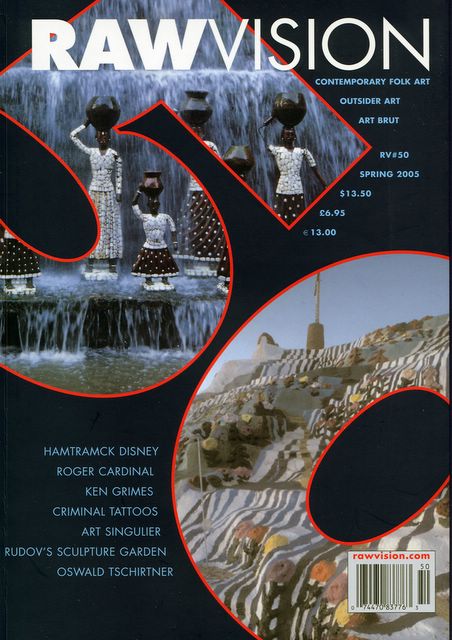
raw vision


50th issue of Raw Vision Posted by Hello

Saudi Gazette
19 April 2005
by Susannah Tarbush

The magazine Raw Vision celebrated the launch of its 50th issue a few evenings ago with a party in a marquee at the Serpentine Gallery in London’s Kensington Gardens. The weather was stormy, with lightning and hail visible through the marquee’s transparent walls, but this somehow suited Raw Vision, which is devoted to the “Outsider Art” movement known also as “Art Brut”, “Visionary Art” and “Contemporary Folk Art.”

The party also marked the launch of American writer Rich Shapero’s novel “Wild Animus”, published by Too Far. The novel tells of a man’s adventures finding himself in the wilds of Alaska.

Raw Vision is edited by John Maizels, who recalls in the 50th issue how, when he and his colleagues published the first edition of just 1,000 copies in 1989, they had little idea that it would still be going after all these years, nor that what was then “an almost secret, covert art” would become so well known and supported.

Maizels points out that during the life of Raw Vision, important specialist museums and collections of Outsider Art have been established in the US and across Europe, and only Britain stands out as “a sad exception to this”.

One has only to glance at the pages of Raw Vision to see that Outsider Art has become a lucrative business. There are numerous full-page advertisements for galleries and exhibitions in different countries.

The content of Raw Vision shows the extent to which Outsider Art is an international movement. The 50th issue has news of the 80th birthday of Nek Chand, the creator and director of the remarkable Rock Garden of Chandigarh, India, with its thousands of sculptures of animals and people made from materials such as porcelain, concrete and stone.

The issue also has an interview with Anna Yarkina, deputy director of the Moscow Museum of Outsider Art. The museum was founded by a retired railway worker, Alexei Ivanovich Rudov, who was advised by his doctor to take up creative expression to improve his health, and started to make sculptures from branches, wood and tree mushrooms.

Another outsider artist, Ukrainian Dmytro Szylak, has built “Hamtramck Disneyland” in Detroit, assembled from toys and other items, which Raw Vision describes as “one man’s personal magical kingdom.”

Outsider Art has a wide definition, and the article Criminal Skins reveals the elaborate, coded world of tattoos sported by Russian criminals.

Maizels says: “Outside Art has proved to anyone with an open mind and open eyes that contemporary art does not have to be unimaginative or derivative, meaningless or boring. Outsider Art shows that art can have deeply personal meaning, be bold and truthful, exciting and moving; that it can be visionary and awe-inspiring.”

Tuesday, April 19, 2005

edgy postcards

Remember the film Postcards from the Edge?
Well, how about some edgy postcards - from Sharjah Biennial

Saudi Gazette
19 April 2005

Postcard for Posterity
by Susannah Tarbush

A few days ago I received in the post a package containing 26 postcards. It turned out that they from the “postcard project” curated by Noor Al-Qasimi as part of the 7th Sharjah International Biennial which runs until June 6.

The project continues Al-Qasimi’s “ongoing love of postcards”. She says: “I wanted to promote the Biennial and at the same time create an exhibition in itself that can stand alone.” There is currently talk of exhibiting the postcards in New York and possibly in San Francisco.

The theme of this year’s Sharjah Biennial is “Belonging”, and the postcard project was inspired by a line from James Joyce’s Ulysses: “He rests. He has travelled.”
The postcards are mainly by Middle Eastern artists, and most relate to particular cities.

The enigmatic images on the postcards raise questions about the stories and people behind them. They are suggestive of a restless, self-aware young generation of artists with a well-developed sense of irony.

A few of the cards carry words rather than pictorial images. Noor al Qasimi’s single-line card reads “i can tell you many stories sweetheart”. The London-based American writer and editor Malu Halasa vividly depicts in words her New York bike route.

Lebanese artists are well represented. Rana Salam’s “bridal dresses for sale” in Damascus, sub-captioned “material pure polyester”, has an eerie atmosphere with its floating veils and frozen made-up faces.

Another wedding dress, this time in pink, features in Zena El-Khalil’s exuberant “beirut is pink”, a collage of images of flowers, religious symbols and portraits of Shiite political and religious figures.

From Christine Tohme there is an identity card across which is printed in red Arabic letters “Sejil ana Arabi” – echoing the line “Record, I am an Arab” from Palestinian poet Mahmoud Darwish’s defiant poem “Identity Card.”

Nadine Touma portrays a dish of the sweet m’hallabeya with the word “Sharjah” written across it in white, while Samir Sayegh adopts a calligraphic approach towards the emirate’s name.

Gilbert Hage’s photograph of three male figures on rocks in front of a wide expanse of sea is from his Beirut series. The video artist and curator Akram Zaatari has provided a video still entitled “Shou bhebbak (how i love you)”.

Photographer Lara Baladi’s view from her Cairo rooftop shows a satellite dish from which dangles a pair of women’s legs in platform heels. Egyptian art photographer Youssef Nabil’s contribution is a self portrait taken in the Brazilian city of Paraty.

Several of the postcards are by Iranian women. From Shirina Shahbazi there is a photograph of a man in Shanghai from her series “Real Love”.

Shirin Aliabadi’s picture of Iranian women in a car is from the work in progress, “Freedom is Boring, Censorship is Fun.” From Parisa Damandan’s book “Portrait Photographs from Isfahan: Faces in Transition 1920-1950”, there is a studio photograph of a woman in a man’s pinstripe jacket and long white skirt, taken by Gholamhossein Derakhshan.

Hengameh Golestan’s postcard is a photograph of three women in Islamic dress paragliding in the Alborz mountains. The artist Ghazel has produced a “wanted (urgent)” poster of a Middle Eastern woman, her eyes covered by a black strip, who offers marriage to an II (illegal immigrant) man, “all origins/religions possible”.

Palestinian Emily Jacir’s postcard comprises a list of the friends on her Ramallah cell phone. There is something poignant about the list in a part of the world where existence is fragmented and fragile.

Tuesday, April 05, 2005

middle east myth machine


Saudi Gazette
5 April 2005
by Susannah Tarbush

In his new book, published by Saqi of London, Professor Fred Halliday tackles head-on some of the oft-repeated statements about the Middle East that he considers to be myths. Among the myths he identifies in “100 Myths about the Middle East” are:

- The Middle East is, in some fundamental way, “different” from the rest of the world and has to be understood in terms distinct from other regions.

- The Middle East is a region contaminated by hatred and solemnity; its people have no sense of humour.

- The crisis of the Arab world can be explained by the negative impact of the conflict with Israel on democratisation and social change.

In debunking these and other myths in his pithy book, Halliday, the Professor of International Relations at the London School of Economics, freely wields words such as “nonsense”, “fiction”, “grotesque distortion” and “preposterous”. He tackles most of the myths in just one or two pages of tight argument.

Among the other myths Halliday demolishes are: There can be no “anti-Semitism” in the European sense in the Middle East because both Arabs and Jews are Semites; the ‘West’ has, for centuries, been hostile to ‘Islam’; the US, backed by the UK, invaded and occupied Iraq in 2003 to gain control of Iraqi oil; we live in an age when international relations are dominated by a ‘clash of civilisations’; the new cause of conflict in the Middle East is going to be water, with the prospect of ‘hydrowars’, ie wars about water, looming in the future.

Not every reader will agree that all Halliday’s targets are myths. Some of the statements he seeks to discredit appear to have at least a large grain of truth in them that makes it hard to dismiss them completely.

The tone of Halliday’s book reflects his impatience with his years of encountering accepted “wisdom”, flabby thinking and unchallenged assumptions. As well as deconstructing 100 myths, Halliday provides a handy 63-page “Glossary of Crisis”, with punchy and witty definitions of everything from battlespace, and corkscrew journalism to groupthink, halal hippie, nuclear souq and “perceived liberal bias”.

Halliday writes in his introduction that he intends to challenge the appearance that the Middle East is a region where the past, political, national and religious, holds sway, while a closer examination shows this is far from being the case.

Another aim is to challenge the assumption that in looking at religions or cultures we are looking at separate, discrete and monolithic entities. Cultures have interacted with each other over time.

Halliday also has an ethical mission, in encouraging a critical distance from the identification with history. “Far from the world being swept by a wave of rationality, historical accuracy and universality, the very turmoil produced by globalisation, by the collapse and discrediting of the dominant radical ideologies of the twentieth century, of left and right, and by a world where violence in many and unexpected forms is prevalent, has led to a strengthening of myth and emotional claims.”

Wednesday, March 23, 2005

sweet nomad girl


(CD cover, photograph by Veronica Doubleday)

Saudi Gazette
22 March 2005

The Other Side of Afghanistan
by Susannah Tarbush


Afghanistan has for decades been associated in the West mainly with images of endless upheaval and bloodshed. But a CD newly released in Britain, on the Metier World label, shows that Afghanistan is also a country of some of the most romantic and tender folk music to be found anywhere.

This is reflected in the title of the CDs: “Sweet Nomad Girl”. The cover photograph depicts a smiling young girl holding a lamb in an encampment of nomad women.

One verse of the song goes: “Shirin, sweet nomad girl/By the sequinned shawl she wears/She’s the beauty of the mountains/May God protect her.”

The song is performed by one of Afghanistan’s best-known singers, Abdul Wahab Madadi, who was born in Herat in the west of the country and worked for over 30 years at Radio Afghanistan.

Madadi left the country in 1992 and now lives in Germany. After the Taliban were ousted from Kabul in 2001, his patriotic song “Watan” was the first piece of music to be broadcast on Radio Afghanistan after five years of musical silence.

As well as being a performer, Madadi is a scholar who has studied and collected music. While at Radio Afghanistan, where he eventually became head of music of radio and television, he collected many Herati folk songs for the station.

Madadi first heard “Sweet Nomad Girl” when it was sung by Zainab Herawi when he was collecting traditional material in the 1970s. She had learnt it in the village where her mother was born.

Another song from the Herat area is “Tangerine Dress” which Madadi was the first person to record on radio and which he sang for the Shah on an official visit to Tehran in 1962.

The poetry of the song is by Herati poet Abdul Hossein Taufiq. The girl in the tangerine-coloured dress has offended the poet, and his cheeks are yellow with love-sickness (tangerines are yellowish in Afghanistan). “Tangerine dress, tangerine cheeks/I left the town of Morghab because of the tangerine girl’s cruelty.”

The CD was recorded in England last August. Five tracks were recorded at a music festival in the village of Semley, Wiltshire, when Madadi performed with Professor of Ethnomusicology at Goldsmiths College, University of London, John Baily and his wife Veronica Doubleday, who sings and plays the daireh frame drum. The other seven tracks were recorded at the church of St Mary in the West Sussex village of Barcombe.

As well as being a delightful assembly of folk songs, the CD is a record of the way in which the traditional Herati long-necked lute the dutar has evolved. The name means “two strings” and traditionally the dutar was played mainly by rural amateur musicians. The first innovation was the development of a three-stringed form, and then in the 1960s a much larger 14-stringed instrument appeared with sympathetic strings that vibrate and amplify the sound. This 14-string version is typical of professional urban musicians.

On the CD Baily plays each of these three types of dutar, and also demonstrates the different effect when the two-stringed version has nylon strings and when it has steel strings.

The tracks include “White Tents” a nomad song about a bride at a wedding, the love song “Rose without thorns”, the famous love song “Siahmu wa Jalali” and the well-known instrumental dance “Shishkebab” which comes from Turkey. When the music stops at different points in the piece, the solo dancer freezes in a stylish pose.

red anemone


Saudi Gazette
22 March 2005

New Angle to Popular Lebanese History
by Susannah Tarbush

The backdrop to “Red Anemone”, the latest novel by the Lebanese lawyer turned fiction writer Nabil Saleh, is the poignant legend of Venus and Adonis.

The prologue of the novel is set in Byblos in summer of 95 BC following the death of Adonis. It depicts the funeral ritual of Aphrodite’s priestesses who have been mourning Adonis for six days and on the seventh process up to the cascading source at Afka in the mountains.

The novel takes its title from the red anemones that are supposed to have sprung from the drops of blood that fell when Adonis, who died in the arms of Aphrodite, was gored by a wild boar while hunting in the gorges of Afka.

The action of the novel takes place in 1935 and is centred around Byblos and the village of Afka. At a convent school in Byblos best friends Zahra and Leila have been cast in a play French nun Amelie is writing, based on the Venus (Aphrodite) and Adonis story.

The Mother Superior is dubious about the play, giving Sister Amelie the go-ahead to stage it only on condition that she excises the word “love” from it.

Zahra, an impulsive blonde, is cast as Venus and steady brunette Leila is to play Adonis. The two schoolgirls are preoccupied with romantic fantasy and speculation over their marriage prospects.

Meanwhile, up in Afka, a young man, Badr, is assailed by disturbing visions of mourners in the valley. The impossibly handsome Badr is an outsider both in the village and within his family, disliked by his father and his two brothers.

His old uncle Tanios is the gardener at the convent, and when he retires Badr comes to take his place. Mother Superior worries that his good looks will cause mayhem among the convent girls. Her presentiment proves well founded when mischievous Zahra embarks on a reckless liaison with the village youth, despite her arranged betrothal to the rich and rotund Michel.

“Red Anemone”, published in Lebanon by Tamyras, gives an unusual angle on Lebanese history. It is the latest of a series in which Saleh explores different phases of Lebanon’s past. He is also the author of a number of law tomes, including “The General Principles of Saudi Arabian and Omani Company Laws.”

Saleh’s first foray into fiction was “The Qadi and the Fortune Teller”, the diary of a judge in Ottoman Beirut in 1843. This was followed by “Outremer”, which is set in the 13th century and tells of conflicts among local communities and between Oriental and Western Christians.

For “Open House”, Saleh moved to the Second World war period when Lebanon was full of intrigue and espionage. A theme common to “Open House” and “Red Anemone” is the interaction in the first half of the 20th century between the French and the Lebanese.

In “Red Anemone” the French-Lebanese relationship is highlighted through the convent, with its French nuns and local pupils, and through the friendship between Leila’s father Dr Fouad Chahine, a sceptic and scientist, and the French doctor Lebrun who believes in the occult. Badr consults Chahine about his visions, and when Chahine can find no medical explanation for them he asks Lebrun for his views.

“Red Anemone” is told with Saleh’s characteristic combination of historical knowledge and story-telling talent. As well as being an enjoyable tale, the novel brings to light some fascinating aspects of Lebanese history.

Wednesday, February 16, 2005

women rev up in Arab media


Saudi Gazette
15 February 2005

Women in the Arab Media
by Susannah Tarbush

One only has to look at the media in Saudi Arabia or any other Middle Eastern country to see the increasing presence of women both as media professionals and as a focus of media interest.

The book “Women and Media in the Middle East: Power Through Self-Expression,” recently published by I B Tauris of London, is a major contribution to the study and evaluation of this development.

The book consists of 11 chapters edited by Dr Naomi Sakr, who teaches at the University of Westminster’s School of Media, Arts and Design. Dr Sakr is author of the prize-winning book “Satellite Realms: Transnational Television, Globalization and the Middle East.”

The chapters are informative, thoughtful and eminently readable. In the opening chapter, Sakr gives an overview of the Women-Media Interaction in the Middle East, taking as her starting point the increasing media involvement of women in Saudi Arabia. Never one to take things at face value, Sakr probes behind appearances to examine the political decisions and policy changes related to women’s enhanced media profile.

Sakr explains that the authors of the various chapters explore how different media have been used at different times and in different places to open up possibilities for women or to restrict them.

Gholam Khiabany and Annabelle Sreberny write on the women’s press in contemporary Iran, and Haya al-Mughni and Mary Ann Tetreault contribute a chapter on women and the press in Kuwait.

Women in Egypt were involved earlier and more deeply in the media than those in any other Arab country. Sonia Dabbous examines women’s rights and women’s journalism in pre-1952 Egypt, and Lina Khatib writes on women as tools of political nationalism in Egyptian political cinema. Sahar Khamis investigates Egyptian rural women’s readings of televised literacy campaigns.

Input on North Africa comes from Zahia Smail Slahi in a chapter on Maghrebi women film-makers. The Palestinian scene is covered by Benaz Somiry-Batrawi in her chapter “Echoes: Gender and Media Challenges in Palestine.” Victoria Firmo-Fontan provides a case study of Lebanon’s Al-Manar TV and the Hezbollah Women’s Association. Deborah L Wheeler weighs up the “blessing and curses” for women of the internet revolution in the Arab World.

In her chapter “Straddling Cultures: Arab Women Journalists at Home and Abroad” Magda Abu-Fadil, Director of the Institute for Professional Journalists at the Lebanese American University in Beirut, profiles seven remarkable Lebanese women journalists. They include Octavia Nasr, senior editor for Arab affairs at CNN, Raghida Dergham, senior diplomatic correspondent in New York for the pan-Arab daily Al-Hayat and Samia Nakhoul, bureau chief of Reuters in the Gulf.

Abu-Fadil writes that Arab women reporters and editors privately admit that they face harassment on the job. “Jealousy by co-workers from both sexes is no different from western models, with the added disadvantage that male colleagues in Arab corporations (who have less experience of working with women in senior positions) may tend to be more chauvinistic and patronizing.”

Tuesday, February 15, 2005

master of the pontic lyra wins award


Saudi Gazette
15 February 2005

Music Notes
by Susannah Tarbush

Before the Greek musician Matthaios Tsahourides came to Goldsmiths College, London University, to study ethnomusicology few people in Britain had heard the haunting sound of the Pontic lyra, a stringed instrument which is played in with a bow..

The Pontic lyra, which is played in an upright position, originated in the Pontos region near the Black Sea in Turkey. When Greeks left the Pontos area in the 1924 exchange of population, they took their music and their lyra to Greece with them.

Tsahourides brought to Britain his mastery of this most expressive of instruments, and has thrilled live, radio and recorded-music audiences. He has played in a variety of musical line-ups including Ensemble Bakhtar founded by his PhD supervisor Professor John Baily of Goldsmiths, which performs Afghan music.

He performs regularly with Greek singer Athena Andreadis’s group, and with his brother Konstantinos, a talented singer and musician who is also at Goldsmiths. The brothers come from a musical family: their grandfather taught Matthaios to play the Pontic lyra at the age of nine.

At Goldsmiths, Tsahourides has developed new playing techniques, and has carried out comparative studies on the Iranian kamancheh and the Afghan ghichak.

Now Tsahourides’s musicianship has won major mainstream recognition in the form of an Arts Foundation fellowship. He faced tough competition from the two other musicians shortlisted in the instrumentalist category: the Syrian qanoun player Abdullah Chhadeh and the Indian sitar player Sheema Mukherjee.

At the awards ceremony held in West London a few evenings ago, Tsahourides was awarded the £10,000 prize by the guest of honour, the musician and record producer Brian Eno. Fellowships were also awarded in four other categories; choreography, new media art, costume design and curating.

The Arts Foundation was set up in 1990 by the then chairman of the Arts Council, Lord Palumbo, after an anonymous benefactor bequeathed £1 million to the Arts Council. The Arts Foundation administers the money, and so far 73 artists have been awarded fellowships in fields as diverse as opera composition, lighting design, ceramics, painting and documentary making.

The chairman of the Arts Foundation’s board of trustees William Sieghart said: “We have given away £800,000 to artists but thanks to the joys of the banking system we still have £800,00 or more in the bank. And fingers crossed, we’ll be able to do this for many years to come.”

Eno expressed particular pleasure that the fellowships programme recognises culture as a wide area, unlike the narrow focus of some other prizes. Each year the categories of awards change, and Eno was amused to learn that in the past there have been awards for circus (the winner was a female clown from Brazil) and thriller writing.

At the end of the awards ceremony, Shelley Warren of the Arts Foundation announced that next year’s awards will be in the categories of painting, jazz composition, comedy writing, performance poetry and furniture design.