Tuesday, April 23, 2013

Kuwaiti novelist Saud Alsanousi wins 2013 International Prize for Arabic Fiction (IPAF - the Arabic Booker)

Saud Alsanousi

The novel The Bamboo Stalk by Kuwaiti author Saud Alsanousi was tonight announced as the winner of the sixth International Prize for Arabic Fiction (IPAF - often known as the Arabic Booker). The prize is worth a total of $60,000 to the winner, comprising the first prize of $50,000 and the $10,000 that goes to each of the six shortlisted authors.

Alsanousi is the first Kuwaiti writer ever to win the prize. Born in 1981 he is also, at the age of 31, the youngest writer to win IPAF. The Bamboo Stick (published by Arab Scientific Publishers) is Alsanousi's second novel; the first, Prisoner of Mirrors, was published in 2010. [update 26.4.2013- a podcast of Granta magazine deputy editor Ellah Allfrey's interview with Alsanousi, with IPAF administrator Fleur Montanaro interpreting between Arabic and English, is posted on Granta's website].

The winner was announced by this year’s Chair of Judges, the Egyptian writer and academic Galal Amin, at a prize ceremony held in Abu Dhabi on the eve of the Abu Dhabi International Book Fair 2013.  Alsanousi will take part in his first public event at the book fair tomorrow, and there will also be a series of talks featuring some of the shortlisted finalists. In addition to the prize money Alsanousi is guaranteed an English translation of his novel, as well as increased book sales and international recognition.

 The Bamboo Stalk

A daring work which looks objectively at the phenomenon of foreign workers in Gulf countries, The Bamboo Stalk is the story of Issa, the son of a Kuwaiti father and a Filipino mother. On returning to his father’s homeland as an adult, Issa finds himself in a difficult position. Rather than the mythical country his mother has described to him, he discovers he is caught between the natural, biological ties he shares with his father’s family and the prejudices of a traditional society, which views a child of Kuwaiti-Filipino heritage as socially unacceptable. Skilfully constructed, The Bamboo Stalk is a story of great strength and depth which questions identity in modern society.

The Bamboo Stalk was chosen as the best work of fiction from the last 12 months, selected from 133 submissions from across the Arab World. On behalf of the Judging Panel, Galal Amin commented: 'The members of the Judging Panel are delighted that The Bamboo Stalk has won the Prize. All the Judges agreed on the superior quality of this novel, both artistically and also in terms of its social and humanitarian content.’

The five other shortlisted finalists were also honoured at the ceremony alongside the winner, each receiving $10,000. The six names on the shortlist were announced in January, in Tunis, by the  distinguished Judging Panel of academics and cultural figures. The shorlist was selected from a  longlist of 16 novels, announced on 6 December and chosen from 133 entries from 15 countries.

Chaired by Galal Amin, the Judging Panel comprised: Lebanese academic and critic Sobhi al-Boustani; Ali Ferzat, who is head of the Arab Cartoonists' Association, and owner and chief editor of the independent Syrian daily newspaper Al-Domari; Polish academic and Professor of Arabic Literature at the Arts College of the Jagiellonian University of Cracow, Barbara Michalak-Pikulska, and Professor Zahia Smail Salhi, specialist in Arabic Literature Classical and Modern and Gender Studies at Manchester University.

The Prize is supported by the Booker Prize Foundation in London and funded by the TCA Abu Dhabi in the UAE, which marks its first year as the new sponsor of the Prize in 2013. IPAF was previously funded by the Emirates Foundation.

Jonathan Taylor, Chair of the Board of IPAF Trustees, said: ‘The Prize has a history of discovering new voices and we’ve done that again this year. The Judges have been working without fear or favour with their sole objective to identify the best of Arabic fiction published over the last year. We salute a distinguished shortlist and congratulate an outstanding winner.’

To date, five of the six winning novels have secured deals for publication in English. Overall, winning and shortlisted books since 2008 have been translated into over 20 languages. (For further information about the Prize, visit www.arabicfiction.org or follow the Prize on Facebook).

Saud Alsanousi is a novelist and journalist whose work has appeared in a number of Kuwaiti publications, including Al-Watan newspaper and Al-Arabi, Al-Kuwait and Al-Abwab magazines. He currently writes for Al-Qabas newspaper.

His first novel The Prisoner of Mirrors won in 2010 the fourth Laila al-Othman Prize, awarded for novels and short stories by young writers. In the "Stories on the Air" competition organised in July 2011 by Al-Arabi magazine with BBC Arabic, he won first place for his story The Bonsai and the Old Man.

In The Bamboo Stalk Josephine comes to Kuwait from the Philippines to work as a household servant, leaving behind her studies and family, who are pinning their hopes for a better future on her. In the house where she works, she meets Rashid, the spoiled only son of Ghanima and Issa. After a brief love affair, he decides to marry Josephine, on condition that the marriage remains a secret.

But things do not go according to plan. Josephine becomes pregnant with José and Rashid abandons them when the child is less than two months old, sending his son away to the Philippines. There he struggles with poverty and clings to the hope of returning to his father's country when he is eighteen. It is at this point that the novel begins. The Bamboo Stalk is a daring work which looks objectively at the phenomenon of foreign workers in Arab countries and deals with the problem of identity through the life of a young man of mixed race who returns to Kuwait, the ‘dream’ or ‘heaven’ which his mother had described to him since he was a child.

Tomorrow there will be a "Meet the Winner of the International Prize for Arabic Fiction 2013" event held at the  Discussion Sofa at 7-8pm, hosted by Dr Maan Al Taie

At the Live Book Club at The Tent Iraqi writer Sinan Antoon will talk about his shortlisted novel Ave Maria with Al Raweyat tomorrow at 5.30-6.30 pm.

Egyptian shortlistee Ibrahim Issa will on Thursday discuss with host Mohamed Mazrouei 'how to write and read after the Arab Spring', at the  Discussion Sofa 7pm-8pm

Further information on the above events, as well as additional events with IPAF authors at the fair, can be found on the book fair’s website: www.adbookfair.com


 the shortlisted titles

When the shortlist of IPAF 2013 was announced in Tunis it was noted that none of the six shortlisted authors had previously been longlisted for the Prize. The shortlist omitted last year's IPAF winner Rabee Jaber and several other long-established and acclaimed authors who were on the longlist. The chair of the until then anonymous Judging Panel,  Galal Amin, said the judges felt "extremely pleased that they were able to select an excellent shortlist of newly written Arabic novels, which bring to the fore several evolving talents around the Arab world." The panel was "gratified to note that outstanding creativity is common across Arab countries and generations of writers.'

In addition to The Bamboo Stick the shortlisted novels were:

 Ave Maria by Sinan Antoon (Iraqi), published by Al-Jamal
 
Sinan Antoon 

I, She and Other Women by Jana Elhassan (Lebanese), published by Arab Scientific Publishers

Jana Elhassan


The Beaver by Mohammed Hassan Alwan (Saudi Arabian), published by Dar al-Saqi
 
Mohammed Hassan Alwan

Our Master by Ibrahim Issa (Egyptian), published by Bloomsbury Qatar Foundation Publishing (BQFP)
 
Ibrahim Issa with his shortlisted book

His Excellency the Minister by Hussein Al-Wad (Tunisian), published by Dar al-Janub

 Hussein Al-Wad

IPAF said the shortlist revealed "a number of varied thematic concerns, which lie at the heart of the Arab reality of today. They include, religious extremism; the lack of tolerance and rejection of the Other; the split between thought and behaviour in the contemporary Arab personality; the Arab woman's frustration and her inability to break through the social wall built around her; the laying bare of the corrupt reality and hypocrisy on social, religious, political and sexual levels."

IPAF provided synopses of the shortlisted novels:

Ave Maria by Sinan Antoon
The events of the novel take place in a single day, with two contradictory visions of life from two characters from an Iraqi Christian family, drawn together by the situation in the country under the same roof in Baghdad. Youssef is an elderly man who is alone. He refuses to emigrate and leave the house he built, where he has lived for half a century. He still clings to hope and memories of a happy past. Maha is a young woman whose life has been torn apart by the sectarian violence. Her family has been made homeless and become separated from her, resulting in her living as a refugee in her own country, lodging in Youssef's house. With her husband she waits to emigrate from a country she feels does not want her. Hope collides with destiny when an event occurs which changes the life of the two characters forever. The novel raises bold and difficult questions about the situation of minorities in Iraq, with one character searching for an Iraq which was, while the other attempts to escape from the Iraq of today.

 I, She and Other Women  by Jana Elhassan
The heroine of the novel, Sahar, feels a sense of loss and loneliness within her family, following her marriage. She had hoped to be a different kind of woman from her mother but finds herself falling into the same trap after her marriage to Sami. In constructing another self in her imagination, she finds an outlet which brings intellectual and existential fulfilment. The novel has an innovative structure, psychological and philosophical depth and a profound humanity.

The Beaver by Mohammed Hassan Alwan
The novel's hero Ghalib al-Wajzi goes from Riyadh in Saudi Arabia to Portland in the USA. He travels back in time, through the story of three generations of his troubled family: separated parents, and brothers with nothing to connect them except the house where they live. Ghalib leaves Riyadh at the age of 40. He heads to a distant city to try to restore his memory with fragmented stories, with the help of a beaver that accompanies him on his fishing journeys to the Willamette River. Throughout the novel, he contemplates his relationship with his girlfriend who visits him over many years in different towns when she can get away from her husband.

Our Master by Ibrahim Issa
The novel relates the career of Sheikh Hatim Al-Shanawi (‘our master’), the permanent guest of a television programme presented by Anwar Outhman. The charming Sheikh answers viewers' questions and becomes one of the richest people in the country through exploiting visual media to the utmost degree for his own ends. By using his natural cunning he gives replies to please everyone, including the security services, though they bear no relation to his personal convictions. The hero has varied adventures such as his relationship with Nashwa, veiled from head to toe, who he later discovers is an actress working for the secret services. The hero plunges into the depths of Egyptian society and uncovers its secrets in a witty and satirical style. The characters appear to live in a corrupt environment dominated by fear, spying and bribery, where people lie to each other and are only concerned with outward appearances and the surface of reality.

His Excellency the Minister by Hussein Al-Wad 
The novel tells the story of a Tunisian teacher who unexpectedly becomes a minister. He witnesses first hand the widespread corruption in the country, eventually becoming embroiled in it himself. It is a richly humorous novel which successfully describes many aspects of human weakness.

Thursday, April 11, 2013

Arab British Centre to receive UNESCO-Sharjah Prize for Arab Culture in Paris 25 April


The Arab British Centre – a London-based charity promoting arts and culture of the Arab world – will receive the  UNESCO-Sharjah Prize for Arab Culture  from UNESCO Director-General Irina Bokova at a ceremony to be held at the UNESCO headquarters in Paris at 7pm on 25 April. (The full programme is on the UNESCO website here.)

The Arab British Centre is the first-ever British recipient of the prize, which was launched in 2011. In addition the Centre is the first-ever organisation, rather than individual, to be awarded the honour.

The UNESCO-Sharjah Prize for Arab Culture, now in its 11th edition, recognises commitment to the dissemination of Arab culture in a global context.The official prize giving ceremony will be preceded by a series of talks entitled: “5 itineraries, 5 visions, 1 question: What is the Role of Arab Culture in Tomorrow’s World?” Five international personalities, renowned for their involvement in Arab culture, will attempt to answer this question. The ceremony will be followed by a concert by the Palestinian group Khoury Project, featuring Egyptian oud player Mohamed Abozekry.

 The Arab British Centre

The Arab British Centre is located in Gough Square, off London's historic Fleet Street, and stands next door to Dr Johnson’s House, which has been restored and opened to the public. The Centre organises and promotes cultural and artistic events relating to the Arab world, and hosts a regular programme of activities including classes Arabic calligraphy classes and the Arabic language. In addition to its regular on-site activities, the Centre has worked on a number of one-off projects in external locations, including the major 2012 project ‘Safar: A Journey Through Popular Arab Cinema’, a week-long series of popular Arab cinema which took place at the Institute of Contemporary Arts (ICA) in London.

An international jury of experts selected the Arab British Centre as co-winner of the prize, with Professor Mustapha Cherif of Algeria. The $60,000 prize money  is shared equally between the two laureates.

Francesco Bandarin, Assistant Director-General for Culture at UNESCO, said the international jury "recognised the dynamic efforts of The Arab British Centre in promoting different aspects of Arab Culture. The various activities and events organised, within and outside the Centre, to promote a better understanding of Arab culture and foster intercultural dialogue were highly appreciated”.

The Arab British Centre’s Chairman Virginia Forbes said: “It is a huge honour for The Arab British Centre to be awarded this prize and is testament to the hard work of our small but dedicated team. We are encouraged to redouble our efforts, presenting the best of Arab arts and culture to a British audience. With the wonderful endorsement of UNESCO, we hope that we can engage more people with all that the Arab world has to offer.”

Despite limited budgetary resources, the Arab British Centre is able to undertake its activities through working with an extensive network of partners to promote the culture and arts of the Arab world in the United Kingdom. The Arab British Centre anticipates spending it $30,000 share of the prize money in furthering this aim.


Wednesday, April 10, 2013

Saturday, March 16, 2013

BQFP authors Abdulaziz al-Mahmoud and Mohammed Achaari at Oxford Literary Festival

The nine-day  Sunday Times Oxford Literary Festival, which starts today, is one of Britain's most high-profile literary festivals. It gives those attending the chance to enjoy a rich programme of literary events in the setting of one of Britain's most beautiful and historic cities.

On Sunday 24 March, the festival features two Arab authors from opposite ends of the Arab world, both with novels newly published in English translation by Bloomsbury Qatar Foundation Publishing (BQFP), the joint venture of Bloomsbury Publishing plc and the Qatar Foundation. The authors are flying in from their respective overseas locations to take part in the events.


Qatari engineer and journalist Abdulaziz al-Mahmoud [above] is a historical novelist whose first published novel The Corsair - published in both Arabic and English by BQFP - is set in the Gulf, India and England in the early 19th century. It tells of the British government's fight against piracy on the high seas and against the expansion of Wahhabism in Arabia. One of the novel's central characters is the legendary 19th century corsair Erhama bin Jaber, who controlled certain trade routes of crucial importance to the British. (There is today a state-of-the-art shipyard named after him in Ras Laffan Industrial City, Qatar). The novel was translated into English by Amira Nowaira.


Mohammed Achaari, a Moroccan poet and novelist who is a former culture minister, focuses on a contemporary political theme in his novel The Arch and the Butterfly, which was joint winner in 2011 of the International Prize for Arabic Fiction (IPAF). (The other winner was Saudi novelist Raja Alem, for The Doves' Necklace. The two winners appeared together at an event at the London Festival of Literature in July 2011 to talk about their prizewinning novels.)

 Mohammed Achaari

The central protagonist of Achaari's novel is a left-wing Moroccan journalist, Youssef al-Firwasi, son of a German mother. Youssef's life is thrown into turmoil when he receives a letter telling him that his only son, whom he had thought was studying in Paris, has been killed as a "martyr" fighting for Islamists in Afghanistan. The novel touches on some of the most burning issues in the Middle East today, with its exploration of religious extremism, cultural identity and generational change. It has been translated by Kareem James Abu-Zeid.


On 24 March Abdulaziz al-Mahmoud will be appearing alongside another historical novelist, Harry Sidebottom, in the event Imagining the Battles of the Past to be held in Christ Church, Festival Room 2  from 10-11am, chaired by author, broadcaster and historian Julie Summers.

Mohammed Achaari will be discussing his novel from 2-3pm in Convocation House, part of the Bodleian Library.

This will be the second occasion within two months that a Moroccan writer and former culture minister shortlisted for IPAF 2011 has been in England. In early February Bensalem Himmich travelled to London for the awarding of the Saif Ghobash Banipal Prize for Arabic Literary Translation to Roger Allen for his translation of Himmich's novel A Muslim Suicide.

Allen's translation of the novel for which Himmich was shortlisted for IPAF 2011, My Torturess, which focuses on extraodinary rendition during the "war on terror" has yet to find a publisher as Allen explained at an event with Himmich at the Mosaic Rooms.  
Susannah Tarbush

Monday, February 18, 2013

review of courttia newland's novel 'the gospel according to cane'

The Gospel According to Cane
by Courttia Newland
Telegram, London
367pp, pbk, £7.99
  
review by Susannah Tarbush


It is often said there is nothing more agonising for a parent than the death of their child. But for Beverley Cottrell, first-person narrator of the novel The Gospel According to Cane by black British writer Courttia Newland, there is one thing even more agonising, and that is "being uncertain whether your child is alive or dead.”

Beverley has lived with this agony for 20 years, ever since her eight-month-old son Malakay was snatched from a locked car. Her husband Patrick had left the car outside a Chinese takeaway while he went inside to order food. Malakay disappeared without trace, and despite intensive police investigations, a blaze of media publicity and the offer of a reward there has been no clue as to his fate.

But now a young man claiming to be Malakay has appeared on the scene. 

The arrival of Wills, as the young man is called, throws Beverley's life into turmoil and raises many questions. Is he indeed her long lost son or an imposter? And if he really is the missing Malakay, why is he adamant that the police should not be told of his reappearance? And how does a mother reconnect emotionally with a child she has not seen for two decades?

Beverley's circumstances have changed in many ways since Malakay disappeared. "That person, the woman I was, is not exactly gone as much as she has faded into the background, distant like a stationery object viewed from a speeding train" she says. Her marriage collapsed and her ex-husband Patrick has remarried and gone to live in the USA. The beautiful family house was sold, and she now lives in a flat on a tough council estate near Portobello Road, in the Notting Hill area of West London.

Beverley has a Bachelor of Education and at the time of Malakay's disappearance she was teaching English in a prestigious private secondary school. After her son vanished she gave up her job and went through a period of incapacitating grief and depression. Once she was better she volunteered to start holding writing classes for young people in a back room of a youth centre For the past 12 years she has now been running this After-School Club. At least she is not under pressure to find paid work: she benefited from the sale of the family house, and her late father provided well for her. 

One of the strengths of The Gospel According to Cane is that Newland develops not only his central but also  his secondary characters, fleshing them out with their complexities and ambivalences. Seth, a policeman Beverley first met when he was one of the team investigating Malakay's disappearance, is a close friend and sometimes lover.

Another support is Beverley's therapist Sue who helped her with her grief over Malakay's disappearance and whom she still sees. And Beverley has a long-standing friendship with an elderly white neighbour, Ida who frequently bakes sweet pies for Beverley or plays cards with her. Through Ida we see an older generation anxious about the challenging groups of youths hanging around the estate.

The Gospel According to Cane purports to be Beverley's written account of the turbulent chain of events set in train by the arrival in her life of Wills. Interwoven with the strong storyline are Beverley's memories of her childhood and youth, as well as disturbing dream sequences in which she and her parents and sister are in Barbados in slavery days, and her thoughts on matters including life, time and pain.

Beverley says "I write, but I am not a writer". Her concern is not narrative, character or chronological structure, but "the rearing of children in modern society, the ills a lack of proper parenting can produce - and "the strange phenomena of pain". People write because they want to make sense of their pain, she tells her After-School writing class.

Beverley also includes in her narrative short sections on neurophysiology, the structure of the brain and the manifestations of pain. For example the pia mater works with the other meningeal layers to protect and cushion the brain: the Latin means "tender mother".


a leading black fiction writer


The Gospel According to Cane is the fourth novel by Newland, one of Britain's leading black fiction writers. Newland was born in 1973 in West London to a father whose roots lie in Jamaica and a mother of Barbadian origin.  He grew up in Shepherd's Bush, not far from the Notting Hill area in which The Gospel According to Cane is set.

Newland's acclaimed novels, short stories and dramas draw on the experiences of black Britons. His first novel The Scholar, published in 1997 when he was only 23, and the second, Society Within (2000), are set among young blacks on the fictional Greenside Estate in West London. His third novel Snakeskin (2002), a detective thriller in which a black MP's daughter is murdered, is also set in London. These three novels were published in the UK by Abacus.

The Gospel According to Cane is published in London by the Saqi fiction imprint Telegram and in New York by Akashic Books. Publishers Weekly contributing editor Calvin Reid has named the novel as one of the seven Notable African-American fiction titles 2012-13.   Newland today begins a five-day visit to New York and Baltimore for four events to promote his new novel.

Over the years Newland has been nominated for several major literary awards and his short stories have appeared in a number of anthologies. He co-edited with Kadija George the 1991 anthology  IC3: The Penguin Book of New Black Writing in Britain, and was co-editor, with  Monique Roffey, of   The Global Village: Tell Tales Volume 4 (Peepal Tree Press, 2009).


Courttia Newland


Newland's fourth novel looks set to further cement his reputation as a powerful chronicler of the life of black Britons, particularly the marginalised young living on estates. The Notting Hill area is one of the most mixed parts of London in terms of race and wealth. Some of the richest people in London live in multi-million mansions at some of the capital's most sought-after addresses, just metres away from deprived estates.

Notting Hill's multiculturalism is for many one of the most attractive features of the  area. The annual Notting Hill carnival is a huge draw for Britons and tourists. But life in the area can be a long way from that portrayed in Notting Hill -  the film starring Hugh Grant and Julia Roberts, in which hardly any  black characters appear. As Deborah Orr wrote in the Independent newspaper at the time of the film's release: It's Notting Hill, but not as I know it. The ethnic minorities of the area suffer problems of high unemployment, discrimination and sometimes disproportionate police actions. There are gangs, knife and drug crime, and shootings.

Newland deftly builds the tension in this absorbing psychological thriller that arrests the attention throughout (I read the novel in virtually one sitting). The book is disquieting from the start, with Beverley noticing a tall boy with a sneer and lazy walk, clad in a black hoodie, who is staring at her and seems to be following her as she strolls the stalls of the Portobello Road outdoor market.

an old newspaper cutting

Beverley has an immediate sense of the significance of this boy. In the small hours of the night someone rattles her letterbox and knocks loudly on her front door. She thinks it is him, but does not answer the door. Some nights later he again knocks on her front door. He shouts through the letterbox that Beverley knows who he is, and as proof of his identity he feeds an old newspaper cutting through the letterbox. Beverley finds that the cutting dates from 20 April 1991: it is a report with photograph on the police press conference at which she and Patrick pleaded for help in finding their son.

As Wills speaks to Beverley through the letter box she cringes at his coarse, deep voice and his pronunciation and accent - "more like the kids I taught in the club than the one I imagined for years."  She tells him he can't come in until morning and passes a blanket to him through letter box so he can try to sleep outside her door. Seeing him standing up, "he's huge, like his long-lost grandfather, like everyone on our side".

When she lets him in for breakfast she feels "nothing. No sensation, familiarity. We searched each other's features." But she soon grows euphoric, with sensations similar to those of falling in love.

Wills tells her about the person he says abducted him and brought him up. But he makes her promise not to tell the police about him. He tells her he's had been having trouble at the place where he has been living with a girl who is an old schoolfriend, and her boyfriend, and that he has recently been sleeping rough.

Beverley feels she can only confide in her closest family and friends that a young man claiming to be Malakay has turned up. Others are in the dark as to why this respected and much-liked teacher in her mid-40s suddenly has a male stranger less than half her age living with her.

Beverley's sole sibling, her sister Jackie, and her brother-in-law Frank are concerned. Sue is supportive but sceptical that Will is Malakay and encourages Beverley to arrange a DNA test. She points out that even if Wills is Beverley's son, he is probably psychologically damaged by his upbringing and may have mental health issues and could even be dangerous. At one point she asks Beverley whether she is more worried that a DNA test would be positive than negative.

Beverley is not a wholly reliable narrator, prone to omissions and contradictions in her account of events. As the story unfolds there are signs that Wills can be violent - but is this just an understandable reaction from a young man who feels cornered and misunderstood, or is she too prepared to make excuses?

race and class

Newland explores questions of race and class in the novel, but in a far from heavy-handed way. Beverley's father was upwardly mobile: he drove a Mercedes and sent Beverley to a private school. He tells her he developed a process involved in the manfuacture of edible fat, and that this is the foundation of the family he has worked so hard to support. Beverley's sister Jackie and brother-in-law Frank are both university lecturers. Their encounters with Beverley and Wills are cringe-inducing, Jackie telling Beverley that Wills is not family but "a feral child, just like those kids you teach."

Beverley's dreams about her family's roots in Barbados seem to carry guilt. She recounts these vivid, often horrific, dreams to Sue. She feels that her family were freed slaves and helped plantation owners maintain the slavery system by selling them shackles, chains and so on, leading to the family being hated by fellow Africans. In one dream Beverley gets caught up in a terrifying fire deliberately started in a  cane field.

Beverley tells Sue that when hearing the youths at her After-School club talk about their lives she realises how much her parents shielded her, in emphasising books and sport and education and in being there for their daughters. When Sue points out that Beverley has no evidence her family was involved in the slave trade Beverley says her family has been wealthy for generations, and its other members are, like Beverley, light-skinned: "You don't get either way in the Caribbean without a bit of dabbling."

Those around Beverley are wary and suspicious of the young man who has inveigled himself into her life and flat and she becomes somewhat isolated. The presence of Wills drives a wedge between Ida and Beverley.

The members of Beverley's After-School Club are particularly wary of this "brudda" who has moved into Beverley's flat. Newland draws these youngsters well, capturing their slang and banter with the authenticity of an insider. Beverley, clearly a dedicated teacher, describes perceptively their different personalities and the group dynamics. She gets them to write: they express themselves fluently and often with real talent in language influenced by rap and hip hop. She encourages them to read authors such as Raymond Carver, and George Pelecanos.

They have a protectiveness and affection towards Beverley, while keeping her on  her toes with their liveliness and humour, but their respect for her is at risk as they grow to suspect there is a sexual element to her relationship with Wills. "Tell the truth, you're pipin that yout, innit?" one of them says. 

Given the subject matter and setting of The Gospel According to Cane and the skill with which it is written, it would not be surprising if it was adapted into a film or TV drama. And there is a precedent: the TV drama West 10 LDN broadcast as a pilot on BBC 3 was based on the interconnected stories in Newland's second novel Society Within. The drama can be viewed in instalments on YouTube.

Thursday, February 14, 2013

judges of 2013 caine prize for african writing announced


The judges of the 2013 Caine Prize for African Writing were announced today. The chair of the judges' panel is art historian and broadcaster Dr Gus Casely-Hayford.

 Dr Gus Casely-Hayford

The judges include the Sudanese-Egyptian writer Leila Aboulela, who won the Caine Prize in its inaugural year, 2000. "This is the first time that a past winner of the £10,000 Caine Prize will take part in the judging" a statement from The Caine Prize notes.  Aboulela went on to have a distinguished literary, broadcasting and creative writing teaching career; her third novel Lyrics Alley appeared in 2011.

Leila Aboulela

The other judges are the Nigerian-born artist Sokari Douglas Camp; author, columnist and the Lord Northcliffe Emeritus Professor at University Collge London, John Sutherland, and Assistant Professor at Georgetown University, Nathan Hensley

This year 96 qualifying stories have been submitted from 16 African countries. This is a decrease in number of entries, from 122 in the 2012 shortlist, but the number of countries is up from 14. In 2011 there were 126 entries from 17 countries. The judges will meet in early May to decide on the shortlisted stories, which will be announced shortly thereafter. The winning story will be announced at a dinner at the Bodleian Library, Oxford University,  on Monday 8 July.

The five shortlisted stories, together with stories written at the Caine Prize workshops are published annually by New Internationalist (UK), Jacana Media (South Africa), Cassava Republic (Nigeria), Kwani? (Kenya), Sub-Saharan Publishers (Ghana), FEMRITE (Uganda), Bookworld Publishers (Zambia) and ‘amaBooks (Zimbabwe).


Included in the 2012 anthology, African Violet, are the stories by last year’s winner, Nigerian writer Rotimi Babatunde and the four other shortlisted authors. Rotimi Babatunde won for Bombay's Republic; Billy Kahora of Kenya was shortlisted for Urban Zoning; Stanley Kenani of Malawi for  Love on Trial; Melissa Tandiwe Myambo of Zimbabwe for  La Salle de Départ; and Constance Myburgh (the pen name of Jenna Bass) of South Africa for Hunter Emmanuel.

Chair of judges Bernardine Evaristo said of the winning story “Bombay's Republic vividly describes the story of a Nigerian soldier fighting in the Burma campaign of World War Two. It is ambitious, darkly humorous and in soaring, scorching prose exposes the exploitative nature of the colonial project and the psychology of Independence.”

The Caine Prize is named after the late Sir Michael Caine, former Chairman of Booker plc and Chairman of the Booker Prize management committee for nearly 25 years. The Prize is awarded for a short story by an African writer published in English of 3,000 to 10,000 words. An “African writer” is normally taken to mean someone who was born in Africa, or who is a national of an African country, or whose parents are African.

The African winners of the Nobel Prize for Literature, Wole Soyinka, Nadine Gordimer and J M Coetzee, are Patrons of The Caine Prize, as is Chinua Achebe, winner of the Man Booker International Prize. Baroness Nicholson of Winterbourne is President of the Council, Ben Okri OBE is Vice President, Jonathan Taylor CBE is the Chairman and Ellah Allfrey OBE is the Deputy Chairperson.

The Caine Prize is sponsored principally by The Oppenheimer Memorial Trust, the Booker Prize Foundation, Weatherly International plc, China Africa Resources, CSL Stockbrokers and Miles Morland. Other funders include the British Council, The Beit Trust, The Thistle Trust, the Royal Overseas League and Kenya Airways.

Wednesday, February 13, 2013

Alan Mackie's book The Sons of Adam: A Memoir of Egypt


British journalist Alan Mackie’s book The Sons of Adam: A Memoir of Egypt
by
Susannah Tarbush
 
[an Arabic version appears in Al-Hayat Arabic daily newspaper
http://alhayat.com/Details/482310 ]

The British financial journalist and consultant Alan Mackie has specialised in the Middle East, and particularly Egypt, for most of his journalistic career. He has written on Egypt for a variety of publications including the Financial Times, Middle East Economic Digest (MEED), and the Economist magazine.

Now Mackie’s highly–enjoyable book The Sons of Adam: A Memoir of Egypt has been published in London by Muswell Press. In his book Mackie writes of his five decades of experiences in, and views on, Egypt from his first brief visit in 1965 to his most recent trip there in 2012.

Mackie was living in Cairo at the time of the 1973 October war. He feels there are certain similarities between the 1973 war and the Egyptian Revolution of 2011. “In facing down Mubarak’s intimidating security machine Egyptians overcame their fear as they had done in the October war when they challenged Israel’s vaunted invincibility and stormed the Bar Lev line,” he says. And “just as in 1973 they experienced for a few exhilarating days what it was like to control their destiny.”

He writes that the Revolution marks “a profound turning point for Egypt. Most importantly in redeems the promise of 1973 when Egyptian briefly took control of their destiny only to see it snatched from them by force of circumstance and their own lack of readiness to assume, in Sadat’s words, responsibility for themselves.” This time it is different. Tahrir Square was an act of national bonding that touched all Egyptians, whether they supported the Revolution or not: “2011 introduced an entirely new dynamic”.

Mackie first visited Egypt in 1965 when he was a university student travelling in his summer vacation. He had travelled from Turkey to Aleppo and Damascus and arrived in Beirut, where he got to know a glamorous young American woman called Linda Kanelous. She had been involved in Beirut with a small-time gangster named Farid who had given her a flat and a chauffeur-driven car. But she ended the relationship when she found Farid too controlling.

One day, sitting by the swimming pool of the St George’s Hotel in Beirut, she quoted to Alan from Lawrence Durrell’s The Alexandria Quartet, and suggested she and Alan go by boat to Alexandria, and from there to Athens.

Alan spent only a day and a half with Linda in Egypt, and by then they had already started to quarrel. After they arrived in Athens they separated and he never saw nor heard of her again. But “something happened in that 36-hour shore leave in Alexandria that was to change my life.” He explains that he was born in the East - in Sri Lanka – and as a child went to boarding school in England, returning to the East by air in the holidays. “These trips by air had the quality of being transported by a magic carpet to another world.” in Egypt he found “unmistakable whiffs of the East: the smell of slaked dust, donkey cars, water buffaloes, palms and mangoes.” His trip through Asia Minor and then to the shores of the Sahara had “covered the dead ground between these two worlds and united them.”

In the several following years Mackie worked as a journalist in London, but his sense of nostalgia about Egypt remained with him. And when he found an opportunity to live In Egypt he took it, arriving in Cairo in 27 January 1973. He remained there until early June 1974, so was in Cairo during the October 1973 war with Israel. The war made a deep impact on him. Although disillusionment had followed the initial Egyptian success in the 1973 war, Egyptians “came out of the war knowing they had it in themselves to change their circumstances...”
 
Alan Mackie with Buzeina El-Gamal and her mother Fatheya

Before going to Egypt in 1973 Mackie had learned some basic Arabic at evening classes One goal of his living in Egypt was to learn Arabic. At first he stayed in the Lotus Hotel, before moving to the legendary Golden Hotel whose proprietor was Fares Sarofim. Sarofim still used to visit the family estates in Al Minya, Upper Egypt.

Mackie wanted to totally immerse himself in Egypt and to understand it from the point of view of Egyptians. On the acknowledgments page of his book he pays tribute to the two wise old men who were his “gurus" in Egypt. One was Fares Sarofim, who died in 1982. The other was Hassan Fahmi, a retired engineering professor from Cairo University. Mackie writes that “Hassan Fahmi provided the “lateral dimension to my understanding of Egypt and Sarofim as a Copt provided the vertical dimension.”

Fahmi’s wife was English, and he was the father of the famous dancer Farida Fahmi . Mackie was taken to meet him several times in his flat in Zamalek, and in his book he records some of their conversations.

The Sons of Adam: A Memoir of Egypt has three main sections. In the first section Mackie presents his wide-ranging analysis of the Egyptian revolution. The middle section consists of the detailed personal diary that Mackie kept during his 18 months in Egypt in 1973 and 197.

In the final section of the book Mackie writes about his trips back to Egypt since 1974, and what became of the people and places he had known. He assesses what went wrong with the Sadat presidency between the 1973 war and his assassination in 1981, and then the factors that led to the downfall of the Mubarak regime.

Mackie’s book is difficult to categorise within any one genre. It is part memoir, part diary, part travel book, part political analysis – and in some places it reads like a novel, with some stunning passages of description, and skilfully-drawn characters who come alive in the pages. As well as writing about Egypt, Mackie vividly records a visit he made to Yemen.

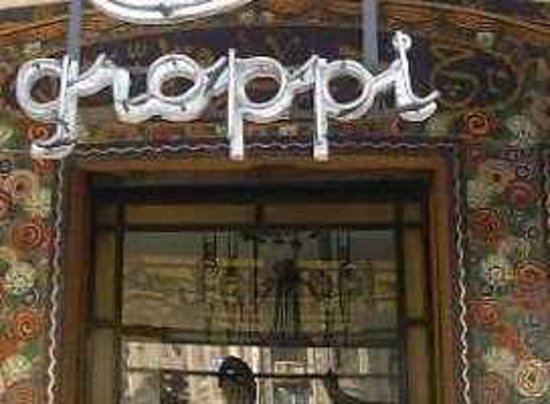
Photos of Groppi, Cairo
photo of Groppi courtesy of TripAdvisor

Mackie frequented cafes such as Groppi’s, Lappas and Cafe Liberté. It was at the Lappas cafe that he met a young man called Maher who had lived in London and was the son of the actress Malak el-Gamal. Maher invited Mackie to a party where all the guests were actors and actresses, and also to a hashish den. When Maher heard how much Mackie was paying for his room at the Golden Hotel he said he was shocked, and suggested that Mackie move to live with Maher’s uncle Am Mohammed in the district of Shobra. A quarter of Cairo’s population lived in Shobra, nearly half of them Copts.

This was how Mackie came to live with the El-Gamal family for much of his time in Cairo. Am Mohammad and his wife had a son, Atar, and two daughters Buzeina and Malak. A Palestinian, Ibrahim, had the room next to Alan’s.

Mackie continued to visit the Golden Hotel where one of his best friends was the manager, a young Copt named Amin Simaika who was the nephew of Fares Sarofim and came from Alexandria. He invited Alan to visit Alexandria with him, and the chapter on Alexandria is one of the most beautifully descriptive in the book. Mackie succumbed to the charms of Alexandria, and those of Agami a bus ride away, where he lay on the beach and let the sun and the warmth wash over his mind “till it was scoured and smoothed in the ebb and flow of the sea cleansing the sands”.

As a tall blond man Mackie had some problems during the war after Al Ahram published a picture of a smiling Egyptian soldier with a tall blond Israeli prisoner of war. He became a figure of some suspicion and was twice forced to go to a police station to be questioned, Am Mohammed coming to his rescue. The mukabarat were suspicious of the notebook in which he wrote Arabic words he did not know, and the fact that he underlined certain words in newspapers, although as Am Moahmmed explained to them, this was because he was learning Arabic. Later, when spies were arrested, it became even more dangerous for Mackie for a time.

After Mackie left Egypt in 1974 he continued to work as a Middle East financial journalist. He worked in Cairo as a journalist throughout the latter Sadat years and returned periodically in the 1980s and early 1990s but then for around 10 years he did not visit at all. When preparing his book he visited, most recently in June 2012.

When he revisited Alexandria in 2002 he was sorry to find that a six-line highway had been constructed along the cornice, cutting the city off from the sea. And he was saddened by the changes in Agami. “The half mile walk to the beach through what used to be walled lanes and fig orchards was now more reminiscent of Gaza, a slum of crumbling algae-stained tenements, pools of fetid groundwater between them.” But the changes in Shobra were more positive, especially with the building of the Metro line.

In assessing the Revolution, Mackie stresses its grass roots nature, and how the revolutionary experience brought Egyptians together across traditional alliances, “turning established structures on their head and pitting friend and foe of the ancient regime against new forces, that occupy the middle ground.” It has “energized political debate at all levels of society.” He is hopeful that a regenerated and reformed Islam, rather than Islamist extremism, may emerge.

Alan Mackie in Agami

He observes that neighbourhoods set up community centres and organised their own social and security networks just as they had done in the October War, “which accounted for the extraordinary self discipline with which the demonstrations were organised.” Mackie is very concerned about Egypt’s always fraught relations with the West and examines the neo-colonialist dimension and the West’s support for Israel.

“Popular anger at the way the Palestinians have been treated, and the West’s collusion in their oppression, colours the political discourse in the new Egypt” he writes. Palestine “defines the Arab world’s relations with the Israel and Israel defines the West’s relations with the Arab world.” Israel was “a colonial enterprise a century too late. .. now it survives by force of arms”.

The transitional government had to rein in its initial open embrace of Palestinian resistance, as it did approaches to Iran, and President Morsi has declared Egypt will honour existing peace agreements. But future relations with the Jewish state will be on a different footing and there has even been talk of a referendum on the Peace Treaty at some point “to give the authorities diplomatic cover for a tougher policy.”

Mackie condemns the way in which the West has tended to engage with other cultures through its own stereotypes, with alien cultures being demonised if they are considered hostile. “Resisting America’s view of reality has been one of the most daunting challenges Egypt and other Arabs have had to face....” he writes “so overbearing and ruthless is the juggernaut of military and economic power deployed to impose it, and unnervingthe faith Americans place in their democracy to ‘do right’.”

He slams the West’s antipathy and prejudice towards, and ignorance of, Islam, and its tendency to meddle in the region’s affairs, which give oxygen to extremist elements. He left Egypt in 1974 with the sense that the West is not very good at “listening”. Instead, it tends to “talk down” to other cultures, assuming that its values are a universal good. But the Arab and Muslim world has proved extraordinarily impervious to western cultural imperialism.

On 9/11 the West woke up to the fact that a large part of the world, if not actively “hating us” wanted to be taken into consideration and heard. “Since then a profound shift in economic power eastwards is forcing the West to adapt to different ways of seeing things, whether it likes it or not.

Sunday, February 10, 2013

Moroccan novelist Bensalem Himmich in discussion with his prizewinning translator Roger Allen

(L to R): Bensalem Himmich; interpreter Mohamed-Salah Omri; Roger Allen; Paul Starkey (portraits in the background are of South Shields Yemenis in the Last of the Dictionary Men exhibition)

When Roger Allen stepped onto the stage of Kings Place in London last Monday to receive the Saif Ghobash Banipal Prize for Arabic Literary Translation for his translation of Moroccan writer Bensalem Himmich's novel A Muslim Suicide (Syracuse University Press, 2011), he spoke of the relevance today of the novel's central figure, 13th century Sufi thinker Ibn Sab'in (1217-1269).

Allen said the novel is "the story of one of Islam's most radical thinkers, Sufi philosopher, theologian and physician, and perhaps there is a contemporary aspect in that: precisely because of the radical nature of his thought he is hounded out of basically every place he tries to settle down, from Spain to North Africa to Egypt, and finishes in Mecca."


The contemporary relevance of Ibn Sab'in was also a main theme of a discussion between Allen and Himmich, held on Tuesday evening at the Mosaic Rooms and chaired by Paul Starkey, chair of the Banipal Trust for Arab Literature. Starkey retired in September 2012 from Durham University where he had been Head of the Arabic Department.

Introducing the event, Starkey said A Muslim Suicide has "some relationship to the kind of debates that go on in the Islamic world at the moment, the sort of things people see in our newspapers day by day. It's so modern."

Ibn Sab'in's career "exemplified many of the debates and the clashes of civilisation - if one can use a cliché - that were evident at the time. This was after all the century when the Mongols came from the East and sacked Baghdad .. . And it was also a period when relations between the Muslim world and the Western world were going through an interesting phase."

Allen had travelled from Philadelphia to receive the Saif Ghobash Banipal Prize. The discussion at the Mosaic Rooms was one of two events organised by the Banipal Trust to celebrate his presence in London: the first event was a three-hour translation masterclass given by Allen on Tuesday morning at the Arab-British Centre.

Allen, who was born in England in 1942, recently retired from his position as Sascha Jane Patterson Harvie Professor of Social Thought and Comparative Ethics in the School of Arts and Sciences at the University of Pennsylvania. He had served as Professor of Arabic and Comparative Literature in the Department of Near Eastern Languages and Civilizations for 43 years and has translated numerous works of modern Arabic literature.

Himmich, born in Meknes in 1949, is a novelist, poet and philosopher. He earned a doctorate from the Sorbonne in Paris for a thesis on Ibn Khaldun. He has been a Professor of Philosophy at Mohammad V University in Rabat, and served as Moroccan Culture Minister in 2009-12.


Himmich's 11 novels include several historical novels. A Muslim Suicide - which was longlisted for the 2009 International Prize for Arabic Fiction (IPAF, often dubbed the Arabic Booker) is the third of Himmich's historical novels that Allen has translated. And Allen has also translated a fourth of Himmich's novels - Mu'adhdhibati (Dar El Shorouk) - which is set in the 21st century's "War on Terror", and for which Himmich was shortlisted for IPAF 2011 (see below).

Himmich is one of the most distinguished contemporary Arab novelists, and has won numerous prizes. He received the 2002 Naguib Mahfouz Medal for Literature for his 1997 novel Al-Allamah, on Ibn Khaldun's later years in Cairo, translated by Allen as The Polymath (American University in Cairo Press, 2004).

His 1989 novel Majnun al-Hukm won the London-based Al-Naqid Prize, and was translated by Allen under the title The Theocrat  (AUC Press 2005).  The novel is an account of the controversial Fatimid Caliph Al-Hakim bi-Amr Allah  In 2009 Himmich received the Naguib Mahfouz Award for Literature from the Union of Egyptian Writers for the whole corpus of his work.

Roger Allen said one of the amazing things about A Muslim Suicide is the very good impression it gives about an era in relations between two cultures "which is utterly different from our conception about the relationship between the West, and what we'll call the Middle East, now." Andalus was the place where one would go to seek knowledge and enlightenment. It was gradually losing that status, "but still you had the Christian King of Sicily, the Holy Roman Emperor King Frederic, writing to a Muslim intellectual asking him profound questions about existence, reality, the spirit, and everything else."

This correspondence between Frederic and Ibn Sab'in took place when Ibn Sab'in was living in the Moroccan town Sabta (Ceuta), the first place he settled when forced to leave Andalus. "If you want some contemporary relevance, it is not  irrelevant that King Frederic of Sicily was excommunicated by the Pope," Allen said. "Perhaps some of the greatest penseurs of any particular generation go through that particular process as a necessary part of maintaining their intellectual honesty when it comes to matters of theology and spirituality."

Allen raised the question of Arab novels after the watershed of the Naksa (Setback) of 1967 and the role of the past, and what novelists are to make of the past, use the past, what is the relationship with the past. The texts written in the wake of the Naksa had two prevalent trends. The first was Turath (legacy), and the second was Asala - ie the quest for authenticity. "And what we see is an enormous and pleasurable variety of ways of negotiating with the past, using the past."

Allen described Ibn Sab'in as a brilliant intellectual scholar, a wonderful human being, a superb doctor and psychologist. Allen said  he is constantly struck by the qualities of the scholars of the Andalusian period - for example Ibn Hassan, one of the great controversialists of Islam who was determined to negotiate meaning with adherents of other religions communities in Spain, and was also a  great poet. Or Ibn Quzman, a wazir who wrote some of the dirtiest zajals in the whole history of Arabic poetry.

Allen spoke of "this enormous variety of intellects and talents represented by this particular culture, this particular moment in the cultural history of Europe which still needs to be rediscovered. And here is Ibn Sab'in writing about the demise of this culture."

One of the most telling things in the novel for Allen is Ibn Sab'in sitting in Sabta, from where one can see Spain, and talking to his students about the demise of Spain, which had led to his expulsion, and the fact that Granada is the only place left, "and we all know of course that Granada is eventually going to fall as well. And a great period in European cultures had come to an end".

'at every turn Salafi belief and politics interfered'

This description of the period of demise is "not only a historical event, it is something which has profound implications and Ibn Sab'in, this radical thinker in Islam - and yes we are thinking about Mali today - who wishes to communicate with a variety of different religious communities, but who wishes to think of Islam as a dynamic force which adapts and changes, and which takes the best of other cultures into itself.

"And yet at every turn Salafi belief and politics interfere to expel him from wherever he is until he lands up in the centre of Islam itself where he confronts the great hero of the defence of the Middle East, Sultan Baybars - who turns out himself to be extremely Salafian in his beliefs and demands the head of Ibn Sab'in."

The novel perhaps suggests that the version of history in which the great battle of Ain Jalut - at which the army of Egypt led by Baybars in 1260 defeated the Mongols - is seen as a tremendous turning point in the Middle East, and that "everything suddenly got happy",  is not quite the right way to look at things. Ibn Sab'in eventually emerges and decides that the only thing he can do is to end his own life. 

Allen said there is a great deal written about historical novels and what they are and what they might be – there is a great deal of theoretical literature – and now also about the parlous relationship between history and fiction – even the fact that history is very often fiction itself, in other words fiction being something which is written by somebody in which somebody puts something in and leaves other things out.

"Any work of this kind which makes use of history in this way seems to me to have things to say to contemporary readers even though it may not be about family life in some Arab capital and problems of women in society or whatever it may be – valuable though those contributions to modern Arab fiction may be.

"This type of work is representative of a strand of novel fiction writing which asks more profound questions, that are concerned about – yes, as Paul said, in Huntington’s dreadful phrase, the clash of civilisations..."


'I am a prisoner of this category, the historical novel' 

Despite the acclaim for his novels set in the past, Himmich said he disagreed with the categorisation "historical novel". He said: "I am a prisoner of this category historical novels" when he actually has "a diversity in my production". He has written novels on present-day issues, for example clandestine immigration, and he is currently writing "a new novel about a very new subject - a businesswoman. But after one decade it will be a historical novel! Indeed history is all, we cannot escape.

"I think the best manner is to consider the past like the present, and this present maybe after all will be a past, this is history, but this label 'historical novel' I don't agree with. I can't put barriers between the past and the present and the future, because at the moment, tomorrow, after tomorow is a past - which is very interesting for a novelist."

He described himself as being "a little iconoclastic" and distinguished between "easy" and "difficult" historical novels. In the "easy" category he put Jurji Zaidan's historical novels. Himmich claimed that Zaidan (1861-1914) had "a deficit of imagination and invention" and that "the historian for me has more credibility than I can find in the novels of Jurji Zaidan." 

Himmich also maintained that Nobel prizewinning Egyptian author Naguib Mahfouz's trilogy on Pharaonic Egypt, which were published at the beginning of Mahfouz's writing career, was of only "middling" quality, and that Mahfouz's writing only really started to take off with his 1945 novel Al-Qahira al-Jadida (Cairo Modern). (Mahfouz's Pharaonic trilogy consists of Khufu's Wisdom  (1939), Rhadopis of Nubia (1943) and  Thebes at War (1944).) Himmich also made fleeting criticisms of works by two contemporary Arab writers of historical novels.

Himmich said he respected Zaidan and Mahfouz, but he contrasted their "easy" type of historical novels with "difficult" historical fiction such as The Memoirs of Hadrian by Marguerite Yourcenar, The Name of the Rose by Umberto Eco and  Salammbo by Gustave Flaubert. He said historical fiction needs to have a clash - such as is seen in Albert Camus's play Caligula. He gave further examples of the importance of history to great writers: Balzac's novels are like historical novels. And central to all Shakespeare's theatre was a historical dimension.

Himmich described the many difficulties facing the writer of his kind of novel. The author must thoroughly research the information from historians and historiography, and after that the work of creation, of invention, begins. But with some novelists there is not this depth of research and "it’s very superficial".

The writing of novels with real significance, raises existential questions. When he was working on A Muslim Suicide or The Polymath he thought endlessly about the character of  Ibn Sab’in or Ibn Khaldun, and "it is for me an obsession, all the time I think about him. The first thing is to know all about this person – it’s necessary – and after that I think what this person was confronted with." In the case of Ibn Sab'in, why did he constantly need to move from place to place? Himmich feels a sense of responsibility in writing about characters who are outsiders, or marginal, and to "recuperate persons out of history."


how 'this man from Spain' metamorphosed into 'a muslim sucide

Starkey asked Allen why the title of the Arabic novel Hadha al-Andalusi (literally 'this Andalusian') became in the English translation A Muslim Suicide. Allen said that while he was translating The Polymath he had met Himmich at a conference - ("one of the  many conferences held in what now appears to be a different era in the cultural life of Egypt, when Gaber Asfour organised a conference on the Arabic novel and indeed there was a Cairo prize for the Arabic novel" - the Arabic Novel Award given by the Egyptian Ministry of Culture.)

Himmich had told him he was writing a new novel on the very controversial Andalusian figure, Ibn Sab'in, and had decided its title would be Al-Intihar bi jiwar al-Ka'ba (Suicide inside the Ka'ba).Allen had said  he wasn't sure this was a good idea;  "certain people might perhaps not be too happy" about that title.

When Allen  received his copy of the new novel he found the title was Hadha al-Andalusi. "And I thought to myself well, that's slightly tilting in the opposite direction from the title which I had originally discouraged."

When Allen translated the novel he gave it the title This Man from Spain, but then received an email from Himmich saying that with the English translation "we're going back to my original intentions." Himmich suggested a number of titles, one of which was A Muslim Suicide.

Thus, the English title is "not a massive reinterpretation of everything the text is about but it is a reflection of the original intentions of the author." Allen said it was interesting that certain people who have read the Arabic now regard the Arabic title as supremely good -  and various people who read the English translation also regard that title as extremely good.

"In a sense it involves two quite different readings of the text itself. In my role as a teacher of literary theory the whole notion of Beginnings and of Titles - and the way that impacts on the reception of text - is a very interesting topic."

Himmich said Ibn Sab'in's committing suicide in the sacred space around the Kabba by slitting his wrists was "an act of sacrilege if ever there was one, which in all probability was not motivated by personal considerations but more likely sprang out of an ineradicable desire ... to hasten his union with God which ... was too slow to happen."

who will have the courage to publish 'my torturess'?

In addition to his translations of The Theocrat, The Polymath and A Muslim Suicide Allen has produced an as-yet unpublished translation of Himmich's post-9/11 novel Mu'adhdhibati (Dar El Shorouk) for which Himmich was shortlisted for IPAF 2011. The title means my female torturer, or tormenter. Allen said  "I coined the non-existent British term My Torturess" for the title.

My Torturess is about extraordinary rendition. It tells of a Moroccan who is extraordinarily rendered, and of his sufferings inside a dreadful anonymous camp.  "I’m hoping that it will be published," Allen said. "But there seems to be a rather cagey element amongst the publishing industry about publishing a work about this extraordinary terrible criminal activity which took place during the George W Bush administration in America.

"Insha'Allah eventually someone is going to have the courage to publish this: the translation’s complete and ready." He added "Stand by for the title:  I'm calling it My Torturess but we'll see what comes out, who decides what." Laughter erupted when Himmich said: "If he is afraid about this title, I have another." 

IPAF said of the novel at the time it was shortlisted for IPAF 2011: "In a gripping novel, whose narrative style is a blend of Kafka and One Thousand and One Nights, Himmich imagines an innocent man’s experience of extraordinary rendition in an American prison. During his captivity, the protagonist is subjected to interrogation and torture by both Arabs and foreigners and yet, against all odds, the author manages to find some hope in an otherwise desperate situation."


Allen said the historical novel itself has a history. "Many people believe that Sir Walter Scott is the origin of the historical novel, certainly Tolstoy – there are some major figures – but the historical novel is not a static entity – nor is it a unified entity - there is a large variety of novels called historical.

"Now the relationship between the writing of fiction and history is an incredibly varied subject – particularly in our current times when we live in a world of spin. I’ve just been through an American election where people have been paying out millions of dollars to lie.

"And so the question I often ask my students is what do we do in a world where fiction has no opposite? And in this particular environment the works of Hayden White and most recently David Shields and his wonderful manifesto Reality Hunger: A Manifesto, talking about the dilemmas of writing different kinds of texts.

"The word ‘historical novel’ covers a multitude of sins and perhaps the best way of going about it might be simply to talk in terms of narrative. And Arabic in fact is using terms such as sarid to try and avoid these problems of generic definition. Genre invites definition but as soon as you define a genre, it makes a habit of breaking those definitions."

Allen expressed a markedly more sympathetic view of Jurji Zaidan than Himmich had. "I would stick up for Jurji Zaidan – Jurji Zaidan is writing in the 1890s and he’s absolutely trying to educate, that’s what he’s doing – he’s educating a people and he’s developing a sense of Arab nationalism in a group who are in a society where people are facing foreign occupation from European colonial powers.

"But I would certainly be in favour of not  trying to nail down anything called historical novels,  that’s not what current literary theory’s all about."

(Jurji Zaidan - 1861-1914 - wrote 22 novels on Arab history. In the more than 100 years since they were published more than 100 translations into over nine languages have been published - but unitl recently none in English. The Zaidan Foundation has now sponsored the English translation and publication of five of the novels. Roger Allen translated The Conquest of Andalusia, and Paul Starkey Saladin and the Assassin.)


In the introduction to his book The Arabic Literary Heritage: The Development of its Genres and Criticism (Cambridge University Press, 1998) Allen says he is not going to use the word history, because I am trying to write a version of what Arabs wrote about that is not based on historical and dynastic criteria. Instead his emphasis is on genres. "You know,  I often think when Abu Nawas woke up in the morning, he didn’t say to himself 'I’m an Abbasid poet!'".  

Allen was asked, as someone who has translated many Arab fiction writers, about his experience of translating Bensalem Himmich. How did he deal with his intertextuality and how did he convey in English the different registers in Himmich's Arabic text?

Allen began his answer by recalling how he first started to translate Himmich. Someone at a conference complained to him that the Modern Arabic Literature volume of the Cambridge History of Arabic Literature - to which he contributed two chapters - contained very little on the Maghreb.

Allen went back to the volume and found the complaint was well-founded, and he decided to spend his next sabbatical in the Maghreb. This he did, and that was when he met Bensalem Himmich. It was a conscious choice on his part to introduce to the Anglophone world novels written by Maghrebi writers, and he has mostly concentrated on Morocco - and especially on Himmich and on Ahmed Toufiq (Allen's translation of Moon and Henna Tree by Toufiq is to be published in May by University of Texas Press - following his translation of Toufiq's Abu Musa's Women Neighbors: A Historical Novel from Morocco - Post Appollo Pr, 2005 ).

Allen told the questioner "you’re absolutely right that these particular texts immediately present you as a translator with a number of issues, the first of which is the extraordinary level of erudition which is implicit in the text itself.

"The publication of The Theocrat raised a very fascinating issue of translation, and this is partially reflected in all the texts, which is that Bensalem regularly puts somewhere in the text what his sources are. I point out of course that Jurji Zaidan does exactly the same thing.

"But I put into the text of The Theocrat the footnotes which Himmich had kindly provided to the various historical sources which he was using, or the accounts of the peculiar behaviour of Al-Hakim bi-Amr Allah - and believe me, his behaviour was frequently very peculiar indeed – such as banning the hajj, and banning molokhia in Egypt – can you imagine that? And everybody had to work at night and sleep during the day – I mean this is interesting stuff,  but the point is it was all footnoted to actual historical accounts, and the AUC Press wrote to me and said 'we don’t do footnotes' so I had to point out, Iwe are talking about TS Eliot’s The Wasteland and the footnotes and the fact that TS Eliot put notes to the complexities of language.

"Anyway, that aside, I had to explain that the footnotes are part of the novel, they are an intrinsic part of the process of writing this text and its use of source material.

"But this is just part and parcel – particularly trying to convey here the difference between the description of travel and as it were the more habitual things which go on in the life of Ibn Sab’in. And than discussing Ibn Sab’in arguing about the accuracy of Ibn Rushd’s version of Aristotle and then meeting Shushtari and listening to Shushtari’s poetry and of course including some of Shushtari’s poetry. This was extremely complicated as a translation exercise, one of the more complicated ones I’ve done.

"But I just point out that there’s a recently-published collection from Columbia University Press [ed Salma Khadra Jayyusi] called Classical Arabic Stories : An Anthology which you may have seen in which I translated six of the Al-Maqamat (The Assemblies). So I have a sort of yardstick about complexity of text.

"But this (A Muslim Suicide) is a modern text, and all of these three texts are, and because Bensalem is such an enormously erudite scholar of pre-modern Arabic texts of a particular kind, the novels that he writes, which include references, are very challenging to translate."

When a member of the audience asked Himmich how his books are received in Morocco he said: "I can't speak about me: I detest autobiography  because autobiography is impossible. Freud was right,  is it possible to write about when I was a child, my problems with my mother, my sexual problems? No no it is not possible. All autobiography is impossible because there are secret gardens - for example if someone has an accident in his life - a sexual relation with his sister - he can't write this.

"For this reason I am against all autobiography except when we have a foolish person, an outsider, a person who has problems with everybody, like Jean Genet for example. But when I am very very old perhaps I will write like an au revoir to my life, the life in the world. Basit".
report and photos by Susannah Tarbush