Saturday, November 02, 2013

Banipal Book Club brings Arab short story telling to London's Nour Festival

Following the success of the first-ever Banipal Book Club Short Story Circles held in November 2012 at the Victoria and Albert Museum in London, the Book Club organised a second session of Story Circles last week at Kensington Central Library.

Like last year's event at the V and A, the well-attended  Short Stories from the Arab World was part of the Nour Festival of contemporary art, film, literature, music and performance from the Middle East and North Africa. The Festival is being held in venues throughout the Royal Borough of Kensington and Chelsea from 1 October to 30 November.

Celia Shenouda (L) and Charis Bredin

The three stories translated from Arabic which were read and discussed during the evening are downloadable from the Banipal magazine website. They are Mordechai's Moustache and his Wife's Cats by Palestinian author Mahmoud Shukair translated by Issa J Boullata; Black Kohl . . . White Heart by Kuwaiti writer Mona al-Shammari, translated by Sophia Vasalou; and Ali the Red by Luay Hamza Abbas of Iraq, translated by Maia Tabet.

Members of the audience were given copies of the two issues of Banipal and the Banipal Books volume in which the stories appeared. And they were kept well supplied with drinks and delicious Arab snacks in the breaks between stories. The discussions that followed each story were lively, the diverse audience contributing rich perspectives.

The event was chaired by Margaret Obank, publisher, cofounder and former editor of Banipal magazine of modern Arab literature. The stories were read by stalwarts of the Banipal Book Club, which was founded last year and meets monthly in the meeting room of the Banipal Arab British Centre Library of Modern Arab Literature (BALMAL) located at the Arab British Centre. Charis Bredin read the first story, Mordechai's Moustache and his Wife's Cats. Shukair is well known for his  gifts of satire and humour under occupation. These qualities are much in evidence in the title story of the author's first collection in English translation, published by Banipal Books in 2007.


Mordechai, a former soldier, and his wife Stella are middle-aged Israelis of modest means who are on their own now their  grown-up children have left home. Stella devotes herself to her three cats while Mordechai grows his handlebar moustache. But Mordechai grows annoyed with the cats, and she in turn resents his moustache. Mordechai decides to volunteer for military service at checkpoints. Posted to the Qalandiya checkpoint he has  his first close encounters with Palestinians.

"Conflicting ideas and feelings overcame him. He was almost ready to express his sympathy for these unarmed human beings waiting for a hand gesture from him," Shukair writes. "However, the security of the state was greater than all other considerations and this made him suppress his tender feelings; for these people – in the final analysis – were the enemies of Israel!" Mordechai sees the young men as potential saboteurs, possibly armed with suicide belts or machine guns.

But he can't stop  himself admiring the Palestinian women. "He cast direct looks at the bodies of the young women crowding at the checkpoint. He said to himself: 'The Palestinians have beautiful girls!' And quickly compared them with the girls of Tel Aviv, thinking: 'But the girls in Tel Aviv are more beautiful.'" The story ends with Mordechai agreeing to shave off his moustache - which the Palestinians had made fun of - if his wife will get rid of her cats. Their negotiating this agreement raises questions of negotiation more generally.
 
Mahmoud Shukair
 
(L to R) Aurora Tellenbach, Margaret Obank, Celia Shenouda

There was dark humour in Mona al-Shammari's story Black Kohl . . . White Heart, read by Aurora Tellenbach. The story appears in Banipal 47, the magazine's current issue, which has a Special Feature on Fiction from Kuwait. A voluptuous young woman, Tiba, has travelled from Saudi Arabia to Kuwait to be married off to a Kuwait man. She is horrified to find her spouse is "an overweight and feeble-minded simpleton who didn’t talk like grown men did, who ate like a child, and slept like a brute." Living in the extended family she is observed by her husband's young niece, the first person narrator of the story, who is bewitched by her beauty. "Her lips are always glossed with jujube lipstick. They’re swollen like red cherries ripe for plucking. Her deep black eyes are like chestnuts; the black kohl makes them wider, and lends languor to her gaze. Her skin is the colour of milk mixed with honey." The child innocently sees how she plots an escape from the arranged marriage, and the story ends with an ingenious twist.


Mona al-Shammari

Ali the Red, read by Celia Shenouda, was published in Banipal 37, in a Special Feature on Iraqi Authors. It was the most gruesome of the three stories, shot through with various forms of violence, yet having flashes of humour. The first-person narrator was at school 20 years earlier with four boys named Ali for whom the sports master had devised monikers. Ali was Red not because of any political affiliation but because of his ruddy complexion. Now the narrator is summoned to the coroner's office to identify the corpse of Ali, whose "forehead and half of his face had been gouged by bullets." The vividly recounted story is set among workers, some toiling like Ali in a quarry, others in the harsh conditions of oilfelds where they might be buried in collapsing well-heads. An Iraqi woman in the audience found the story a reflection of the everyday brutal killings that Iraq has been suffering for years.
report and photos by Susannah Tarbush

Celia Shenouda reads Ali the Red

Wednesday, October 30, 2013

5th IPAF Nadwa for emerging Arab writers opens in Abu Dhabi resort

 IPAF Nadwa mentor: Mohammed Achaari

Eight emerging writers - four men and four women - from eight Arab countries yesterday began the writers' workshop  known as the International Prize for Arabic Fiction (IPAF) Nadwa, held annually in Abu Dhabi.

This year's Nadwa is led by two mentors:  Moroccan writer Mohammed Achaari - joint winner of IPAF (often referred to as the Arabic Booker) in 2011 for his novel The Arch and the Butterfly - and Lebanese author May Menassa, shortlisted in IPAF's first year, 2008, for Walking in the Dust.

The eight emerging writers participating in the Nadwa are Ayman Otoom (Jordan b1972); Hicham Benchchaoui (Morocco b1976); Samir Kacimi (Algeria 1974); Noha Mahmoud (Egypt b1980); Lulwah al-Mansuri (UAE 1979); Bushra al-Maqtari (Yemen b1979);  Abdullah Mohammed Alobaid (Saudi Arabia b1984), and Nasrin Trabulsi (Syria). (Full biographical details are below)

This year marks the fifth anniversary of the prestigious IPAF Nadwa, which brings together emerging writers from across North Africa and the Middle East and gives them the opportunity to hone their skills under the tutelage of IPAF winning and shortlisted authors.

This is the sixth year of the International Prize for Arabic Fiction. The longlist for IPAF 2014 will be announced on Monday 6 January, the shortlist on Monday 10 February 2013, and the winner on Tuesday 29 April

May Menassa

This year's eight-day IPAF Nadwa, from 29 October to 5 November, is taking place in the secluded desert resort of Qasr Al Sarab. It is sponsored by HH Sheikh Hamdan bin Zayed Al-Nahyan, the Ruler's Representative in the Western Region.

The eight participants were identified by former judges of IPAF as ‘ones to watch’.  Aged from 29 to 43, they come from  a variety of writing backgrounds and professions.

The Nadwa offers emerging authors a retreat where they are able to work on a new piece of fiction, or to develop an existing, unpublished work. In addition to their mentoring sessions with Mohammed Achaari and May Menassa, the participants will take part in daily discussions with their peers, critique each other’s work, and discuss literature in more general terms.

 the first volume of works produced at the IPAF Nadwa

The fruits of the Nadwa will include eight new works of fiction. These will  in time be edited and translated into a bilingual volume of extracts. To date, two volumes IPAF Nadwa volumes have been published, by Saqi Books and Arab Scientific Publishers. Two previous Nadwa participants – Egyptian Mansoura Ez Eldin and Saudi Mohammed Hasan Alwan – went on to be shortlisted for IPAF. Alwan's novel The Beaver, which was shortlisted in IPAF 2012, began life in the 2009 IPAF Nadwa.

Mohammed Achaari said:  "I am greatly looking forward to encountering new texts as they are in the process of being created." He noted that "it is commonly thought that writing is a work which happens between the writer and their text, in isolation and solitude. Perhaps this is true at a deep level, but transforming this almost sensory intimacy into open dialogue and group interchange gives the writing another dimension, as it becomes a shared effort." Achaari says "it will be exciting to get to know these new works in the mirror of other texts, both during the workshop and as they develop afterwards".

Fleur Montanaro

IPAF Administrator Fleur Montanaro, who is coordinating the Nadwa, adds: "We are delighted to be celebrating the fifth year of the IPAF Nadwa, which provides a forum for talented young writers from across the Arab world to interact and engage with each other's work. In the company of Mohammed Achaari and May Menassa as mentors, this year’s Nadwa promises to be as inspiring and stimulating as ever".

IPAF is the leading international prize for Arabic literature. Sponsored by Abu Dhabi Tourism and Culture Authority (TCA Abu Dhabi), and run in association with the Booker Prize Foundation in the UK, the Prize aims to celebrate the very best of contemporary Arabic fiction and encourage wider international readership of Arabic literature through translation.
Further information on the Prize can be found at: www.arabicfiction.org 

NADWA 2013: PARTICIPANTS

Ayman Otoom is a Jordanian poet and novelist, born in Jerash, Jordan in 1972. He went to secondary school in the UAE and graduated in Civil Engineering from the Jordanian University of Science and Technology in 1997. He then went on to obtain a B.A. in Arabic Language from the University of Yarmuk, Jordan, in 1999 and an M.A. and doctorate in Arabic Language from the University of Jordan in 2007. He has published several volumes of poetry, including his most recent Take Me to the Al-Aqsa Mosque (2013), and is the author of three novels: My Friend, Prison and They Hear Her Whispering (both published in 2012) and The Taste of Death (2013). He is currently a teacher in Amman.


Hicham Benchchaoui is a Moroccan writer. Born in al-Jadida, Morocco, in 1976, he trained as a journalist and has written for several Arab newspapers and periodicals. From 2008 to 2010 he worked as a cultural reporter for Iraqi newspaper Al-Mada and Moroccan newspaper Al-Jarida al-Oula. He also co-edited the seventh edition of Sisra magazine, published by the cultural association Aljouf, Saudi Arabia. He is the author of two novels and four short story collections. His novel Nap on an Autumn Sunday came third in the Al Tayeb Salih Award for Creative Writing in 2012. 

Samir Kacimi is an Algerian novelist. Born in Algiers in 1974, he graduated with a Law degree and currently works as a newspaper columnist. His first novel was Declaration of Lostness (2009), the first Algerian novel to deal with prison in Algeria, which won the Hashemi Saidani Award for the best Algerian debut. In the same year, he published his second novel A Great Day to Die, the first Algerian novel to reach the IPAF longlist. His third novel, Halabil, was published in 2010 and chapters from his next work In Love with a Barren Woman (2011) were featured in English translation in Banipal Magazine. His most recent novel is The Dreamer (2012).

Noha Mahmoud is an Egyptian writer, born in 1980. She currently writes for Egyptian newspaper The Republic. She has published three prose works and three novels: Telling Stories Sitting on Marble Blocks (2007), Rakousha (2009) and Hallucinations (2013), for which she won the Dubai Cultural Prize. 

Lulwah al-Mansuri is a writer and journalist from the United Arab Emirates. Born in 1979, she has a B.A. in Arabic and a diploma in Family and Media Studies. Her novel, The Last Women of Lengeh, was published by the Department of Media and Culture in Sharjah in 2013. Her short story collection, The Village Which Sleeps in My Pocket, won the Dubai Cultural Prize in 2013.

Bushra al-Maqtari was born in Taiz, Yemen in 1979. She is a writer and novelist and member of the executive board of the Union of Yemeni Writers. She has published a prose collection called The Furthest Reaches of Pain (2003) and a novel, Behind the Sun (2012). Her writing has been published in various Arab newspapers and periodicals. In 2013, she was awarded the Françoise Giroud Award for Defence of Freedom and Liberties in Paris and also the Leaders for Democracy Prize, presented by the Project on Middle East Democracy, in Washington.  

Abdullah Alobaid is a Saudi Arabian writer. Born in Riyadh in 1984, he studied Management Information Systems at the King Fahd University of Petroleum and Minerals in Dhahran. He is the author of one novel, Nicotine (2011), and Companion, a book of prose and poetry (2013). He has also written scripts for television dramas and, for the last four years, has performed stand-up comedy. 

Nasrin Trabulsi is a Syrian writer. Based in Kuwait, she works as a television news presenter. She has a B.A. in Dramatic Literature and is the author of three collections of short stories – Waiting for a Legend (1997), Scheherazade Got Bored (2004), The Last Dance Rehearsal (2008) – and a book of prose poetry, entitled Speech of the Dumb (2009). She has published a number of critical articles in Arab newspapers and specialist periodicals on literature and the theatre, as well as a series of articles called From the Balcony of Humanity in Sawa Magazine and the Kuwaiti al-Qabas newspaper. Currently, she writes a column for Al-Quds al-Arabi called Fadaai'yat. She has hosted several literary evenings in which she dramatically enacted her short stories, in Damascus, Kuwait, Cairo and Sharjah.  

NADWA 2013: MENTORS

Mohammed Achaari was born in 1951 in Zerhoun, Morocco. After studying Law and Administration, he worked in political and cultural journalism and was editor of a number of newspapers and cultural supplements. He has written articles on literature and the arts, including poetry and short stories. For three consecutive years, he was head of the Union of Moroccan writers and his political work led him to take up various government posts, including that of Minister of Culture in Morocco from 1998-2007. His 11 poetry collections have been published in Baghdad, Beirut and Casablanca, and he is regarded as one of the most prominent poetic voices of the 70s generation in Morocco. His 2011 novel The Arch and the Butterfly won IPAF and was recently nominated for Italy’s Ziator Prize. His works have been translated into a number of languages. He lives in Rabat, Morocco, where he is a full-time writer. 

May Menassa was born in Beirut in 1939 and holds a postgraduate diploma in French Literature. She began her career as a broadcast journalist in 1959. She has worked as a critic for the Lebanese newspaper An Nahar since 1969. She has published eight novels, as well as two children’s books and she has worked on many translations, mainly from French into Arabic. Her fifth novel Walking in the Dust was shortlisted for IPAF in 2008. Her first novel, Pages from Notebooks of a Pomegranate Tree (1998), was translated into French in 2012. 

Sunday, October 06, 2013

Saqi Books events at Nour Festival focus on Arab history, sexuality, art and fiction


Saqi Books, a "proud partner" of the Nour Festival of Arts: Contemporary art, film, literature, music and performance from the Middle East and North Africa is organising three literary events for the two-month Festival which was officially launched on 1 October.
 
The Festival, spearheaded by the Council of the Royal Borough of Kensington and Chelsea, and involving some 36 partners, is taking place in more than 20 venues in the borough. It offers six art exhibitions, 16 film screenings, 15 talks and debates, 14 performances across dance and drama music and poetry, four evenings of special events, three cookery classes, eight workshops, the Pop-Up Souk and the Nour Tour Bus .
 
On 15 October at 18.30 at Kensington Central Library John McHugo talks about his work A Concise History of the Arabs, published recently by Saqi Books. McHugo is an international lawyer and Arabist, with over forty years’ experience of the region. He has worked as a lawyer in many Arab countries, notably Egypt, Bahrain and Oman. 
 
His book deals with the political, social and intellectual history of the Arabs, from the Roman Empire to the present day. His talk will cover the mission of Prophet Muhammad, the expansion of Islam, medieval and modern conflicts, the interaction with Western ideas, the struggle to escape foreign domination, the rise of Islamism and end of the era of dictators. A Q and A session will follow. The talk is part of the London History Festival.


"Does the Arab Spring Need a Summer of Love?". This is the topic of a discussion on taboos and changing sexual mores in the Arab world,  to be held at the Mosaic Rooms at 19.00 on 6 November.
 
The discussants are eminently equipped to discuss the subject. They are Shereen El Feki, author of Sex and the Citadel: Intimate Life in a Changing Arab World, Brian Whitaker, author of Unspeakable Love: Gay and Lesbian Life in the Middle East, Daniel L. Newman, Professor of Arabic at Durham University, translator of works of Mediaeval Arabic Erotica, and  Malu Halasa - co-author of The Secret Life of Syrian Lingerie: Intimacy and Design.


During the summer the Saqi imprint Telegram published the novel The Lady from Tel Aviv, by Palestinian Raba'i al-Madhoun. The author and his translator Elliott Colla will discuss the book and give bilingual readings at an event chaired by Rosie Goldsmith to be held at the Mosaic Rooms on 21 November at 19.00. The Lady from Tel Aviv was shortlisted for the International Prize for Arabic Fiction (IPAF) in 2010. The translated book received an English PEN Writers in Translation Award.
 
In addition to its three literary events, Saqi is also involved in the the Pop-Up Souk, and the Nour Tour Bus events. Its bookshop in Westbourne Grove is one of five Arab-related cultural institutions in the Royal Borough to which private visits will be made by passengers aboard the Nour Tour Bus on 9 November, from 10.00.
 
Al-Souk, to be held from 14 November to 1 December, is the first-ever Arab Arts and Design pop-up boutique. It will take place in Notting Hill, in the Graffik Gallery at 242 Portobello Road and the Tabernacle Gallery in Powis Square.
Susannah Tarbush

Saturday, October 05, 2013

all aboard for the Nour Festival of Middle East and North African culture


The Nour Tour Bus

On Saturday 9 November one of London's iconic Routemaster double-decker buses will travel the streets of the Royal Borough of Kensington and Chelsea (RBKC) to the accompaniment of Middle Eastern music, courtesy of an onboard DJ.

The bus will stop at four of the borough's key venues related to Arab art: the Victoria and Albert Museum, the Ismaili Centre, Leighton House Museum and the Mosaic Rooms. The bus will also stop at  Al Saqi - the capital's leading Arab literature bookshop. The £25 tour ticket covers private visits to the five venues. At midday passengers will be served with a complimentary drink and a mezze platter.

The bus - dubbed the Nour Tour Bus - is just one of the events on the programme of the two-month Nour Festival of Arts: Contemporary art, film, literature, music and performance from the Middle East and North Africa. The festival organised by RBKC in association with some 36 partners runs from 1 October to 30 November. It encompasses more than 20 venues across the borough. RBKC is home to a diversity of communities from the Middle East and North Africa, and its second language is Arabic.


from the Ferozkoh exhibition

This is the fourth year of the Nour Festival. One of the highlights of this year's Festival is the partnership with the Museum of Islamic Art (MIA) in Doha, which brings to Leighton House Museum the remarkable exhibition  Ferozkoh: Tradition and Continuity in Afghan Art. Ferozkoh pairs priceless historical objects from MIA's collection with modern-day interpretations by craftspeople from Afghanistan. The exhibition is MIA's first-ever touring show, and is part of Qatar UK 2013 Year of Culture. Ferozkoh runs from 15 November to 23 February 2014.

Councillor Timothy Coleridge

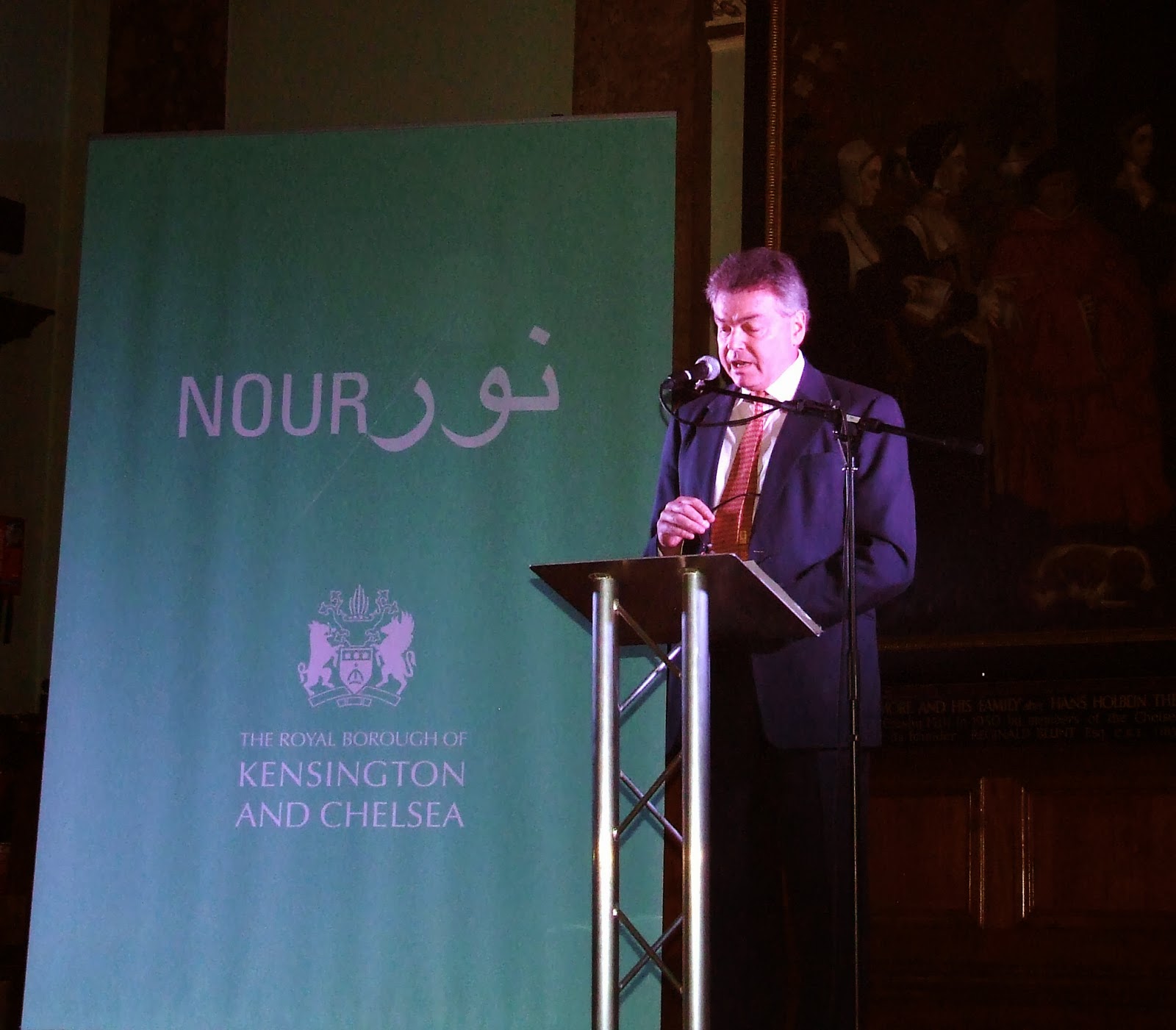
The Festival was launched on Tuesday evening at a reception held in the splendid surroundings of Chelsea Old Town Hall on the King's Road, with live music performed by Parvaz Ensemble. In his speech Councillor Timothy Coleridge, RBKC Cabinet Member for Planning Policy, Transport and Arts, enumerated the events on offer during the Festival: six art exhibitions, 16 film screenings, 15 talks and debates, 14 performances across dance and drama music and poetry, four evenings of special events, three cookery classes, eight workshops, a Pop-up Souk, and the Nour Tour Bus.

Councillor Coleridge said: "The Royal Borough believes very strongly that arts and culture are an important part of our  borough's life. We want all our residents to have an opportunity to experience and enjoy the arts in their own communities. We believe that the arts can bring out the best in people and they can  help build together better neighbourhoods, encourage economic benefit and most important of all bring enjoyment to people's lives."

earrings from the Ferozkoh exhibition

The RBKC Council enables the Festival to happen by acting as an organiser and a catalyst. "But it is without doubt the partnership of all the organisations - you who are here tonight - and the artists represented that make it such a success."

Coleridge was sure those attending the opening would like to join him in extending thanks to Alan Kirwan, the Council's former Arts Officer.  Kirwan created the Nour Festival in its first three years. "We wish him well in his new role at the European Parliament's House of European History in Brussels," Coleridge said, adding jokingly "I expect he'll have to rewrite most of it."

Since its inception, Nour has grown and is rapidly becoming one of Europe's most significant annual showcases of contemporary arts and culture from across the Middle East and North Africa. Councillor Coleridge said:  "We always have an eye on the future, and our ambition is to make Nour year on year better and more successful. So I'm very pleased tonight that guests include representatives of prominent organisations which have not been part of Nour before but with whom we are beginning to discuss collaborations and partnerships. 


 Dr Shahidha Bari

Dr Shahidha Bari, lecturer in Romanticism at the Department of English at Queen Mary's University of London has research interests including the Romantic Poets, and Islam and Arab Culture. She said in her speech how excited she was to be at the Nour Festival  which is so obviously going to be "lively, challenging and engaging."

She had been invited to address the opening by John Hampson, the Strategy Officer behind the Arts and Culture programme at RBKC. She thought it worth noting "how hard he himself has worked on developing this very important festival, now in its fourth year, growing bigger and bolder."

Dr Bari said the festival is important for several reasons, not least because it brings something enriching and rewarding to the area: for two months it alters the complexion and nature of this particularly highly cultured part of London.

"But it's important too because it is representative of the way culture is in itself inestimably valuable. It is, of course, increasingly important that we continue to support and sanction ventures like this, providing platforms and audiences for practitioners, especially through moments of economic downturn and political tumult - even more so, in those circumstances. And the Nour Festival is an intellectual and political venture as well as a celebratory cultural one."

The Festival is freighted with the political and intellectual weight of what has happened and is happening in the Arab and North African world, Dr Bari observed. "But it's important to note that it is not simply the case that culture and the arts represent or respond to the complex social world we live in", they also "produce the world as well as reflect it. The arts not only represent but produce our world in powerful ways."


London Algerian Ballet

Dr Bari thought it important to remember that "this lovely festival, which promises to be full of inquiry and intelligence, is also a small but significant part of a serious engagement with ourselves in the present. It is an opportunity to articulate our global, collective selves, where the people of Kensington & Chelsea borough are not separable from the worlds that will be presented to them throughout the duration of his festival."

This year's Nour programme showcases the varied work of diaspora communities. The London Algerian Ballet promises to marry vintage, traditional and contemporary dance. "I don't know if we have any representatives, but in the programme you've also promised to feed us - 'A traditional Algerian meal will be served during the evening.' -  I'm there! It's at the Tabernacle on 8th Nov. It sounds amazing!

"I'm there because the ways that diaspora communities sustain, develop and transform their cultures in different places, is sacred and important and valuable work. And the programme is full of these great projects." Dr Bari also noted that the Council has made particular efforts to make the Festival genuinely participatory, as evidenced by the impressive number of open workshops, art, dance and calligraphy classes. "I think these are marvellous efforts at making our cultural engagement engaged."

The third speaker was Rose Issa of the Rose Issa Gallery, which has been a Nour partner from the start. This year the Gallery is sponsoring two events in the Nour programme. The first is the London debut of the Paris-based Tunisian artist Mourad Salem with his exhibition 'Sultans Are No Sultans' at the Leighton House Museum from 3 to 31 October.

 Beware of the Orchids by Mourad Salem, from the exhibition Sultans Are No Sultans

The second event sponsored by the Rose Issa gallery is Sajaya:Oud concert by the Egyptian composer and player Georges Kazazian at Leighton House Museum on 29 October. The recital will be Kazazian's first performance in London. 

 Rose Issa

Issa thanked the senior curator of Leighton House Museum Daniel Robbins, as well as John Hampson of RBKC. They had been extremely supportive generally, and in particular over the participation of Mourad Salem and Georges Kazazian in their events at Leighton House Museum. She said many of the artists who were promoted at Leighton House 10 or 20 years ago are now big names, thanks to this first  small-scale breakthrough in Europe.

Issa recalled how when the idea of  a Middle Eastern festival for the borough was first being mooted a few years back, Alan Kirwan - who was at that time working at  Leighton House - approached her to find a name for it. Issa is half Lebanese, half Iranian, and has been promoting for the last 30 years mainly contemporary artists and filmmakers from the Arab world, Iran and Turkey.  Nour means light, and enlightenment, and is a word that "links Arab culture with Iranian culture with Turkish culture with Kurdish culture, with many Afghans and central Asians: that was the word that linked us together." Nour opens the door for many to understand the region's cultures.

Isssa said she has always thought that "artists are our best speakers, whether it be visual arts, film or music. Giving  a platform to talented artists means opening new doors for the general public in Britain to our culture." The public is bombarded with media distortions  and this image needs to be balanced. "With  sNour and this enlightenment we can fight distorted perspectives. Nour is part of that struggle to open doors to understanding."
 by Susannah Tarbush

Friday, September 27, 2013

an evening of Arab literature at Maida Vale Library

 Maida Vale Library

At Maida Vale Library in West London last Monday evening, the publisher of Arabia Books and Haus Publishing Barbara Schwepcke, the co-founder and publisher of Banipal magazine Margaret Obank, and translator, author and Banipal contributing editor Peter Clark were panellists at an event entitled Arab Literature Today.

Introducing the event, area manager of Westminster City Council libraries Ben Walsh explained that the library has only just returned to its home after having to be relocated in 2012 due to a major problem with the roof. The library moved temporarily down to the basement while the roof repairs were carried out. Since 12th August it has been moving back to its original home on the ground floor.

To mark its return, the library has been holding a series of free Super September events. "This is our largest attended event so far," Walsh said of Arab Literature Today.

Barbara Schwepcke (L) and Margaret Obank

Arabia Books was set up in 2008, as an imprint of London-based Haus Publishing, with the aim of bringing to a British readership the best literature by Arab authors in English translation. To celebrate its fifth anniversary, Arabia Books has teamed up with the Reading Agency to offer sets of the thirty books it has published since 2008 to each of the 200 or so library services in the UK (including two prison libraries). The Reading Agency is a charity with a mission to inspire more people to read more. It work with many partners, but in particular with libraries because they offer everyone equal access to books and reading.

The 30 Arabia Books titles donated to Maida Vale Library were arranged in a colourful display at the Arab Literature Today event. Authors published by the imprint include Rafik Schami, Hoda Barakat, Radwa Ashour, Rashid Boudjedra, Habib Selmi and Samar Yazbek, winner of the 2012 PEN/Pinter Author of Courage Award.

Peter Clark

Peter Clark, who was for a number of years head of the British Council in Damascus, outlined the dramatic changes in Arab literature translation and publishing he has witnessed since his first translation from Arabic was published in 1980. He and Schwepcke both paid tribute to the pivotal role Banipal Magazine of Modern Arab Literature has played in helping transform the availability of Arab literature in English translation over the past 15 years.

Margaret Obank spoke on Banipal's mission to open a window on the literature of the Arab world, and on the changes in the magazine from its first issue published in February 1998 to the current issue, Number 47, which has a special feature on Kuwaiti fiction. She outlined Banipal's other activities including tours by visiting Arab authors, its data base of some 1000 titles, the establishment of the Saif Ghobash-Banipal Prize for Arabic Literary Translation, and how she and Peter Clark were involved in the setting up of the International Prize for Arabic Fiction. Banipal has also founded the Banipal Arab British Centre Library of Modern Arab Literature (BALMAL), based, like the magazine's offices, in the Arab British Centre in London.


part of the display of titles from Arabia Books

Barbara Schwepcke recalled how the idea of starting Arabia Books arose from a conversation she had at the 2008 London Book Fair with the late Mark Linz, director of the American University in Cairo Press. In that year the Arab world was the LBF's Market Focus. At that time she was a publisher only of non-fiction, through Haus Publishing, and publishing translated Arab fiction was a new departure. She believes translation helps build bridges between cultures, and as regards Arab fiction "there is a wealth of literature out there that people should read." Her discussions with Linz led to Arabia Books having a co-publishing and distribution with AUC Press, with an initial list of nine titles. In her choice of titles she tried to show the variety of Arab writing in terms of genre (including crime fiction), and geographical spread from the Mediterranean to the Indian Ocean. Arabia Books has "not quite an even mix of men and women" writers.

Arabia Books forged a particularly strong link with the Syrian writer Rafik Schami, born in Damascus in 1946, "a firebrand who fell out in rather a spectacular way with Bashar Assad's father." He has lived in Germany since 1971 and writes in German. Haus Publishing published the English translation of his book Damascus: Taste of a City written with the "culinary help" of his sister Marie Fadel. Schami's novel The Dark Side of Love was the first book whose translation Arabia Books itself commissioned. The translation from German, by Anthea Bell, had the distinction of being shortlisted for the Independent Foreign Fiction Prize in 2010. 
  
 
more titles from Arabia Books in Maida Vale Library

 
This prize is shared between author and translation. Schami had said that if his novel won he would put his share of the prize towards setting up a fund to help emerging writers in the Middle East get published in English. Even though he did not win he still went ahead and set up the imprint Swallow Editions. The first, and so far only, book to be published by Swallow Editions was Sarmada by Syrian writer Fadi Azzam which appeared in 2011 in translation by Adam Talib.

During the Maida Vale Library evening Schwepcke played a recording made at the launch of Sarmada at Haus Publishing's Bookhaus in Cadogan Place, Central London. (The recording is on YouTube). Given the terrible bloodshed Syria has endured for more than two and a half years, it was moving to hear the evocative recording, in which Diwan Foundation's Louai Alhenawi plays nay to a soundtrack of bird song and percussion, recreating the atmosphere of the Syrian village in which the novel is set. The extract from Sarmada read in English translation by an actress tells of a beautiful girl, Hela Mansour,  returning to the village five years after she fled it with her lover, knowing that her five brothers will butcher her to death. Her killing is graphically described.
report and photographs by Susannah Tarbush 

Thursday, September 26, 2013

Anissa Helou's 'Levant': a compendium of Middle Eastern recipes and memories


In her prolific career as a cookery writer, the acclaimed Syrian-Lebanese food expert Anissa Helou (of whom this blog published a  profile last year) has written authoritative books on Lebanese cuisine, Mediterranean savoury baking, modern mezze, offal cookery, and the street food of Morocco and of the Mediterranean more generally.

Helou's latest, seventh, book Levant: Recipes and Memories from the Middle East (Harper Collins, in hardback and on Kindle) is a wide-ranging and ambitious work covering an entire region and a lifetime of food memories. Helou draws on her long experience of Middle Eastern food from her early childhood to her recent travels in the region.

The book has an attractive cover design based on patterned classic tiles with the shades of blue so characteristic of the Middle East.  In her introduction Helou explains the term Levant and why for the purposes of her book she defines it as comprising her two home countries, Lebanon and Syria, plus Iran, Turkey, Jordan and Palestine. She acknowledges that some may find the inclusion of Iran controversial. But Iran has had a "sweeping influence" over the cookery of the Middle East and North Africa and she feels justified in including some of its classic northern dishes.

Another possibly controversial choice is the exclusion of Israel. Helou explains: "As everyone knows, Israel is a very young state and many dishes that are now described as Israeli were, and still are, originally Palestinian, Lebanese or Egyptian, and I prefer to give the original rather than the assumed version of a dish where I can."

There are few pictures in the 346 pages of Helou's book. This is unusual in an age when cookery books tend to be ever more lavishly illustrated, but Levant does not suffer as a result. The few photographs in Levant are in black and white. One shows Anissa standing in front of one side of al-Dar in Mashta el-Helou, the ancestral home in Syria of her late father. She and her family would spend their summers there.

Another picture is of Helou's maternal grandmother and aunt in action in their kitchen in Beirut. helou also includes a photo of a "sexy ambulant green grocer in Beirut", his stall groaning with fresh produce.

Anissa's interest in food and cookery began as a child, when she watched her mother and other women of the family preparing dishes. Her mother, Laurice Helou, comes from the lovely Lebanese village of Rechmaya perched above a dramatic valley in the Shouf mountains and is "an invaluable fount of knowledge as far as the country's cooking is concerned."

Levant is a  treasure trove of insights and tips and Helou is refreshingly opinionated. She states: "The Silver Shore in Tripoli is another of my favourite fish restaurants. and Tripoli is my favourite city in Lebanon now because it hasn't lost its character like Beirut has." And she is always open to experimentation. Her recipe for Samkeh Harrah - Spicy Fish - is a hybrid of the recipe of her of mother (with no tahini sauce) and the Silver Shore (which has tahini sauce, and less coriander).

As regards tabbuleh, the iconic parsley, burghul and tomato salad, it may have "gone global" but it is rare to find it made properly in the West with the correct ratio of parsley and herbs to burghul. "Somehow it is not natural for Westerners to regard parsley as an essential ingredient when they are used to it as a garnish." Helou is convinced that the Turkish version of tabbuleh is at the root of how tabbuleh came to be misinterpreted in the West as a grain salad. Whereas it is a herb salad. 

During her culinary travels Helou has made numerous friends, who have offered her hospitality and invited her into their kitchens: the acknowledgements at the end of the book run to three pages. I was pleased to see a couple of recipes from a mutual friend, the Palestinian singer Reem Kelani (on whose traditional Palestinian food Anissa wrote in the Financial Times).   One is Mutabbal Qara' - Pumpkin dip made with tahini, garlic and lemon (both Helou and Kelani have separately concluded that butternut squash is preferable to pumpkin). The other is Mussakhkhan - Sumac Chicken Wraps.


Anissa Helou beside al-Dar in Mashta el-Helou


Levant is organised differently from conventional cookery books which begin with starters, move on to mains and end with desserts. Her six chapters are named after locations and settings: En Famille; On the Farm; In the Souq; At the Restaurant; At the Bakery; and At the Sweet-maker's. This way of organising the book works well.

In the 'At the Restaurant' chapter Helou takes the reader on a tour of favourite restaurants scattered through the Levant.  Although Wild Chicory in Olive Oil with Caremelised Onions - or Hindbeh bil-Zeyt - is on the menu at most Lebanese restaurants Helou only orders it at Chez Sami on the beach north of Beirut "because theirs is almost as good as my mother's".

The book is highly evocative. Helou recalls a wonderful moment near Aleppo at Apamea, a stunning Roman site, where she came across farmers "burning" frikeh, green cracked wheat. "The last time I had seen farmers doing this was back in 1982, near Qalb Lozeh, a fabuouls Byzantine church now surrounded by ugly concrete modern houses". When frikeh is cooked in the broth of the boiled lamb or chicken it is served with, some cooks add a little rice to make the frikeh lighter but "I prefer it without as I love  the distinctive smoky flavour."  

When Helou was growing up, her father took the family only to elegant resaturants. As she grew older and became independent she was free to explore street food and simple cafes/restaurants specialising in one particular dish or a specific meal such as breakfast. One of her favourites is the basic El-Soussi, a simple breakfast cafe in West Beirut which specialises in fatteh. Fatteh is a composite dish made of different layers starting with toasted or fried pita bread and ending with yoghurt mixed with crushed garlic and garnished with toasted pine nuts. When it comes to ful medammes, the breakfast dish of boiled fava beans originally from Egypt, Helou would wait until she as in Alepppo and could go to Hajj Abdo, "a wonderful old man whose ful medammes is the best".

Helou says that although Damascus has many restaurants few of them are good. An exception is Khawali which was until recently the only excellent restaurant in town. Now there is also Naranj "the restaurant of choice for the top echelon of Syrian society", where Bashar  Assad entertained Brad Pitt and Angelina Jolie. Helou used to love going to Naranj until she  realised it was the place of choice of the Syrian regime "who wined and dined their guests there while their army and shabbiha were killing the people." Regardless, the food "was, and I suppose still is, exquisite."

When Anissa wrote her first book Lebanese Cuisine (initially published by Grub Street in 1994), one of her aims was to address the needs of young Lebanese who had been displaced from their country by the civil war and had not had the chance to learn how to cook Lebanese dishes from observing their mothers in the kitchen.

Now it is her father's country, Syria, that is tearing itself apart in civil war. Millions of Syrians have been uprooted, taking refuge outside the country or in different regions of Syria. Cities and cultures are being destroyed.

In the years before the war in Syria erupted Helou used to take small groups to Syria on culinary tours. The members of such tours had the chance to get  intimately acquainted with Syrian cuisine in food markets, restaurants, homes and kitchens. Anissa's book is rich in recipes and food from Syria, and is a precious record of the food culture. It is of course the terrible loss of lives and material destruction that are the main concern in  the Syrian civil war. In the longer term it will become more evident what the toll has also been on culture, including the magnificent culinary traditions of for example Aleppo.
Susannah Tarbush

Monday, September 16, 2013

Arab British Centre announces shortlist for its Culture Award 2013

The London-based Arab British Centre announced today the six-person shortlist for its 2013 Award for Culture, for which nominations were submitted from 20 May. The winner will be announced at an Award Ceremony to be held at Leighton House Museum, London, on Thursday 26 September.

The shortlistees are:


Palestinian visual communicator Danah Abdulla, founder, creative director and editor of Kalimat Magazine


 Iraqi playwright and scientist Dr Hassan Abdulrazzak


Syria-born oud performer of Iraqi descent  Khyam Allami 


Daniel Gorman, a founder of Reel Festivals


Palestinian singer and musicologist Reem Kelani  


Jordan-born filmmaker Amin Matalqa

The Arab British Centre has been playing an increasingly prominent role in promoting Arab culture in Britain, and in April it won the UNESCO-Sharjah Prize for Arab Culture,. The Centre's £2,500 Culture Award celebrates the individual who is judged to have made the most constructive contribution to British understanding of Arab culture in the past two years. It is the successor to the £5,000 Arab British Culture and Society Award, which ran from 2008 to 2011.While the Arab British Culture and Society Award was open to both organisations and individuals, the revamped award  has been tailored to celebrate individuals only. This year's shortlist was chosen by a panel of five judges from more than 40 applications from the world of arts and culture - including actors, musicians, curators, authors, playwrights, filmmakers and artists.

The members of the panel are distinguished experts with knowledge of the cultures of the Arab World and of the UK. The panel is chaired by Baroness Helena Kennedy QC who was previously a chair of the judges of the Arab British Culture and Society Award.  Kennedy has served as Chair of the British Council and of the London International Festival of Theatre (LIFT), and is a Trustee of the British Museum and the Booker Prize.

The other panellists are: Maxime Duda, CEO and Founder of Arab New Trends; Rose Issa, a curator, writer and publisher who for the last 30 years has been promoting contemporary art and films from the Arab world and Iran; Deborah Shaw, Associate Director of the Royal Shakespeare Company and Director of the World Shakespeare Festival 2012, and Brian Whitaker, journalist and former Middle East Editor of the Guardian newspaper.

BIOS OF THE SHORTLISTEES:

DANAH ABDULLA Over the last two years, as both an individual and representing Kalimat, Abdulla has participated in numerous conferecnes, panels, organised events, and exhibitions. As well as this, Abdulla has produced a publication entirely dedicated to providing an open space for Arab creative to showcase their work. Since launching Kalimat in November 2010, the project has grown to incorporate an expanding network of contributors worldwide, and a series of events that seeks innovative ways of bringing the project to wider audiences. A designer by trade, Abdulla is currently enrolled for her PhD at Goldsmiths, University of London, where she focuses on integrating locality in design education in Amman, Jordan, and the development of design policy. In September 2013, Abdulla organised and curated In The City, a graphic design and sound exhibition showing at P21 Gallery, London. The exhibition invites graphic designers and sound artists to reinterpret and reimagine four overlooked cities in the Middle East; Alexandria, Algiers, Baghdad and Nablus. As well as this, the exhibition will feature a number of talks, readings and screenings throughout its run at the gallery.

HASSAN ABDULRAZZAK A playwright of Iraqi origin, the plays Abdulrazzak has written thus far have all been about the Arab world. In 2012, Abdulrazzak’s second full-length play The Prophet premiered at the Gate Theatre, London. The play’s events take place during a single day, January 28th 2011, the start of the Egyptian revolution. The Prophet has been described as “a vivid picture of the way public corruption invades private life”, Michael Billington, The Guardian; “Visceral, verbally dextrous, edgy, exciting, darkly humorous and downright riveting”, What’s On Stage; “Abdulrazzak’s script is laced with witticisms and colourful symmetry”, The New Statesmen; “a gripping non-stop ninety minutes that mixes humour with visceral excitement”, The British Theatre Guide; “bright, sexy, dirty, critical, sarcastic and beautifully wrought. It buzzes with psychological insight and radical references; Abdulrazzak’s confident storytelling is faultless, and this play about betrayal and moral courage comes in the guise of a thriller…[the] play is immensely satisfying”, Alex Sierz, The Arts Desk. Abdulrazzak is currently working on a feature film, a TV film and two plays.

KHYAM ALLAMI Allami’s critically acclaimed 2011 debut album Resonance/Dissonance, was a profound and honest work representing his attempts at the process of “individuation” which was marked by the 2003 US/UK war on Iraq and directly questioned his relationship with himself, his country of origin, his past, present and future. Since its release he has toured across the UK, Europe and the Arab world. Allami was chosen by Scottish director Anthony Nielson to compose new music and re-set all the songs in his revival of Peter Weisse’s seminal play Marat/Sade as part of the Royal Shakespeare Company’s 50 Year Anniversary programming. His 2011 collaboration with the London based acapella trio Voice, was a new work commissioned from British composer Marcus Davidson for three voices, oud and cello, using the poem The Ziggurat Builders by Iraqi-Assyrian poet Sargon Boulus (translated by the author himself). This was the first time ever that Sargon Boulus’s work was set to music. In 2012 Allami dedicated all of his UK based opportunities to creating new projects with contemporary musicians from the Arab world; Double Duo with Ahmad Al Khatib (Palestine), Youssef Hbeisch (Palestine) and Andrea Piccioni (Italy), and the Alif Ensemble with Tamer Abu Ghazaleh (Palestine), Maurice Louca (Egypt), Khaled Yassine (Lebanon), and Bashar Farran (Lebanon).

DANIEL GORMAN Over the past six years, Gorman has developed several large-scale festivals and long-term exchange and translation projects which have focused on his goal of fostering dialogue between communitis in the UK and Arab world. In 2007, Gorman co-founded Reel Festivals which now takes place on an annual basis and in 2012, Reel Syria took place in London and Edinburgh. Artists such as Ali Ferzat and Samih Choukeir were brought to the UK as well as independent documentary films courtesy of DoxBox; The National reported that ‘Reel Syria gives British audiences a look beyond the conflict’. In 2013, Gorman coordinated Reel Iraq, a wide ranging project showcasing a range of contemporary Iraqi arts which included over fifty events in nine cities in the UK. In 2011, Gorman also organised a number of poetry exchange projects involving Arab and British poets which included a workshop where a series of short films by British-Iranian director Roxana Vilk were created. These films led to the development of a six part ‘Poets of Protest’ series which was aired on Al Jazeera.

REEM KELANI For over 20 years, Kelani has been putting herself out into communities across the UK and connecting with people, through her concerts, lectures, workshops and her radio work. In July 2013, Kelani delivered workshops in Egyptian song to some 180 Year 3 and Year 5 children at two schools in Kent. In April 2013, as part of Kelani’s tour in Seattle and Vancouver, she gave a master class at the prestigious Cornish College of the Arts. In May 2011, she gave a master class to over 70 students and tutors at the Shanghai Conservatory of Music. Closer to home, Kelani has been a visiting lecturer at Goldsmiths College for the past decade. In 2012, Radio 4 broadcast ‘Songs for Tahrir’, which was researched, written and presented by Kelani, about her experiences in Cairo from the beginning of the revolution in 2011. BBC figures suggest that over 1 million people will have listened to Kelani’s analysis of the songs and their musical and political components, and the broadcast was in ‘Pick of the week’ for online programmes. Kelani’s work on introducing Arabic music to British listeners took another edge, when she contributed her arrangement of an anthemic Tunisian song as part of the Anti-Capitalist Roadshow.

AMIN MATALQA In 2003, Matalqa quit his successful corporate career to pursue filmmaking fulltime, an act he deems “mad”. Ten years on, Matalqa has graduated from the American Film Institute, directed three feature films, 27 short films and written over twenty screenplays. When Matalqa set out to make Captain Abu Raed in Jordan in 2007, there was no Jordanian film industry and most thought it would be a failed experiment. Matalqa and his team raised $2 million from private Jordanian investors, hired a cast of non-actors (apart from the lead, played by Nadim Sawalha), taught local crews as they went along and ended up making a film that not only had critical and festival success, but went on to play in theatres internationally which is a rare feat for an Arabic language film. Matalqa’s second feature film, The United was due to take place in Egypt pre-revolution, 2010, but when the Egyptian producers failed to deliver their promises, Disney slammed the brakes on the film and stopped the entire plan. Matalqa therefore, rewrote the script, set the film in Jordan but retained the pan-Arab cast led by an Egyptian star and Disney agreed. Although the uprisings in the Middle East pushed Disney to threaten shutting down the production, Matalqa and his team kept convincing everyone to keep going and the film is currently rolling out to 80 countries across the world.

For further information contact: Ruba Asfahani | ruba@arabbritishcentre.org.uk | 020 7832 1310

Thursday, August 29, 2013

Tina Gharavi's BAFTA-nominated 'I Am Nasrine' screened in Notting Hill

feature film on Iranian refugee siblings shown at Gate Cinema
by
Susannah Tarbush 


I
Micsha Sadeghi as Nasrine

I'd been hoping to see Tina Gharavi's feature film I Am Nasrine ever since I heard about it at the opening in February of the Last of the Dictionary Men exhibition on the Yemenis of South Shields, held at the Mosaic Rooms in London. This touring exhibition was conceived and executed by Iran-born filmmaker  Gharavi, who trained as a painter in USA and studied cinema in France.

My chance to see the BAFTA-nominated film - written, directed and produced by Gharavi -  came a few days ago at a special screening at the Gate Cinema in Notting Hill, West London. The screening was introduced by economist Susie Symes, Chair of 19 Princelet Street - the East London-based Museum of Immigration and Diversity, the only such museum in Britain (in a nice touch 19 Princelet Street gave members of the audience on arrival Middle Eastern sweets from Edgware Road).

After the screening Symes chaired an on-stage Q and A session with two of the film's stars  -  Shiraz Haq who plays Iranian refugee Ali (Nasrine's brother), and Steven Hooper who portrays Gypsy traveller Leigh.

I Am Nasrine is the first feature film of  Bridge + Tunnel, the award-winning production company founded by Gharavi in 1998 in the north-eastern English city of Newcastle to support "unheard voices, untold stories".  Bridge + Tunnel, of which Gharavi is the creative director, has produced a string of acclaimed documentaries and short dramas, and has several other feature films and documentaries in development. I Am Nasrine had the distinction earlier this year of being on the BAFTA Film Awards 2013 five-film shortlist for 'Outstanding Debut by a British Writer, Director or Producer'.


Tina Gharavi

Patron of the project to make I Am Nasrine was actor Ben Kingsley who wrote a letter of support for "an important and much-needed film." The film has attracted considerable high-profile interest and praise, including from critic Jason Solomons who wrote about it in The Observer under the heading "The Other Argo" (a reference to Ben Affleck's Oscar-winning 2012 film Argo which centres on a phoney American film crew in post-revolutionary Iran on a secret mission to rescue American hostages from their embassy).

I Am Nasrine is relatively short, at 93 minutes, but has a wide scope  and its story unfolds with admirable economy and surprising developments. Nasrine and Ali are the children of a comfortably-off Tehran family. Nasrine is hauled in by the police after she is seen riding with a boy on the pillion of his motorcycle. The policemen's interrogation of Nasrine morphs into sexual violation. Nasrine's saying "I Am Nasrine!" is her defiant assertion of her strength in the face of this attempt to crush her. Micsha Sadeghi, with her eloquent facial expressions, gives a powerful, sensitive performance as Nasrine.

Realising that things are likely to get even worse for his daughter, Nasrine's father decides that she must leave Iran for safety abroad, and he arranges for people-traffickers to transport her and Ali to the UK. They reach there with other illegals in the back of a lorry, and claim political asylum. While their asylum claim is considered they are accommodated in a flat on a  run-down council estate in the Tyneside area of north-east England. 
 

 actors Steven Hooper (left) and Shiraz Haq answer questions after the screening

While Nasrine is a free spirit and open to her new surroundings Ali is a buttoned-up, watchful character, aware of the burden of responsibility for his sister. He and Nasrine have to renegotiate their relationship as they come to terms with their new surroundings. They face problems as Muslim immigrants living in a deprived area, especially after the 9/11 attacks in the USA.

One might expect a relentlessly downbeat story of alienated and desperate asylum seekers in the UK,  but Gharavi's film is a nuanced mixture of light and shade. It is a non-stereotypical film with surprising turns. It gives a strong flavour of life in Tyneside, an area with a distinctive character and scenery. Nasrine is befriended by a spirited Gypsy Traveller girl Nichole (played by Nichole Hall) who rides around in a horse and cart. They first meet when Nichole comes to Nasrine's aid and reprimands some men who are harassing her. Nasrine is warmly accepted into Nichole's family, who live in an encampment of caravans. As an outsider herself Nasrine seems to find an affinity with a marginal group reviled by some other parts of society.

 Shiraz Haq as Ali

The scenes in which Nasrine learns to groom and ride horses, finding a sense of release and freedom, are some of the most beautiful in the film. One scene is set at the famous Appleby Horse Fair  which is held for a week in June every year in the Cumbrian village of Appleby-in-Westmorland. It is attended by thousands of Gypsies and Travellers. In the scene Nasrine and Nichole ride a horse through the river.

Nasrine and the tall, softly-spoken, Traveller Leigh are drawn to each other, but her ordeal in Iran at the hands of the police carries over into her new life in England and she fends off Leigh's physical advances at a certain point. At the same time, over-protective Ali is wary of Nasrine's friendship with the Travellers, and tries to come down heavily on her budding relationship with Leigh. But she points out to Ali that he has he has sexual identity issues of his own to grapple with. He begins to unfreeze and realises he is free to explore new possibilities. The film packs an increasing emotional punch, and some scenes are likely to have viewers reaching for their hankies (OK, I admit I was among them).


Steven Hooper as Leigh

Ali is part of the immigrant workers' sub-culture, working first in a car wash and then - when the carwash  hurriedly closes down in the face of  official checks for illegal immigrants - in a fast food takeaway.  The film captures both the constant anxiety of the immigrant workers and their camaraderie.  When Nichole and Nasrine dress up and put on makeup for a night on the town, and go to visit Ali at the takeaway, Ali is angry at what he sees as his sister's shamefulness. But his co-workers behind the counter defuse the situation, defending Nasrine and teasing Ali for his almost regimental restraint.


Nasrine and Leigh at the seaside

The cast give authentic, natural performances. Asked during the Q and A session whether shooting  had started with a complete script, or whether there was development and improvisation while the film was being made, Haq said it had started out with a 30-page script rather than the 90 or so pages that might have been expected. Much of the dialogue and characterisation emerged during the making of the film. Haq said that on occasion Ghiravi had asked him to stay silent during certain shots, and once he saw the film he had understood why. His expressions say a lot without words.

Haq described how he and the others involved in the shooting of the Tehran scenes had travelled to Iran and worked covertly, with the risk of discovery constantly present. Gharavi  had used her resourcefulness to get the footage out of Iran.

Seeing the actors in "real life" one realised how fully they had developed and inhaibted their on-screen characters. They described the processes through which they arrived at their characterisations. Both had needed to master accents: Haq, who was born and brought up in England  had to learn to speak in English with Ali's Iranian accent, and Hooper  needed to speak in Leigh's Geordie accent. 

Haq told how once he had started to learn the Iranian accent he would go to parts of London such as Kilburn where many Iranians live and work. Once he wasmore  confident of the accent, he put on old clothes and went to other parts of London, masquerading as a recent immigrant and asking directions  in heavily accented English "because I needed to feel like a refugee".  The experience really did  make him feel small, and low, he said.

Hooper joined the cast at a fairly late stage, and had little time to prepare a Geordie accent in advance. For the first day's filming, " I had to learn it in a couple of minutes; I spoke to some Geordies and they gave me advice. After that, it was a  case of trying to talk with the accent constantly day after day on set, and off set, asking the people I was working with 'is this right?', and 'how would you say it?''" They advised him that one of the most important things was not to force the Geordie accent in a stereotyped way but to be natural. "They said  Byker Grove [a TV youth series set in Newcastle] was not a good example" because its characters have exaggerated  "wahey man"-type exaggerated Geordie accents. 

For his role as Leigh, Hooper had needed to feel comfortable within the Traveller community, and he spent time with the Traveller family who took part in the film. In addition, "the producer took me to a local farm where I learned to ride horses, and a horse and cart.. I would spend time with the horses just touching them, because I'd not worked with animals before or been near them and horses pick up very easily on how you're feeling. If you're nervous, you make the horse nervous and it becomes a potentially dangerous situation." 

The two actors spoke warmly of the genuine immigrants they had met who, as non-professional actors, had roles in the film.

Nichole (Nichole Hall) and Nasrine (Micsha Sadeghi)

It is to be hoped that I Am Nasrine will reach the wide audience it deserves. It has been on a UK tour, of which the Gate Notting Hill was a venue. The tour's the final screening will take place tomorrow in the Centuria Building of Teesside University, Middlesbrough,  at 18.30 (doors open at 17.30).

In the USA the film will be screened at the Creative Alliance at the Patterson in Baltimore on 24 October. The film returns to the north of England on 8 December when it will be shown at the Alhambra Cinema in Keswick. 

I Am Nasrine has yet to be screened on a UK TV channel. Film programmers at channels such as Channel 4, Film Four, BBC2 or BBC4 should definitely consider showing it. Not only is the film compelling, with excellent performances, but it addresses vital issues of today including migration, identity, various kinds of bigotry, Traveller life, and the North-South divide in England.