Sunday, July 21, 2013

part 2 of pop-up mathaf: mapping arab literature in london

Hisham Matar in conversation with Deena Chalabi

Serpentine Gallery and Mathaf:Arab Museum of Modern Art map London-Arab links
by Susannah Tarbush
Part 2
(Part 1)

The second half of Pop-Up Mathaf: Mapping Arab Literature in London, held at the London Review Bookshop, featured three Arab authors with strong links to London: prizewinning Libyan novelist and essayist Hisham Matar; Jordanian short fiction writer and advertising copywriter Ma’n Abu-Taleb (who, like Matar, lives in London); and Qatari-American writer, artist and filmmaker Sophia Al-Maria who describes London is one of her "two adopted cities".

The three appeared along with Margaret Obank, publisher, former editor, and co-founder in 1998 of London-based Banipal Magazine of Modern Arab Literature. 

Pop-Up Mathaf marked the beginning of Continuous City: Mapping Arab London, a series of talks, discussions and publications mapping relationships between London and Arab cities. Continuous City is being developed by Doha-based  Mathaf: Arab Museum of Modern Art  and the Serpentine Gallery's Edgware Road Project as part of Qatar UK 2013 Year of Culture.

The event was hosted by its guest curator Deena Chalabi, a New York-based writer and curator who grew up in London and was founding Head of Strategy at Mathaf, which opened in 2010. The evening was a tribute to the great Sudanese novelist Tayeb Salih (1929-2009) who for many years lived and worked in London. The British capital is the setting of crucial parts of his masterwork, the novel Season of Migration to the North.

The first part of Pop-Up Mathaf included an engaging conversation between Co-Director of the Serpentine Gallery, Hans Ulrich Obrist, and Salih's friend and creative collaborator, the Sudanese artist Ibrahim El-Salahi. The artist's major retrospective Ibrahim El-Salahi: A Visionary Modernist opened the day before the event took place and continues to 22 September.

The participants in Pop-Up Mathaf: Mapping Arab Literature in London spanned the generations. Ibrahim El-Salahi, is 82, and the Beirut-born poet and artist Etel Adnan 88. (Adnan sent from Paris a text on Salih which was read out at the event by Co-Director of the Serpentine Gallery Hans Ulrich Obrist.)

Six decades separate Adnan from Sophia Al-Maria who, at 29, has already made quite an impact with her writing and art, some of which is on concepts of  Gulf Futurism. Al-Maria's writing has appeared in publications including Harper's, Five Dials, Triple Canopy and Bidoun. Her acute, courageous and entertaining memoir The Girl Who Fell to Earth, published last November by Harper Perennial, has attracted much favourable attention.  

Sophia Al-Maria's memoir

Al-Maria studied comparative literature at the American University in Cairo (AUC) and aural and visual cultures at Goldsmiths, University of London. Her work has been exhibited at the Gwangju Biennale in South Korea, the New Museum in New York and the Architectural Association in London.

Al-Maria spoke on the background to her writing a memoir at the age of only 29. "Although I'm here in very amazing company to talk about Arabic literature, I write, speak and dream for the most part in English. And since this is an event that is supposed to be about mapping, I'm going to talk a little bit about the landmarks, the literary landmarks specifically that made it possible for me to write this book and to find my way here."

The project of Arab literature as she first read it at AUC seemed to be about "the internalisation of the post-colonial state - the narrativization of trauma from the safe distance of fiction - the speaking of things left too long unspoken.

"The books on my syllabus all occurred at least in part in London, this metropolis of Arab dreams or, as Tayeb Salih terms it, 'London, another mountain, larger than Cairo, where I knew not how many nights I would stay.' To Arabs through the 20th century 'Lenden' provided a sort of centrifugal point where the gravity of reputation, language and nationality is set to zero, if only for a brief moment, somewhere along the Edgware Road or, increasingly these days, the richer cousins in Knightsbridge.

The first pair of books to "make a serious dent in my nascent ideas about being Arab, and actually about writing", were published in the mid-1960s: Season of Migration to the North and Waguih Ghali's Beer in the Snooker Club. Both were "filled with antagonism and indifference and were set in the complex terrain of post-colonial and post -evolutionary states. They were stories encased inside the extremely subjective but also supremely fun to read experience - that of young philandering male narrators who travel to the West, or perhaps more accurately to the North or whatever."


Later, when the time came to write of her father's travels from the Saudi desert to the Pacific North West, where he met Al-Maria's mother, "these two books are the ones which paved the road. Like my father, both Ram and Mustafa like women and drinking, and both books talk quite explicitly about sex, specifically sex with foreign women - an act that seems in their hands to be a symbolic conquest sometimes or occasionally, more disturbingly, some kind of retrograde revenge for the rape of their respective countries."

While reading the books she had "moments of cringey discomfort in the thought of my American mother falling prey to my father, the young Arab student. Had he objectified her in this way? Had my father been as cynical?

"No, nor was he as educated or entitled, but he was like the protagonists of these novels in another way - because in the end he came to the same understanding: that the chasm between his home and this alien culture was too deep for him to cross. In the end he returned to the Gulf with the legion of others like him and started a second family with his cousin, my stepmother Flu."

Al-Maria asked "What happens to the offspring of these sojourns? Where does the story go with the narrative? This was where my mission picked up, this is where I hoped vainly to write something new and this is what turned my book into some kind of weird sequel to Season and Snooker -  at least in my mind - both of which circled my two adopted cities Cairo and London."

Many books gave Al-Maria "the courage/terrible idea to write from the experience of being a decentered Arab woman: Ahdaf Soueif's Aisha, Nawal El Saadawi's Woman at Point Zero and, more surreally, Fantasia by Assia Djebar."

Most of the time outside the syllabus of modern Arab literature was spent with SF, cult, weird fiction and comics. "I was wallowing in the Janus-faced literature and film born of binaries, the stories of mutts and half-castes and twins and trannies. The neither/nors with crossed eyes who spoke in doublespeak - forever possessive of their dispossession.

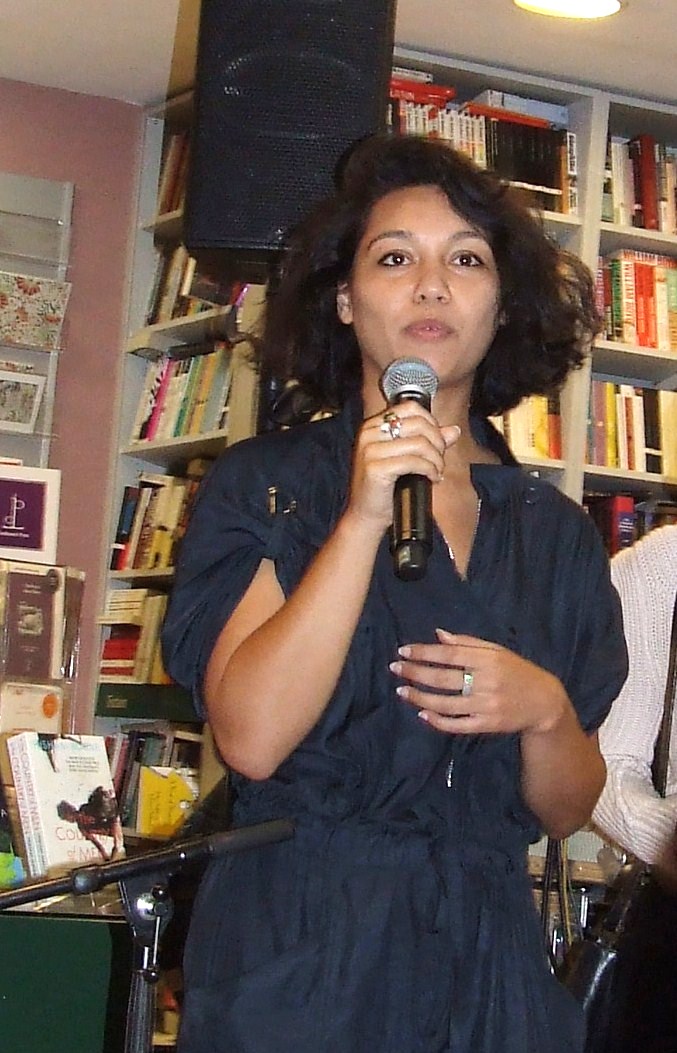
 Sophia Al-Maria

"In revisiting the only recently abandoned Atlal of my personal past I found my way as an extraterritorial extraterrestrial lost with nothing but a broken moral compass of these books and music and movies for a guide."

She said she couldn't talk about the beacons that led her to writing without talking about the over-arching theme of her book: "being lost". In writing her memoir "I had to have a clear destination and route in mind when I began or I'd end up hacking my way down the same old paths as my predecessors who are far better at writing anyway. .. navigating a narrative from my prehistory to my present without falling into certain traps of writing as or about being Arab and being female was going to be tricky. There were traps set out for the native informant not all of which I avoided successfully ... anthropological musings on Islam, tribalism, cultural mores, sexual proclivities and that sin of sins self-Orientalisation."

Al-Maria concluded: "The leaden personal geographies of north, south, east, west, here, there have in the 20th and 21st centuries provided a fine ballast to the literatures of the Arab world, and more generally post-colonial literature - but I'm not so sure any more.

"This approach - however wonderful and necessary at the time Tayeb Salih or Waguih Ghali were writing - has in this age of selfies started to seem really indulgent and has turned us into tail-eating ouroboroses, Golems lost to time isolated in our caves, muttering in schizophrenic debate about identity politics, when the world is waiting for a surprise and something shiny and new, something ... precious to emerge."

Ma'n Abu-Taleb reads All Things

In introducing Jordanian writer Ma'n Abu-Taleb to the audience, Chalabi said he was "determined to steer clear of identity politics" in his contribution.  In addition to his fiction writing Abu-Taleb is co-founder and editor of the online Arabic music analysis and criticism magazine Ma3azef.com. His story, All Things, was translated jointly by him and Egyptian Wiam El-Tamami, who in 2011 won the Harvill Secker Young Translators' Prize. Abu-Taleb's interests include philosophy and his story is introduced with a quote from Alexandre Kojève: "Except that the dog is here and now, while its concept is everywhere and nowhere, always and ever." Abu-Taleb works in communications and in his short fiction he has a talent for succinct writing and clarity.

The narrator of All Things is on a worldwide quest to recapature the experience of eating a wondrous chocolate ice-cream once given to him by a big, comforting hand in a strange street in which people are speaking a strange language. "In London, I thought I would find it. This is why I fell in love with that city: if there were five people in the entire world obsessed with one very odd and obscure thing, three of them would be in London - and will most likely have formed some sort of club.

"There, I got together with ice-cream lover; in fact, I joined a society for fans of my flavour, chocolate. Our monthly meetings were held in a pub called The Duck and Barrow and were usually attended by twelve or thirteen people, most in their forties. We would have a few pints, share stories about ice cream, and organize visits to ice cream artisans all over Europe I soon came to realise, however, that their obsession was not quite the same as mine..."


Hisham Matar''s debut novel

In the final session of the evening, Chalabi interviewed Hisham Matar and Margaret Obank. Like Sophia Al-Maria, Hisham Matar writes in English. His first novel, In the Country of Men (Viking, 2006), set in Libya, was shortlisted for the Man Booker Prize in 2006. His second novel Anatomy of a Disappearance also won accolades. Both novels have been translated to many languages. Matar writes for publications including the New Yorker magazine and the Guardian newspaper. 

Matar wrote the introduction to the New York Review Books Classics 2010 edition of Denys Johnson-Davies' 1969 English translation of Tayeb Salih's The Wedding of Zein, illustrated by Ibrahim El-Salahi.


 New York Review Books Classics edition of The Wedding of Zein, with an introduction by Hisham Matar

Matar said he had been deeply touched by Obrist's discussion with Ustadh Ibrahim El-Salahi about the artist's friendship and artistic collaboration with Tayeb Salih. "It was a wonderful portrait that you painted of two friends - I think you said coming to know one another perfectly - it made me think about whether I know anyone perfectly, I don't even think I know myself perfectly.

"I find it very difficult to imagine that Tayeb Salih wouldn't feel deeply grateful to you for this wonderful, generous portrait that you've painted tonight - generous towards him but also towards us. So it's an inspiration."

Matar thought it appropriate that Tayeb Salih had been chosen as the inspiration of a conversation about London. He remembered reading the line by Edward Said describing Season of Migration to the North as a Heart of Darkness in reverse. "That statement is for a Western audience - but for me in a sense Season of Migration to the North is a sort of Heart of Darkness not in reverse, in the sense that through it he managed to paint for us a sense of isolation that perhaps we were enduring and feeling but no one had articulated in this particular way."

Matar thought London was an interesting place to do that because "notwithstanding the usually stated assertion that London's wonderful qualities of tolerance and acceptance of outsiders it remains on some level a complicated place to be a foreigner. It lacks some of the social grace - for lack of a better expression - that eases the path, that maybe even helps to delude, the foreigner that he or she is not a foreigner.

London is an interesting and wonderfully appropriate place for an exiled artist to work because it offers an "abstracted existence where you are not socially obliged - in fact you are socially almost the opposite - in a sense that the abstracted space itself is on some level cruel, it needs to be cruel, and so for me personally it's a place that it's good to make work for that reason."


Asked by Chalabi whether, after all these years, he thinks of London as home, Matar said: "I never think of this question about home, until someone asks me. When I sit and make work I don't think about home, when I'm walking around I don't think about home. I think about incredibly mundane, specific things - who I'm going to see, where will I sleep, when do I eat, you know. It's home in the sense that I know how to do all of those things here, I know the good places to eat, I know where my friends are, and I know where to escape, which I think is a definition of home."

Chalabi said it is clear from Matar's books that he is able to function in a variety of cities. "I would be interested to hear you talk further about this idea of dislocation and of mapping cities onto cities and that process that occurs as a exile."

Matar replied that when he first came to London as a 15-year-old "I found that my most visceral experiences were happening with literature, and art, and film, and music. I didn't belong to an Arabic community that was somehow sheltering me. I felt very exposed to British culture for that reason.

"Being Libyan and from a family that's the wrong side of the dictatorship your immediate instinct when you hear a Libyan voice is to run in the opposite direction. So your own don't represent a sense of kind of a sheltering community, and my engagements were through art and literature."

Matar added, to audience laughter: “When I watch the quantity of Arabs that hover around Selfridges I think that maybe that is also a sort of engagement with the city. Perhaps the history of the Middle East would be entirely different if the amount of people that have been going to Selfridges from say 1948 - an interesting year - to the present had gone, say, to the National Gallery or the Serpentine Gallery."

Matar, who was born in 1970, said: "I think one of the things London does, to particularly the younger generation of Arabic artists and writers, is it becomes a sort of dreamscape, it becomes a space where to fantasise - particularly about conduct actually, not even identity, but ways of being. And so it becomes a space for experimenting with this. I think that's something that hasn't - for many good reasons - really come through work by writers from a previous generation. Not even from my generation. I think it's something that's happening more now."

Asked about the experience of having his work translated, Matar said "I don't really have much to say except that every time I am translated into a language I know it is a deeply painful terrible process, not marked by any pleasure at all." Even though he thinks very highly of his Arabic translator, with whom he works together, it is still "deeply painful".  He is not sure of all the reasons for this, but "one of the things we forget when we read a book in translation is that none of the words in there have been written by the author. If you are the author, it is slightly complicated. But as a reader I find it incredibly interesting... when I  read a translation, particularly a good translation. It's fascinating because what you're hearing is two writers working at the same time in a sense. And a good translation can conceivably be better than the original because you have two writers working on it. But when it's my own work I'm too close and too involved to be objective about it."

Chalabi said the landscape sounds very different from when Matar began, and "we see that in London with Shubbak as a festival, now in its second iteration." (Pop-Up Mathaf was one of the final events in the second Shubbak festival of contemporary Arab culture, which ran in London from 22 June to 6 July).  She said: "I think it's interesting to see that there is a certain generation of young Arab authors, artists etc who feel that this notion of the Other is no longer necessarily relevant". She asked Matar about the issue of "how does one conduct oneself, how does one position oneself, in terms of representation, in terms of acceptance by different places to which one is supposed to belong ." 

Matar said that one of the things that happens to you when you're Arab, or from anywhere in the world, and you go to a place that has very specific ideas about who you might be or the place you come from is that you are immediately confronted with history, that you have to engage with in a sense. At some level history is not only events but it is also assumptions. Britain has a ... very definite sense of the self which expresses itself in a kind of confident gesture such as criticising oneself, criticising the place, flirting with ideas of living here and there, buying places here and there, a kind of expression on one level of a sort of national confidence that invests a lot in certain readings of history.

"And if you come from a place like Libya or the Sudan, and you are a young man here, and you are not surrounded by your own, then you are in a sense in a very vulnerable historical place. I remember when I first came here and there wasn't a day I didn't hear something on the radio or read something in the paper that wasn't presumptuous about myself, or about my part of the world, or about my history. It had some sort of presumption that wasn't exactly accurate and that is something that you have to find a way to deal with. I think particularly as an artist."

Margaret Obank

Margaret Obank said that during the evening she had been remembering the various occasions on which she and her husband, the Iraqi writer and editor of Banipal Samuel Shimon, had met Tayeb Salih. She particularly recalled a conference in Nottingham. "When all of us who had been at the conference had nothing to do, Tayeb engaged us by reciting Mutanabbi the whole evening. Absolutely brilliant, word perfect".

She recounted how Banipal came to be founded in 1998. She knew many members of the Iraqi community in London and then met and married the Iraqi writer and journalist Samuel Shimon who was at that time a publisher of poetry in France, with the small press Gilgamesh Editions. She had been trying to learn Arabic at night school and so on "but never learnt enough  to read it. I've always loved poetry and literature myself." And so the idea was born of translating and publishing Arab literature in English themselves, and after discussion with some of their many Arab writer friends "we decided to do that. And we didn't know how it would happen but it did.

"We felt really the most important thing was the literature of the Arab world is part of the canon of world literature. We, I, felt a responsibility to bring it into the English language." She showed the audience the first issue of Banipal, with its cover illustrated by the Syrian aritst Youssef Abdelké showing the Arabic letter "ayn" and the letter "E" to symbolise the Arabic and English languages. The magazine started an A4 size but is now in a book format. Three issues appear annually and the 47th issue of Banipal, with a focus on Kuwait fiction, has just been published.

Obank said the magazine had received a lot of letters telling them they had made a mistake in depicting Banipal as a magazine of Arab, rather than Arabic, literature. "We said no, we haven't made a mistake. Arab authors write in many different languages, particularly with the growing diaspora.  So we publish Arab authors who write in any language, and even in English of course."

Many Arab writers do not know any English, and are very pleased to be translated into it. Obank noted the ways in which the world of translation has changed since Banipal started, including the introduction of new technology. When Banipal started, many people thought that translation from Arabic had to be carried out by a mother tongue English speaker with an English name. If a translator had an Arabic name some found this less acceptable - an attitude that still persists to a small extent. 

The teaching of Arabic, and of translation, has completely changed. Since 9/11 there has been a phenomenal growth of interest in the Arab world, and translation departments are massively over-subscribed. "Two or three generations of young students have come out who are  very keen and who have a completely different attitude from the older generation about the Arab world."


"We're always looking for ways to encourage people to read, to get across, because you've got in this country a massive media, you've got a massive state establishment, and you have an ideology which is actually full of stereotypes about the Other, particularly about the Arab world, considered to be full of camels." (When the Mayor of London Boris Johnson spoke at the Shubbak reception, he told a story about a camel and its drooling lips..)

 But on the other hand we want readers all over the world to enjoy contemporary Arab authors and to get into the heart and soul of those countries where they come from. And we really feel that it's through literature that you understand the other and you get this dialogue between cultures and, you know, when somebody reads a translation you read and you get involved in it and you have such an incredible experience - you are sort of living the life of the author, of the author's characters, and so for human beings this is incredibly important. to have an experience of other cultures.

Banipal receives many requests from the younger generation with BAs or MAs from top universities to work as interns at Banipal, and "so we have this continuous stream through".

In addition to the magazine, Obank felt ahamed that the field of Arab literature translation was so poor, and so every few years Banipal launches an initiative to increase it. One of its major initiatives was to start the first-ever prize, the annual Saif Ghobash - Banipal Prize for Arabic Literary Translation, for an Arabic literary translation published as a book.

This immediately put Arabic on the same level as languages such as French, Dutch, German, Spanish, Greek and Hebrew for which there are literary translation prizes administered by the Society of Authors and awarded at the annual awards ceremony.

Banipal has also organised tours of Arab authors, "bringing them over from different countries to travel around Europe, going to read in libraries and we came here to the London Review Bookshop." Then the London Review of Books started World Literature Weekends, which in 2011 included an Arabic Literary Translation Workshop run by Professor Paul Starkey.

Deena Chalabi said that one aim of Continuous City: Mapping Arab London is to try to map out archives in London that help to tell certain kinds of histories and stories about the Arab world. She asked Obank about the Banipal archive. "How accessible is it, and what are your plans for increasing its accessibility?"

Obank said "we haven't really thought about it being accessible unless somebody's doing a PhD or a study." She noted that the Banipal website carries every issue of the magazine, and information about the contributors, including authors and translators. There have been around 800 contributors so far.

Obank pointed out that although Banipal has many translators and authors all over the world, "in our little office is a very small team." And Banipal does not really get any support from the Arab world. "We always thought that we would once we started we would get major funding and would be able to employ somebody to create and look after an archive." But there is virtually no funding coming from the Arab world, and yet there are huge foundations translating into Arabic from other language.

Obank said the lack of respect for contemporary Arab literature is "a big problem in the Arab world." There are many prizes, and literary festivals, but "making sure that the rest of the world hears the voice of contemporary Arabic literature is not one of the concerns. And that's a problem for us - we have to rely on asking the Arts Council to give us some support" - which is tiny. "We'd love to have an archive, but we need the funds to create it. If anybody wants to come to our office, they're very welcome to visit."

Thursday, July 18, 2013

part 1 of pop-up mathaf: mapping arab literature in london

Tayeb Salih

Serpentine Gallery and Mathaf:Arab Museum of Modern Art map London-Arab links
by Susannah Tarbush
Part 1
(Part 2)
 
London has long been an important city on the world map of Arab literature, with Arab authors writing about it and sometimes making it their home. The Arab literary relationship to London was the focus of  Pop-Up Mathaf: Mapping Arab Literature in London, an evening event held recently at the London Review Bookshop. The event was part of Continuous City: Mapping Arab London, a series of talks, discussions and publications mapping relationships between London and Arab cities. Continuous City is being developed by Doha-based  Mathaf: Arab Museum of Modern Art  and the Serpentine Gallery's Edgware Road Project as part of Qatar UK 2013 Year of Culture.

The event was a tribute to the late great Sudanese writer Tayeb Salih (1929-2009), author of the acclaimed and pioneering novel Season of Migration to the North which was first published in Arabic in 1966. The novel was translated into English by Denys Johnson-Davies, and has appeared in around 30 other languages. Season of Migration is partly set in London, where Salih himself resided for a long period and where he was at one time head of drama for the BBC Arabic Service.


The gathering offered the audience the privilege of hearing from Salih’s 82-year-old close friend and collaborator, the Sudanese artist Ibrahim El-Salahi, a man of much wisdom, clarity and charm. His major retrospective Ibrahim El-Salahi: A Visionary Modernist , bringing together 100 works produced over more than 50 years, opened at London’s Tate Modern on 3 July and runs until 22 September.


Ibrahim El-Salahi

Pop-Up Mathaf: Mapping Arab Literature in London was hosted by Deena Chalabi, a New York-based writer and curator who grew up in London and was founding Head of Strategy at Mathaf: Arab Museum of Modern Art. This year she is guest curator of the two Pop-Up Mathaf programmes in London and Liverpool.

Chalabi said it had been "an absolute honour" to know El-Salahi since the opening of Mathaf almost three years ago. He was not only one of the artists in Mathaf's opening exhibition, Sajjil: A Century of Modern Art, but was also featured in the exhibition Interventions. "The work he has made in Doha before and since continues to be an inspiration to all of us."

Pop-Up Mathaf: Mapping Arab Literature in London was one of the events in the three-day Ehtifal Festival of art, literature, music and family events presented by the Serpentine Gallery and the Qatar Museums Authority (QMA) as part of Qatar UK 2013 Year of Culture. Ehtifal was also one of the final events in the Shubbak Festival of contemporary Arab culture from 22 June to 6 July.

Since opening in Doha in December 2010 Mathaf has explored various strategies for engaging with audiences in the Arab world and beyond. The Pop-Up Mathaf framework, developed by Deena Chalabi, aims to engage with international audiences through a “flexible, innovative and engaging cross-cultural platform for multiple voices on art and ideas.” This year Chalabi is guest curator of the two Pop-Up Mathaf programmes in London and Liverpool.

Deena Chalabi

Chalabi said the Continuous City project grew out of conversations she had with the Edgware Road Project, and during her upbringing in London with Arab relatives who were always referencing and thinking about other cities and places. Added to these conversations was “my exposure to the cosmopolitanism of Arab artists and writers in my work over the past five years with Mathaf”. Together, “they outline the importance of activating culture and memory, intergenerational dialogue, and engagement with place in different ways, as being crucial to each of us as we try and navigate our own space in the world.”

Jochen Volz, head of programmes at the Serpentine Gallery, explained that the Edgware Road Project is one of the Serpentine’s off-site initiatives. Since 2008 it has brought artists, thinkers, writers and researchers to the Edgware Road area. “Here we have worked with members of the community to chart histories and map relationships between London and the Arab world from a local perspective. It is in the spirit of this project that we are very happy to be collaborating with our great friends at Mathaf, the QMA and Shubbak to present this evening's programme"

Volz noted that he and the Serpentine’s Director Julia Peyton-Jones and Co-Director Hans Ulrich Obrist have worked with the QMA on many occasions. This collaboration included the commissioning of a public installation Rock on Top of Another Rock, by artists Fischli and Weiss, currently on display in Kensington Gardens.

Rock on Top of Another Rock in Kensington Gardens

Volz said: "It is with this idea of exchange in mind that this evening we will hear from writers and publishers who span generations of Arab literature in London. They will interrogate questions of time, place, memory and migration.”

He added that “Continuous City invites artists, writers, economists and historians to develop an atlas charting relationships between London and the Arab world. We will see the results of this research emerge through publishing initiatives, online and through events.”

Janna Graham

Janna Graham, curator of the Edgware Road Project, explained "we've been working on archives for many years connecting the Edgware Road to other places in the world. It was a great moment when Deena approached us and said what would it be like to do this in a broader way - to think about London, mapping histories of the relations between the Arab world and London, but not through a sociological or purely anthropological or purely journalistic perspective, but through all the kind of poetics and artistic strategies that have been developed over a number of years. We're really happy to be launching this year of work together, which complicates this question of what it is to do a mapping to begin with, because we all know histories of mapping are not always the best histories to refer to."

Amal Khalaf

Amal Khalaf, assistant curator of the Edgware Road Project said Continuous City is “a really great opportunity for us to put out all of the research, the studies, the stories that we've been collecting on the Edgware Road with artists and people from the community, from the cafes, from the community centres and cultural centres.”

Deena Chalabi said the Pop-Up Mathaf event was "just the beginning of the Continuous City project which will feature research on many different aspects of Arab London. The publication will hopefully include many expanded versions of the conversations and readings this evening." The contributions during the ever would be “teasers for what will come later" in Continuous City. “Each of our writers and artists has tremendously varied experiences of the world and this particular world city we're in and we're delighted to have them all with us.”

Serpentine co-director Hans Ulrich Obrist screened a short section of a two-hour interview he conducted with Tayeb Salih at his house in Wimbledon in 2006 as part of the gallery's first Marathon event. Obrist cited Eric Hobsbawm “who always said we need an urgent memory moment”. Obrist added that “memory may be in our age of the internet even more urgent than before: because we have more and more information there are more memories. Maybe as Rem Koolhaas said there is much amnesia in the centre of this information age.”

His interview with Salih included discussion of mapping, memory and Season of Migration to the North. The novel is "an inspiration not only to so many writers but also to many architects we work with, and to many visual artists. So we felt it was very important to do an event in memory of Tayeb Salih."

He discussed with Salih what Hobsbawm had told him about living in an age of increasing amnesia and that he thinks we should somehow protest against forgetting. Salih responded “I also claim that I'm trying to do that because in the things which happen to a country like the Sudan and the changes and the coups and the new ideology, the various ideologies, often people think they are doing something new but they are not.

"If only they could go back 100 years, 200 years, 500 years they will realise that they are not doing anything new, they are merely repeating, in a slightly different way. And a great deal of time is wasted because people imagine they are innovating, they are pioneers, they are doing something new, they are not. So awakening memory is very important."

Salih compared the writing of a novel to carrying out archaeology. "In my writing I hanker after something impossible: to keep the world I knew and loved the same. And of course I know very well that is impossible, but there is no harm in trying. Many architects are now trying to do the same, and poets and painters and so on.”

Obrist asked Salih about Season of Migration and issues of transition, migration and being out of place.  Salih said "when you read Season of Migration with reference to an earlier novel called The Wedding of Zein – in which the community I grew up in is more or less intact - then you see the trauma which befell the community in the end.

a photograph of the young Tayeb Salih (R) displayed during Pop-Up Mathaf

“There is a stranger coming from the outside - and then the place undergoes a very extreme trauma with double murder in the village and things the like of which never happened before. It’s almost a Shakespearean idea or Greek idea. Shakespeare [Hamlet] says ‘Time is out of joint’. And the time comes out of joint in Season of Migration.”

Obrist read out a message which the legendary 88-year-old Beirut-born poet, writer and visual artist Etel Adnan had sent to the event from Paris.  Obrist said many of Adnan's paintings had been shown in the last Documenta in Germany and that she had often talked to him about Salih and his notion of time being out of joint.

Adnan's text began: "I am writing you a letter, dear Tayeb, as where you are computers haven't reached yet... " She recalled meeting him in Beirut in around 1973. “You were radiant. A beautiful human being. I had to interview you for my newspaper. I had such a love for your writings that I couldn't say much. I still can't.

“You brought Africa in Arab literature - of course the whole of North Africa is African but that didn't really enter our consciousness. We have a serious reality problem, we are mainly Africans, and because of you we may start to belong to that continent that is still to be discovered by its own people... you brought - with the immense expanses of the Sudan and the incredible majesty of the Nile - a modernity and an elegance of style that no one in Arabic had ever achieved."

She wrote that Salih "spoke of our new nomadic lives, the caravans nowadays not following the Silk Road, but always North. I remember that your voice over the radio had the humming of a drum, and your thinking the originality of wild life."

Hans Ulrich Obrist interviews Ibrahim El-Salahi

After the screening of the excerpt from his 2006 interview with Salih, Obrist recalled that during the interview “I asked him about art and his answer was very short: he said for him art is Ibrahim El-Salahi."

In conversation with Obrist, El-Salahi spoke captivatingly about his creative friendship with Salih whom he first met at secondary school in Omdurman. "I remember him very well indeed. He was a little bit shy, kept to himself, he was a bookworm. He read a great deal and he learnt and recited Arab poetry and colloquial local poetry.” As far as Arabic classical poetry is concerned he was “in love till his last days with Abu Tayeb al-Mutanabbi”.

At secondary school "we grew really close to each other and I understood him fully during our fourth year and that was in 1948, a long time ago." Tayeb loved chatting and getting together. But it was only years later that he found out Tayeb was a writer: “he was secretive, almost shy” about his writing.

"The first time that I knew he was a writer was in the early 60s. I was contacted by Tawfiq Sayegh, the Lebanese publisher, who ran the magazine called Hiwar - Dialogue - and he said to me 'Tayeb Salih says that you have to illustrate this book', which was The Wedding of Zein, with the seven stories in it. So I read the material .... I was puzzled, I said to him when I met him later, Tayeb Salih, you have all this wealth of literature and creative work and you never tell me about it? He said it's very simple, there's nothing much at all about it. He was very humble about his work, as if he wasn't sure in the beginning of the strength and power in his work." Working on illustrations for The Wedding of Zein was "when I realised what a powerful writer Tayeb Salih is."


This period "coincided with a time when I returned from Europe and for many reasons had to change my style and my work and get down to simplify form. So I did the initial illustrations for him - many people who saw it, I remember, thought that ‘this chap can't draw’ because it is simplified almost to the backbone. And I used to work on something which is representational and so on in detail with perspective, and anatomy, everything - but this was bare."

El-Salahi said when he had heard Salih's voice in the extract from Obrist's filmed interview it "made me a little bit sad not to see him here with us. But he speaks about the past, the wealth of the past in Sudan, long before the time of Kush, and the kingdoms we had. And he always evokes the past in such a lively way.

 “I know he cared a great deal about my work as a picture maker, as a draughtsman, but I think of him as a real artist because he can create with words the essence of the scene and makes it so alive that it's fantastic - he's a painter."

Ibrahim El-Salahi spent time as a political prisoner in Sudan in the 1970s. Tayeb Salih helped him during this difficult period. "He was at that time working as a director of information in Qatar and he sent two telegrams to get me out of Sudan to Qatar with the pretence of helping in the process of creating a department of culture - which was there before. It was just a kind of a trick to get me out."

In Qatar he was asked by  Doha magazine to illustrate Salih's story Maryud (which was published in  English translation by Denys Johnson-Davies, together with the story Dan al-Beit, as Bandarshah). "That was something I enjoyed enormously because here with all the characters which are in it and all of them who evoke the past and the riches of the life we had before - I never know what happened later on - that's the kind of work I did in The Wedding of Zein and all the seven stories which are involved in that book and with Maryud. I used to call him Maryud because I saw in him the flag of our history, the flag of our dignity, as Sudanese - a mixture of Arab and African and Nubian."


Obrist told El-Salahi he had been reading during the previous couple of weeks "this incredible book which Salah Hassan edited,  Ibrahim El-Salahi: A Visionary Modernist , which is actually in a different form and different cover the catalogue of your Tate exhibition." The book includes an interview with  Ulli Beier on his collaboration with Tayeb Salih in Qatar, and the illustrations to his work made for Doha  literary magazine. "You said how important they were because they led you to something more surreal, more colourful. They were  somehow the trigger for you, for many many works you did after, larger designs with calligraphy elements. I think it's so interesting this dialogue between you as an artist and him as a writer, which was much more than illustration - it triggered something."


El-Salahi said Salih was "always interested in seeing how I developed my work. I remember that when I came back from Europe I changed into a style which was manifested first in his books which I illustrated. I cared about two elements which I found valuable as far as aesthetics are concerned: Arabic calligraphy and African motifs and sense of decoration, which also takes me back to my childhood. I remember I was sent to school at the age of two and there whenever we learnt certain verses of the Koran we decorated our wooden slates with a sense of decoration that we called sharafa - sharafa means the honoured one - and we honour what we learn and what we believe in.

"I took those two elements - Arabic calligraphy, and the sense of decoration -  and I put them in a melting pot to see what I could derive from them, what I could get out of this combination of two elements - an abstract form, an abstract design. And that's how it worked in the beginning. In  the early 60s in the Sudan I was working in  collaboration with other artists who were there at the same time and had the same notion of the identity of the Sudanese in Northern Sudan - and this was called later on the 'School of Khartoum'." It was the painter and art critic Denis Williams who gave this title to the art movement in Northern Sudan.

Self-Portrait of Suffering by Ibrahim El-Salahi 1961
Iwalewa-Haus, University of Bayreuth, Germany © Ibrahim El-Salahi

The artists in this movement were "trying to create a new alphabet, a new idiom, a new pictorial idiom, which can relate and join up with the people, because we cared very much indeed not to be artists who are separate and living in a vacuum, but to bridge a gap between the artist and the public. I find that the artist has three entities to address: the first is the self, and the second is others around in society, and the third is all, which is the human being wherever it might be. If an artist can hit those three birds with one stone he will make it.

"Tayeb Salih was very keen and always asked me to show him what I am doing.  He used to say to me  sometimes - because I had some times when I managed to break the form of the letter to see the components and what is in it - other things came out - plant forms and animals forms and spiritual shapes - he used to say to me, 'all those devils you create, you'd better control some of them, otherwise they will overpower you.' I'll never forget him saying that."

Obrist asked him about unrealised projects. "We can see five decades of your work at Tate Modern, so much of your realised work, books in collaboration with Tayeb Salih are also in the exhibition... are there projects you still have not realised? What are the unbuilt roads of Ibrahim?"

"There are many of them," El-Salahi said. "I keep working continuously, until now. I am 82 years, I am going to be 83 soon, in September, I keep working daily - I only stop now because there is an exhibition. But I work about 12 hours a day seven days a week - I find it is something which has to keep going on. I have works comes to me as ideas as sort of a sperm of an idea kind of a germ, a small thing. By working at it continuously it grows and develops.

"Right now I have masses of canvases which are still blank, and I'm just waiting for this exhibition to finish to start working on them. The thing is that there's a child within me - 82 years, 83 years, but I still have a child which has never grown and therefore never leaves me alone at all, and reminds me that there is a lot to be done before it's time to say goodbye."

Thursday, June 20, 2013

'Writing Revolution: The Voices from Tunis to Damascus' launched at the Mosaic Rooms in London


In the past two years a variety of books on the Arab revolutions have appeared in English. They range from "instant histories" based on tweets to the accounts of journalists who covered the uprisings. 

The book Writing Revolution: The Voices from Tunis to Damascus published recently in London by IB Tauris is different from other books so far on the Arab revolutions. It is a unique collection of substantial essays on the revolutions by eight authors from different Arab countries (excerpts are on the IB Tauris website). All but one of the essays were completed between May and December 2011. Wishful Thinking by Saudi journalist Safa Al Ahmad is dated September 2012.

The essays were specially commissioned by the editors: activist and writer Layla Al-Zubaidi, who is Director of the Heinrich Böll Foundation in South Africa and was previously based for the Böll Foundation in Beirut and Ramallah; journalist and photographer Matthew Cassel, who covers the Middle East for Al Jazeera English and is former Assistant Editor of The Electronic Intifada; and literary agent and writer Nemonie Craven Roderick .

The introduction to the collection is by the renowned Syrian writer, journalist and activist Samar Yazbek. In 2012 Yazbek won the PEN Pinter International Writer of Courage prize, and the PEN Tucholsky Prize in Sweden, for her book  A Woman in the Crossfire: Diaries of the Syrian Revolution (Haus, 2012). This year she won the Oxfam Novib/PEN Award for Freedom of Expression.

Yazbek writes: "These revolutions pre-empted the process of revolutionary and intellectual theorizing, and yet now wait on a new form of literature to describe them: a writing forged in the present moment." The essays "vary between the personal and the general, but all express a single point: that writing at a time of revolution is part of the process of change. Moving between the subjective and the dispassionate, they offer us examples of heroism and of hope for the future."

L to R: Matthew Cassel, Layla Al-Zubaidi, Nemonie Craven Roderick and Mohamed Mesrati

At an event on Writing Revolution at the Mosaic Rooms in London, Nemonie Craven Roderick said: "I don't think it's inappropriate to invoke Walter Benjamin who, when he felt there was a need for a new kind of historical writing, said it should be by those who can bear witness to change at a moment of risk or danger. That's what the contributors to this book have done, and the essays are incredibly striking. They are certainly very personal, and passion really flies off the page."

The excellence of the book was recognised when it won an  English PEN Writers in Translation Award 2013 last November. The awards provide publishers with funds to promote and market the winning books.

Craven Roderick said it is hoped that, following its publication in English, there will be various foreign editions of Writing Revolution. It already has a Turkish publisher, Metis, which was co-founded by "an amazing courageous publisher Müge Sökmen - a wonderful woman." She added: "We are in conversation with a few Arabic publishers."

The evening at the Mosaic Rooms was one of several UK events to mark the launch of Writing Revolution. There were events at the Hay Festival,with English PEN's director Jo Glanville; at the Frontline Club in London, chaired by journalist and writer Rachel Shabi;  and at St Anne's College, Oxford University, organised by Oxford Student PEN.

On 28th June there is an opportunity to hear contributors Mohamed Mesrati of Libya and Malek Sghiri of Tunisia when they appear at The Rich Mix in London as part of the Shubbak Festival of contemporary Arab culture.

At the Mosaic Rooms Mesrati appeared alongside the book's editors. Layla Al-Zubaidi said: "For us the aim was to get out some of the voices that usually wouldn't be translated: some of the authors have never been translated into English and some have never written anything, even in their own languages."

She said that although journalism and the activities of foreign reporters have been important, "we felt that it's also important to hear people who are actually engaged in the revolutions writing about themselves in their own language. We wanted them to write in a literary fashion so that we wouldn't have the same as is found for example in blogs or newspapers."

Craven Roderick highlighted the vital role of translator Robin Moger, who translated five essays and Yazbek's introduction from Arabic to English. She noted that Moger is also translating Mesrati's novel-in-progress Mama Pizza and his other work, and is  "incredibly excited" about his writing.

Algerian journalist Ghania Mouffok wrote her essay  We Are Not Swallows in French; it was translated to English by Georgina Collins. Safa Al Ahmad and Egyptian journalist and writer Yasmine El Rashidi submitted their contributions in English.

Al-Zubaidi said the editors had wanted to make sure that the contributors were really honest about their weaknesses and doubts: "If you read the essays you can read a lot of doubt and sometimes also fear about the future. We felt it is extremely difficult in that milieu to find people who really express themselves very honestly... we didn’t want to have political messages, we really wanted to have personal stories with all their kind of conflicting identities, opinions etc."  

Matthew Cassel pointed to the limitations of journalism, with journalists having to meet limits such as word count and deadlines, and increasingly relying on "a small number of elite experts who have made a career out of analysing events in the Middle East."

He said: "That's exactly why I think we need more voices who at least couple the journalism with the voices on the ground to really give us the depth, the detail about what’s happening on the everyday. If we just follow the news we’re not really going to get a full picture of what’s happening in these countries."

The Mosaic Rooms event was enhanced by readings from Writing Revolution by actors Sam West and Jonjo O'Neill. Belfast-born Jonjo O'Neill read from Mesrati's essay Bayou and Laila in his warm Irish accent. Sam West gave a powerful reading from Bahraini activist, critic and author Ali Aldairy's essay  Coming Down from the Tower.

Mesrati completed his wide-ranging essay in exile in London in May 2011 while the Libyan revolution was raging, its outcome far from certain. He said: "When I wrote it I thought it was going to be the last thing I'm going to write, because at that time I was going back to Libya."

Nemonie Craven Roderick and Mohamed Mesrati

Bayou and Leila is named after Mesrati's parents, opponents of the late Libyan leader Muammar Gaddafi. They fled Libya with their children in 2005 and were eventually given asylum in the UK. Mesrati was 21 when he wrote his essay. At the time he was beginning to make a name for himself as a writer of short stories, and an excerpt from Mama Pizza had been published in April 2011 in Banipal 40's special feature on Libyan Fiction (Mesrati talked about his life and writing in this interview).

Knowing the essay might be his last-ever piece of writing, Mesrati tried "to deliver many messages - to tell the story of my parents in opposition, and to tell the story of my friends, and to say what I wanted to do in this life, and what I wanted to write, and all the dreams that I wanted to come true - but there was only one thing I had to do, to go back there and be among all the rebels and join the fighters."  He felt he needed to put into the essay "all the novels I'd like to write in the future, and all the essays".

Mesrati's wide-ranging essay begins with his being "born into history" in Tripoli in 1990, when Libya was suffering under the sanctions imposed after the Lockerbie bombing. With humour and precision he conveys the flavour of life as a child growing up under the Gaddafi regime as part of "a generation born from our fathers' defeats." In art classes pupils would illustrate "tragic and deeply dull themes like 'Spring', 'The Joy of the Libyan People at the Revolution', or 'Cleansing the British camps from the Homeland's Soil'. Not once were we asked to draw a loved one's face or our parents."

He and his four deareset friends Khairi, Altakali, Baaisho and Faris got up to mischief and played schoolboy pranks.  But there were undercurrents of fear. Mesrati's father was an actor and theatre producer, but the regime's repression, censorship and paranoia severely curbed artistic freedom. He earned his living working in the oil industry.

Young Mohamed's favourite childhood story was The Elephant, O Ruler of Time! which his father would tell him with "his rich radio voice and his theatrical gestures." Only some years later would Mesrati fully grasp the desperate truths about Libya and its ruler Colonel Gaddafi symbolised in the story.

 Jonjo O'Neill

Mesrati's essay takes a chilling turn when he depicts the horrific days when his student father and schoolgirl mother witnessed the terror of the late 1970s and early 1980s. Students were crushed and  some were publicly hanged.

When the Libyan uprising started on 15 February Mesrati re-established from the UK contact with his childhood friends Khairi, Baaisho and Altakali in Libya (Faris had been killed in a car crash). He received daily reports from them which he circulated on Twitter, Facebook and elsewhere. The three friends went to fight for the revolution. On 21 February 2011, "the day of sadness, the day the cross of tears was lowered across my back", Mesrati learned that they had been killed.

Mesrati's essay concludes: "This story doesn't end here. The truth is that there are many stories that need to be told ... this is a people that have borne the weight of enough stories to fill all the novels and films you could wish for. To be continued..."

Mesrati is now working on a film, The Morganti Rebels, with Lebanese director Nisrine Mansour. The film tells of four friends who were on the frontline during the revolution and launched a coffee shop in the heart of Misrata. "They have a library and they are doing gigs every Thursday and they have literary events and a place for discussions. Many intellectuals, writers and activists after the war started to go regularly to that coffee shop. We would like in this film to focus on art activism in Libya after the war and how culture and art are the only things that can make a change in society."

Ali Aldairy participated in the uprising in Bahrain but now lives in exile, founding the  online Arabic newspaper Mira'at al-Bahrain (The Bahrain Mirror). He was unable to attend the UK launches of Writing Revolution, but at the Frontline Club event he was represented by his friend and fellow Bahraini activist Ali Abdulemam. Abdulemam was one of the first to agree to contribute to Writing Revolution, but he then went into hiding for two years and the book's editors lost touch with him. He was sentenced in absentia to 15 years in prison and recently fled from Bahrain to the UK where he has been granted political asylum.

Aldairy gives a vivid account of participating in the uprising, which was met with violence by the security forces. He writes that the Bahrain revolution is about two things: state and sect. "How does a sect make the transition to a state? How does the state become a system of governance capable of incorporating a number of sectarian gropus with different (if not openly contradictory) cultures, interests and historical narratives?"

He recalls the funeral on 18 February 2011 of engineering student Ali Ahmad al-Mumin, shot in an attack by security forces on Pearl Square. Al-Mumin's final entry on his Facebook page was: My blood for my country. "Six hours later his words became reality, a truth that stunned his father, mother and six siblings when they received news of his martyrdom." Looking at al-Mumin's Facebook page "my senses were penetrated by his glowing image. I sat frozen before the picture: from its depths something was calling me to write about him."

Aldairy wrote an article for an-Nahar, addressing the dead student. "I see you in every young man I met" he wrote. University students copied the article and made it into a booklet which was distributed in Pearl Square. Aldairy was overwhelmed when Al-Mumin's father phoned him, and when later on he met the student's brother.

 Sam West

Saudi journalist Safa Al Ahmad writes perceptively of her visits to Arab countries in the throes of revolution, intercut with highly critical observations on Saudi Arabia. She begins: '"I'm Saudi. I'm sorry.' It's a phrase uttered at every introduction in Tunisia, Egypt and Yemen, not so much in Libya. Whisper it to myself in Bahrain."  Sitting with Yemeni women who are discussing revolution she feels they are decades ahead of Saudi Arabia on women's rights and civil society. In her Cairo hotel room she experiences "full-on revolution jealousy and depression".

 Layla Al-Zubaidi said that in their essays the contributors to Writing Revolution reflected on their own roles and "described what has led up to the revolutions so that people realise the revolutions didn't actually fall from the sky." The contributors had already invested much time and energy in political change before the uprisings began.

The Tunisian activist, trade unionist and student leader Malek Sghiri is from a long line of activists: his father was a political prisoner for a total of seven years under the Bourguiba and Ben Ali presidencies. In  Greetings to the Dawn: Living Through the Bittersweet Revolution  he writes of how during the revolution he and his comrades were horribly tortured at the Ministry of the Interior. His interrogator told him: "In 1991, inside this building but in a different room, I was one of those who interrogated your father."

Egyptian journalist and author Yasmine El Rashidi writes in  Cairo, City in Waiting of leaving her grandmother's Cairo house, in which she had grown up, to go and study in the  US in 1997. On visits back to Egypt she saw Cairo becoming "downtrodden and dim".  In summer 2010 she realised something was shifting, and later she was an eye-witness to the revolution: "... my memories of the 18 days, the revolution, are mere fragments of a larger journey and search that I now wait to complete."


 Matthew Cassel and Layla Al-Zubaidi

In  The Resistance: Armed with Words Yemeni journalist, poet and author Jamal Jubran writes as a Yemeni who was born in Eritrea to an Eritrean mother. On going to live in Yemen as a boy he suffered racism and was teased for his less than fluent Arabic. But he then had a revelation: "My talent for writing in Arabic would be my ticket out of the terminal state of weakness and vulnerability that left me exposed to daily humiliations."

Jubran has endured a series of vicissitudes, personal and political. After the unification of Yemen in 1990 he worked for a socialist newspaper. Then in the disastrous civil war of 1994 the Socialist Party was defeated. He eventually became a lecturer in the French department of a university, but then found his name on a hit list of an extremist party's "enemies of Islam". He became emboldened by a group of young journalists who championed  honest writing and freedom, and in his articles he expressed in particular his anger at the prospect of president Ali Saleh passing power to  his son Ahmed. Around the time students started to demonstrate for the removal of the president, Jubran was dismissed from his post at the university.

When the "Arab Spring" reached Yemen Jubran found it painful that certain Arab writers and intellectuals "found it hilarious that such a thing should be attempted in Yemen, and regarded our young people as poorly equipped for a revolution when compared with their contemporaries in Tunisia and Egypt."  Many were killed but "we did not fire a single bullet in response." He lost many of those he knew and feels bad about not joining the demonstrators in the revolution. "I did nothing but write."

Algerian journalist Ghania Mouffok's essay  We Are Not Swallows is a reminder of Algeria's painful history. "This epic has gone on for 130 years" she writes. When she takes her son on demonstrations  "it's not to teach him anything, but to show him that being a citizen of Algeria can be joyous, chaotic and rebellious." Her essay has an elegiac tone. She writes: "We are not swallows. We're not just making spring but also winter, autumn and summer too, because we've been around for a long time."

Khawla Dunia is a Syrian lawyer, writer and researcher and a member of the editorial board of the Damascus Center for Theoretical Studies and Civil Rights. She is the author of several studies, and contributes to the Arabic website Safhat Suriya. And like Yazbek she is one of those Alawites (the sect to which President Bashar Assad belongs) to take a courageous stand for freedom.

Dunia's essay, an account of the uprising in its first 100 days after the killing of demonstrators in Deraa, has the apt title  And the Demonstrations Go On: Diary of an Unfinished Revolution. As Misrati does with Libya, she compares Syria to the republic of fear portrayed by George Orwell in his novel 1984. Her husband had already been imprisoned twice previously for his political activities, and he is arrested for a third time during the uprising. He suffers brutal torture in detention, its marks obvious when he is released on bail.

Dunia's words "where is the country heading? The future is is terrifying and obscure" are, unfortunately, as apposite today as when she wrote them.
report and photos by Susannah Tarbush


Sunday, June 16, 2013

'Unholyland': Aidan Andrew Dun's book of Palestine-Israel love sonnets launched at P21 Gallery London 20 June

UPDATE: THIS EVENT HAS NOW BEEN CANCELLED DUE TO ARTIST ILLNESS - WILL BE RESCHEDULED

From the P21 Gallery: 

The staff of the P21 Gallery invite you to our next Thursday Fringe session -

Night of the Poets Presents: 

The Launch of Aidan Andrew Dun's Critically Acclaimed Book Unholyland  [reviewed here ] -  a dark romance of the Shift, a love story at the crux of our time

Thursday 20 June
6.30-9 pm
Hosted by Moses Latif: actor, lyricist, DJ and Music Producer
RSVP essential: info@p21.org.uk
£5 entry fee on the door

P21 Gallery 21 Chalton Street London NW1 1JD


Please see the attached invite. We very much look forward to seeing you there. 


Aidan Andrew Dun


Thursday, June 13, 2013

In honour of Khalid Kishtainy : an evening of humour, writing, music and painting at London's Iraqi Cultural Centre

report and photos by Susannah Tarbush 

 Waheda al-Mikdadi introduces Khalid Kishtainy

At an event held in his honour at the Iraqi Cultural Centre in Shepherd's Bush, West London on  the evening of 8 June, the Iraqi journalist, satirist, writer and painter Khalid Kishtainy spoke with candour and humour about his eventful and creative life. The event also marked the launch of his new book, an autobiography entitled Time in Iraq and England (Dar Al Hikma, London).

The evening was introduced by journalist Waheda al-Mikdadi, who paid fulsome tribute to Kishtainy's many achievements and contributions. Kishtainy thanked Waheda for her kind words and flattering phrases, which reminded him of "the Archbishop of Canterbury, when he was in a similar situation giving a lecture, and the chairman showered him with praise... the Archbishop came to the platform, paused for a while and said 'excuse me, I'm sorry but I have to make two prayers: one to ask the Almighty to forgive the chairman for all these flattering words, the other to pray to the Almighty to forgive me for having enjoyed all this flattery!'" Kishtainy continued: "In addition to these two prayers I make another one: that you will say these same things behind my back!"


'swerving between the worlds of word and paint'
Kishtainy was born in Karkh, Baghdad, on 10 October 1929. His father, Shakir Mahmud Kishtainy, was a teacher. A 12-page booklet on Khalid's life and works issued on the occasion of the evening begins: "With so many interests and talents, Khalid Kishtainy spent most of his life swerving between the world of the word and the world of paint. At the age of 18, he was busy writing poetry, like most educated young Arabs, and thought of improving his power of poetic description by studying painting, which prompted him to join the art department of the Fine Arts Institute in Baghdad." There he was coached by Faiq Hassan, a grand master of Iraqi art.

After spending five years at the Fine Arts Institute Khalid won a scholarship to study painting in London, where he was enrolled at Camberwell College of Arts, Chelsea College of Art and Design and the Central School of Art and Design. This period "influenced his entire life and opened his mind to Western thought." On returning to Baghdad, Kishtainy taught painting and theatre design at the Fine Arts Institute.

The evening honouring Kishtainy included the official opening in the Iraqi Cultural Centre's gallery of an  exhibition of paintings by him and by his daughter Jasmine Jones-Kishtainy. Jasmine was born during Khalid's first marriage: the booklet on Kishtainy tells of how "in some very unhappy circumstances, Khalid Kishtainy was separated from his only daughter, Jasmine, almost fifty years ago."

After a long and painful search he managed to trace her and re-established contact. To his surprise he found that she too had pursued a career in art, and had like him studied at the Central School of Art. 

Kishtainy's writing career began when he started writing for the Lebanese magazine Al-Adab during his time in England. He has written some 34 books in Arabic and English, and has a widely-read and highly-appreciated columnist in the London-based newspaper Ash-Sharq al-Awsat newspaper. He recently started to write a well-received satirical column for the London-based Middle East monthly magazine, and contributes to various other publications.

A selection of Kishtainy's books in Arabic and English was displayed on the glass table in front of him at the Iraqi Cultural Centre. One of his books, Arab Political Humour (Quartet Books 1985), was a particular favourite of the late renowned scholar of International Relations and of the Middle East Professor Fred Halliday, who regularly commended it to audiences.

Kishtainy's other books in English include The New Statesman and the Middle East (Palestine Essays) published in 1972 by the Palestine Research Centre in Beirut; The Prostitute in Progressive Literature (Allison and Busby 1983); Tales from Old Baghdad: Grandma and I (Quartet 1997); Tomorrow is Another Day: A Tale of Getting By in Baghdad (Elliott and Thompson Limited 2003); By the Rivers of Babylon (Quartet, 2008), and Arabian Tales: Baghdad on Thames (Quartet 2012).

The Kishtainys are a highly talented family. The evening at the Iraqi Cultural Centre included guitar performances by one of Khalid's two sons, Adam, who is an accomplished musician and a music therapist. Introducing Adam, Khalid said there was nothing more fitting for a beginning to the evening than "the mistress of all the arts, music". Adam gave a beautiful performance of  Isaac Albeniz's famous composition Asturias.  


 Adam Kishtainy

"You may wonder why I brought him here," Khalid said, joking that Adam's music therapy might be needed in case the audience were shocked when they read his latest book Time in Iraq and England.

Sitting in the audience was Britain's former ambassador to Iraq (in 1985-89) Sir Terence Clark. Khalid recounted how on a recent trip to Baghdad he and Sir Terence had been stuck in Al-Rashid  hotel in the Green Zone with little to do. He had noticed Sir Terence looking bored, and so gave him a copy of his new book, suggesting he read a few pages to pass the time. "The following day he came to me and said 'I spent the whole night reading this book and I tell you, it is a shocker!'" Kishtainy said readers might get a series of shocks from Time in Iraq and England, and "if you're not satisfied with that you can go to my short stories and you will have even more shocks. One of you may even faint and collapse, or get a nervous breakdown - and here is the music therapist to revive you."

 Adam Kishtainy prepares to "therapise" the audience

Introducing the second piece he performed Adam explained that music therapy - in which he did an MA, after a first degree in physics - is very diverse, and  that you can listen to music in a wide variety of ways. His second piece was an improvisation, as used in the type of therapy sometimes known as receptive music therapy in which the therapist actually performs the music. "So you are about to be therapised if that's OK - don't listen too closely - just let your mind wander and see if it takes you somewhere. I don't  know where this will go, but it's made up just for you tonight. " He embarked on a  delightful meditative improvisation that suggested Moorish influences.


The artist Emad Altaay (standing) at the unveiling of his portrait of Khalid Kishtainy


Adam's guitar performance was one of several surprises during the evening. Another was the unveiling of a portrait of Kishtainy painted by the Iraqi artist Emad Altaay. Altaay specialises in equestrian painting: "He came to one of my lectures and as he listened to me he said 'oh this man must be a horse' and he decided to paint me as a horse." The portrait is in fact an excellent likeness of Kishtainy.

In a wide-ranging, often amusing, account of his life and experiences Khalid revealed how his wife Margaret, whom he married in 1972, had encouraged him to write about his family and Iraq, and about his coming to England.

Looking back over his life Kishtainy said: "My real trouble is backing the wrong horse or, putting it plainly, espousing unpopular causes". In his latest book he recalls how as a child he saw peasants and their families and children pushing at each other while competing to get morsels of food his family had left behind after a picnic. That incident influenced him deeply:  "Poverty and the poor and the eradication of poverty became the theme of all my life - and it was a very unpopular theme which landed me in so many unpalatable situations."


In his young days Kishtainy became a communist, but he found the communists did not solve the problems of the poor. "I started writing against them, and turned the communists against me too. Being a communist in a Muslim country is bad enough but to have the communists against you as well...."  Another of his concerns was corruption and ways of tackling it. "I came to discover the only period Iraq was free from corruption was when Iraq was under the British mandate. Really the people who were more considerate to the poor and trying to help them were the British and not the Iraqi nationalist leaders who took over." Some time after this  "I went even further and wrote that the leaders of the sacred cow in the Arab world - the national liberation movement - are no more than a bunch of thieves."

Following this he began to address the question of Arabs and Jews and spent years studying the problem of Palestine and the Arab-Israeli conflict, partly "as a result of my contact with Palestinians who were working with me in the BBC."  He wrote a dozen books on this subject, the last of which was the novel By the Rivers of Babylon. He and his publisher, Quartet, had high hopes for the book and "waited to see a great stampede for it, at least in Israel where we have a very big community of Israelis of Iraqi origin - but that hope did not materialise. The Arabs didn't like the book because it portrays a Jew as a noble man who risks his life to save a Muslim woman. The Jews, or most of the Jews, didn't like it either because there's a Palestinian who suddenly appears on the scene and says to an Israeli Jew 'this house you live in was the house in which I was born and spent my childhood'. Most of the Jews didn't like the mention of a Palestinian at all. As a result the book was boycotted in Israel as well."


Sir Terence Clark about to open the exhibition of paintings by Khalid and his daughter Jasmine

After Kishtainy's talk Sir Terence Clark cut the red ribbon to open the exhibition of paintings by Khalid and his daughter Jasmine. Khalid said that he still paints "with an impressionist's brush, and in a realistic fashion. Realism and impressionsm I adhere to - and they are out of fashion. I describe the bulk of modern art as humbug; all this stuff of Tracey Emin and Damien Hirst is humbug and I wouldn't follow their track. This is another cause in which I lost, I am old fashioned and behind the times." His daughter happened to follow the same school of realism as he did, although in her case it is photographic realism. After graduating from the Central School of Art she did a Masters in History of Art at Nottingham and a further course at the Hochschule DerKünste, Berlin.

Khalid said visitors to  the exhibition would notice that some of the people in his paintings are wearing masks. "This was a stage in my career when I tried to express the theory of Dr Al Wardi who wrote a book about the duality or duplicity of the Iraqi character. There is always a dual personality for the Iraqi, and its not only Iraqi - in this country it's just the same." 

pictures at an exhibition


two of the "mask" paintings by Khalid Kishtainy
above and below, paintings by Jasmine Jones-Kishtainy


 Jasmine Jones-Kishtainy

Thursday, June 06, 2013

Iraqi writer, satirist & columnist Khalid Kishtainy appears at Iraqi Cultural Centre London 8th June 6.30pm


Khalid Kishtainy | The Man Entire
Khalid Kishtainy is a controversial man of many parts, author of some 34 books, journalist, artist, politician and gripping story teller. People often see one part of him, but this rare event, presents him in his entirety as he will talk about his life, his work and his ideas. It will be all supported by his autobiography, Time in Iraq and England, published last month and available at the Centre, as well as during the joint exhibition of his paintings and the paintings of his daughter, Jasmine. His son Adam Kishtainy will be playing guitar music.

 خالد القشطيني بكامل شخصيته خالد القشطيني شخصية متعددة الادوار والجوانب والاهتمامات. فهو مؤلف لنحو 34 كتابا، وكاتب ساخر، وصحافي و فنان و مفكر سياسي و قاص متمكن. قد لايعرف الآخرون عنه سوى جانب واحد، و لكن في هذه الأمسية المتميزة، سيظهر القشطيني متكاملا حيث سيتكلم عن حياته و اعماله و افكاره. و ستتوج الأمسية بأستعراض كتابه الجديد المتضمن سيرته الذاتية والصادر مؤخرا تحت عنوان " زمن في العراق وانكلترا" والذي ستتوفر نسخ منه خلال الأمسية وطوال فترة المعرض الشخصي المشترك للوحاته الفنية و لوحات ابنته ياسمين. وسيقدم السيد آدم القشطيني-أبن الأستاذ خالد- عزفا على القيثار.
JOIN US!

6.30 pm Saturday 8 June
  
Iraqi Cultural Centre in London 
Threshold and Union House 
65-69 Shepherds Bush Green 
London W12 8TX

A review of Khalid's book of saucy London and Iraq stories: Arabian Tales: Baghdad on Thames (Quartet, 2012)

A review of Khalid's novel By the Rivers of Babylon (Quartet, 2008)